
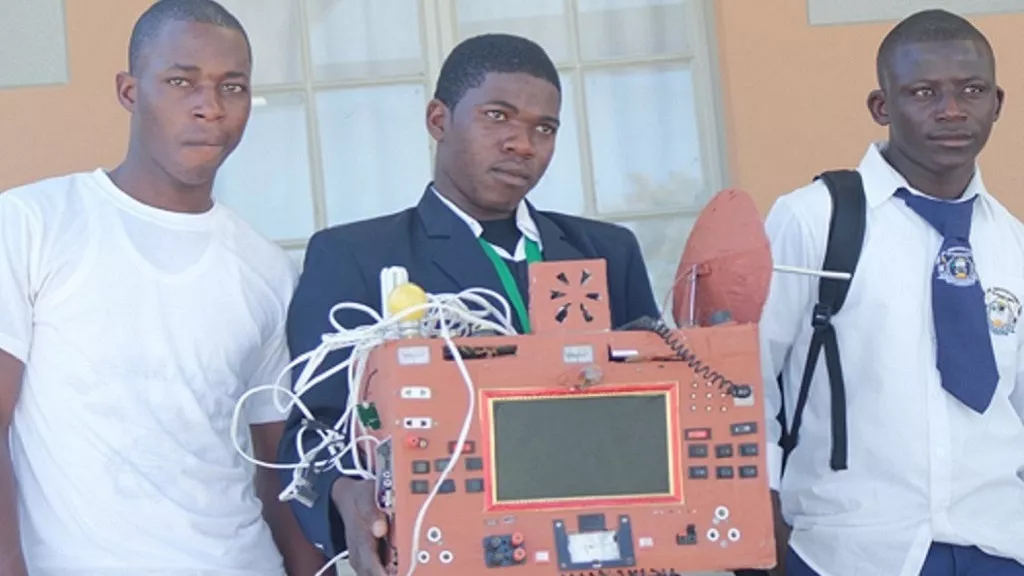
Imagine picking up a phone, dialing a number anywhere on Earth, and talking for hours — without ever buying airtime, recharging data, or inserting a SIM card.
No carrier fees.
No blocked signals.
No monthly bills draining your finances.
Just a device… that works.
Sounds impossible, right?
Yet this is exactly what a Namibian high school student invented — a device so unexpected, so disruptive, that it challenges everything we think we know about global telecommunications.
And once the world heard about a teenager building a phone powered entirely by radio frequencies, the story exploded. Tech companies noticed. Investors noticed. Engineers raised their eyebrows. And millions of people asked the same question:
“How did a high school student do something billion-dollar telecom companies never attempted?”
This story isn’t just about a gadget.
It’s about imagination, inequality, innovation under pressure, and what happens when someone who has less… dreams bigger.
Let’s go back to where it started.
Table of Contents
- The Spark: A Problem Most People Overlook — But Students in Africa Live With Every Day
- The Invention: A Phone Powered by Radio Waves — No SIM, No Airtime, No Limits
- The Moment of Truth: Can a Teenage Inventor Really Call Anywhere Worldwide?
- What This Means for the World: More Than a Gadget, It’s a Revolution
- Innovation From Scarcity: Why Groundbreaking Ideas Often Come From Those With Less
- The Technology Behind the Invention: Simple in Theory, Complex in Execution
- Tech Companies React: Disruption or Opportunity?
- What This Means for the Future of Education and Innovation in Africa
- Could This Technology Replace Traditional Phones? Here’s What Experts Predict
- But the Most Remarkable Part? His Motivation Wasn’t Money.
- Before We End — Ask Yourself This
The Spark: A Problem Most People Overlook — But Students in Africa Live With Every Day
For many teenagers around the world, airtime and mobile data are as common as pencils.
But in large parts of Namibia — and across Africa — mobile communication is expensive.
Families must choose:
food or mobile credit?
transport or data?
opportunities or airtime?
A dropped call isn’t just an inconvenience.
It’s a financial loss.
A text message isn’t just communication.
It’s an expense.
The student behind the SIM-less phone grew up watching people run out of airtime at the worst moments — during emergencies, job searches, travel, and family crises. And he asked the question that would change everything:
“Why does communication have to cost money?”
It wasn’t a complaint.
It was a challenge.
Because innovation often starts where frustration meets curiosity.
The Invention: A Phone Powered by Radio Waves — No SIM, No Airtime, No Limits
While other students were studying for exams or playing soccer, he was tinkering in his school workshop — working late, soldering parts, taking devices apart to understand how they worked.
He believed something no telecom company dared to believe:
“Radio frequencies exist everywhere. Why can’t a phone use them directly?”
His prototype was built from:
- basic circuit boards
- repeater components
- radio wave amplifiers
- old phone parts
- a coding module he programmed himself
- a small battery system
No corporate funding.
No laboratory.
No expensive tools.
Just pure creativity.
The device captured radio frequencies, converted them into voice-call signals, and transmitted them across vast distances — bypassing SIM cards, cell towers, and commercial networks entirely.
Think about what that means:
This wasn’t a cheaper phone.
This wasn’t a modified phone.
This wasn’t a hacked phone.
This was a new category of communication device.
And its implications?
They shook assumptions in every corner of the tech world.
The Moment of Truth: Can a Teenage Inventor Really Call Anywhere Worldwide?
When the first test call was placed, nobody breathed.
He dialed the number.
Static crackled.
A faint ringing tone echoed through the room.
Then —
A voice answered.
Not next door.
Not across town.
Not within Namibia.
But from another country.
A connection without a SIM.
A call without a network.
A conversation carried on a wave he harnessed from thin air.
It felt like magic.
But it wasn’t magic at all —
it was physics, innovation, and audacity working together in one moment.
Teachers were stunned.
Local engineers were shocked.
Telecom companies… were nervous.
And before long, a simple question started traveling across the world:
“If a teenager can do this, what happens to the global telecom industry?”
But before we get to that, we must understand the invention’s deeper impact — far beyond technology.
What This Means for the World: More Than a Gadget, It’s a Revolution
A phone that works without airtime is not just a cool invention —
it represents economic freedom in places where communication is a luxury.
Imagine what this technology could mean for:
1. Low-income families
No more airtime purchases draining limited budgets.
A lifeline during emergencies.
More money for essentials like food, education, and transportation.
2. Remote villages
No cell towers needed.
No monthly bills.
People can connect for the first time ever.
3. Travelers and explorers
Hikers, sailors, and remote-area researchers could call anywhere without relying on unstable networks.
4. Disaster zones
Earthquakes, hurricanes, and floods destroy traditional networks.
A SIM-less phone could become the backbone of emergency communication.
5. Developing economies
Millions could suddenly access free communication — opening doors to business, banking, education, healthcare, and global opportunities.
Tech analysts began asking:
Could this be the beginning of a world where communication is a right, not a commodity?
But before we jump into the global implications, let’s explore how this teenager accomplished something the telecom giants deliberately avoid.
Innovation From Scarcity: Why Groundbreaking Ideas Often Come From Those With Less
People from wealthy nations often assume innovation comes from Silicon Valley labs or billion-dollar research centers.
But the truth is different.
Some of the world’s greatest inventions — from low-cost medical devices to renewable energy hacks — come from people who grew up without access to the resources they needed.
Scarcity breeds creativity.
And this young Namibian inventor understood something the world forgets:
When you have nothing, you learn to make something out of everything.
Where telecom companies see revenue streams, he saw barriers to communication.
Where corporations saw customers, he saw people needing help.
And while others saw fees and SIM cards as “normal,” he asked:
“Why does normal have to stay normal?”
That question changed his life… and may one day change ours.
The Technology Behind the Invention: Simple in Theory, Complex in Execution
Let’s break down how this airtime-free phone works in clean, digestible language.
It relies on:
✔ Ambient radio frequencies
Radio waves exist everywhere — from natural sources, broadcast towers, even space.
✔ Frequency-hopping communication
The device “rides” existing frequencies without interfering with them.
✔ Signal boosting + conversion
It strengthens weak frequencies and converts them into call-ready signals.
✔ Encryption modules
For secure connections, protecting users from interception or misuse.
✔ Home-built circuit architecture
Custom wiring allowed the phone to operate independently of cellular networks.
This mixture of physics, coding, and hardware design mirrors early radio-communication breakthroughs — except redesigned for the modern world.
A student did this.
Just imagine what he could build next.
Tech Companies React: Disruption or Opportunity?
Telecom giants were stunned.
If this technology evolves, billions in revenue — airtime, data packages, SIM cards, subscriptions — could collapse.
Telecom is one of the most profitable industries on Earth.
And this invention threatens its foundation.
But there’s another side to the story:
Forward-thinking investors saw potential.
Governments saw opportunity.
Humanitarian organizations saw life-saving applications.
Tech accelerators saw a prodigy.
The real question is:
Will corporations try to bury this invention… or fund it?
History shows both outcomes are possible.
And innovations that disrupt power structures often face enormous resistance.
We are witnessing the beginning of a battle between old and new.
What This Means for the Future of Education and Innovation in Africa
Africa is often underestimated.
But stories like this remind the world of something powerful:
Talent is everywhere. Opportunity is not.
This invention is proof that:
- African students are world-class innovators
- African schools can produce global breakthroughs
- African youth carry untapped technological potential
And maybe — just maybe — the next major global tech revolution won’t come from California.
It will come from a school workshop in Namibia.
A place where a student built a device that should have been impossible.
Could This Technology Replace Traditional Phones? Here’s What Experts Predict
Tech analysts predict three possible futures:
1. Integration
Traditional phones adopt SIM-less features.
Companies monetize it differently.
2. Disruption
Entire nations embrace airtime-free networks.
Telecom industry transforms.
3. Suppression
Corporations fight to block or patent the idea to protect profits.
Which one happens depends on:
- funding
- political will
- regulatory battles
- patent protection
- public demand
- global tech ethics
And one more thing:
Will the inventor be supported, or exploited?
Africa has seen too many young geniuses lose their inventions to corporations who buy patents cheaply.
This story is still unfolding.
But the Most Remarkable Part? His Motivation Wasn’t Money.
When asked why he built the phone, he didn’t talk about:
- fame
- wealth
- viral recognition
- investors
- global disruption
He said he wanted one thing:
“People should be able to talk to each other — even if they have no money.”
A mission built on humanity, not profit.
And that is why his invention captured hearts worldwide.
Before We End — Ask Yourself This
If you could make one invention that solved a problem you see every day…
what would it be?
What frustrates you enough to want to fix it?
Because stories like this remind us:
Innovation doesn’t start in labs.
It starts in questions.
In curiosity.
In the courage to say:
“Why does it have to be this way?”
A high school student asked that question —
and the world may never be the same again.