
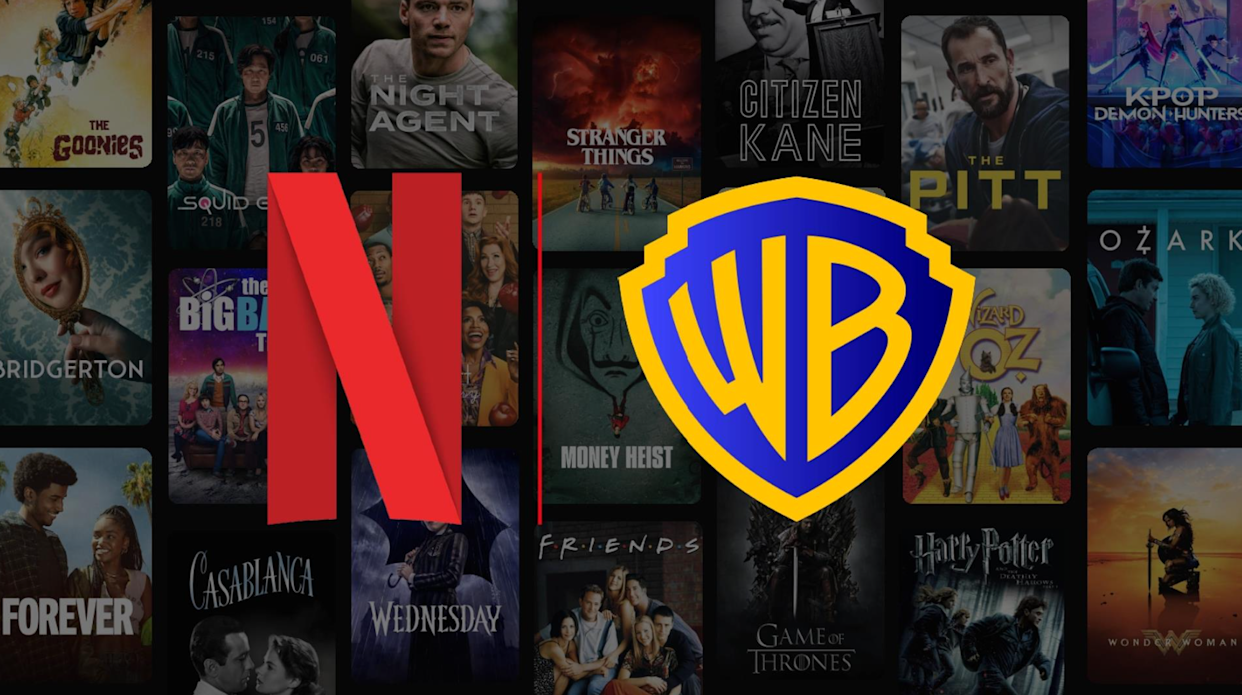
Picture this:
You wake up, check your phone, and see a headline you thought was satire —
“Netflix to Buy Warner Bros. for $82.7 Billion.”
At first, you blink.
Then you reread.
Then you realize something huge just happened.
This isn’t a studio acquiring a library.
It isn’t a merger of convenience.
It isn’t even an industry shake-up.
This is a rewriting of the Hollywood rulebook — a tectonic shift that could reshape global entertainment, streaming, finance, and even how families watch movies in their own living rooms.
And it’s happening right now.
But to understand the magnitude of this deal, you have to understand the players — and the stakes.
Because this isn’t just about movies.
It’s about power.
It’s about survival.
It’s about the future of storytelling itself.
Let’s dig in.
Table of Contents
- Why This Deal Is Unlike Anything Hollywood Has Ever Seen
- Streaming Is No Longer Entertainment — It’s Infrastructure
- The Biggest Question Fans Are Asking: What Happens to HBO?
- $82.7 Billion: This Isn’t Just a Purchase — It’s a Power Move
- Hollywood Is Nervous — And Here’s Why
- Will This Make Netflix Better — or Worse?
- Is This the End of Competition — And the Start of a Streaming Monopoly?
- Why Did Warner Bros. Agree to This?
- The Creative Explosion: A New Era for Filmmakers and Storytellers
- What This Means for the Future of Entertainment — And for You
- Before You Leave — Ask Yourself This
Why This Deal Is Unlike Anything Hollywood Has Ever Seen
For decades, Warner Bros. was a towering symbol of old Hollywood.
It owned:
- DC Comics
- Harry Potter
- Looney Tunes
- HBO
- CNN
- WB Television
- Countless blockbuster franchises
It shaped childhoods, dominated box offices, and set the tone for global entertainment culture.
And now?
Netflix — once dismissed as a mail-order DVD service — is writing a check big enough to absorb a century-old empire.
Think about that for a second.
A company that didn’t exist when Friends premiered is now purchasing the studio that produced it.
This isn’t evolution.
It’s combustion.
But why now?
Streaming Is No Longer Entertainment — It’s Infrastructure
The streaming wars are no longer about who has the best show.
They’re about:
- global market share
- content engines
- platform dominance
- user retention
- licensing control
- data ownership
- investor confidence
In the digital age, content isn’t art alone —
it is currency.
And Netflix, while powerful, has one weakness:
it doesn’t own enough iconic IP.
Meanwhile, Warner Bros. has more IP than almost any studio on Earth —
but struggles with debt, restructuring, and a media landscape shifting faster than it can adapt.
So Netflix gets heritage and franchises.
Warner gets stability and future-proofing.
It’s the perfect storm of need, opportunity, and timing.
But what does this mean for viewers?
The Biggest Question Fans Are Asking: What Happens to HBO?
Imagine HBO — the home of:
- Game of Thrones
- The Last of Us
- Euphoria
- Succession
- True Detective
…now under Netflix’s umbrella.
It sounds impossible.
But here we are.
Streaming analysts say that this merger could create the world’s largest entertainment library — a collection so massive it dwarfs Disney+ and Amazon Prime Video.
But could HBO content appear inside Netflix?
Or will HBO remain a sub-brand, like Marvel inside Disney?
Netflix hasn’t said yet.
And that silence is fueling speculation.
Because whichever direction they choose…
the global streaming landscape will shift overnight.
But content is only one part of the story.
The real drama sits behind the scenes — in boardrooms, financial models, and the geopolitical tug-of-war over media influence.
$82.7 Billion: This Isn’t Just a Purchase — It’s a Power Move
Let’s talk numbers.
An $82.7 billion acquisition instantly becomes one of the largest in entertainment history.
This is bigger than:
- Disney buying Fox
- Amazon buying MGM
- Microsoft buying Activision Blizzard
And this deal isn’t funded by Hollywood magic.
It’s powered by:
- global subscriptions
- investor capital
- platform economics
- expanding international markets
Netflix is betting not just on Warner Bros.’ library —
but on the future of world streaming finance.
The company is aiming for:
- media dominance
- multi-platform ecosystem control
- video game expansion
- theatrical influence
- global brand recognition
Netflix doesn’t want to compete.
It wants to become the gravitational center of entertainment —
the place where every other studio orbits.
But with great ambition comes great disruption.
And Hollywood feels the tremors already.
Hollywood Is Nervous — And Here’s Why
Traditional studios rely on:
- distribution windows
- licensing deals
- syndication
- box office cycles
Netflix doesn’t.
Netflix collapses windows.
Distributes instantly.
Owns global streaming rights.
Uses predictive data to greenlight projects.
And will soon own Warner Bros.’ IP engine.
This means:
Other studios may lose leverage.
Actors and writers may renegotiate power structures.
Theaters may face a new era of uncertainty.
Advertisers may shift billions in spending.
Hollywood insiders are calling this:
“The biggest entertainment earthquake since the streaming wars began.”
But average viewers?
They’re wondering something much more personal:
Will This Make Netflix Better — or Worse?
Let’s explore the potential impact on your daily life.
1. More Blockbusters on One Platform
Imagine scrolling through Netflix and seeing:
- Batman
- Wonder Woman
- Harry Potter
- Lord of the Rings
- Mad Max
- The Conjuring
- The Matrix
…all in one place.
That alone changes entertainment habits globally.
2. Rising Subscription Prices?
Large mergers often bring higher costs.
But Netflix may bundle tiers, adding:
- HBO Max content
- theatrical releases
- live programming
- premium ad-free experiences
This could reshape home entertainment the way cable bundles once did.
3. Content Exclusivity
If Netflix makes Warner Bros. content exclusive, other platforms could lose massive libraries overnight.
Imagine HBO titles vanishing from competitors.
4. A New Golden Age of Big-Budget Content
With deeper pockets and more IP, Netflix may fund projects once considered too risky or too large.
This merger may ignite a creative explosion.
But we still haven’t touched the biggest threat:
Is This the End of Competition — And the Start of a Streaming Monopoly?
When one company controls:
- the largest subscriber base
- the largest content library
- the strongest algorithm
- the most influential franchises
…it becomes more than a streaming service.
It becomes a media empire.
Regulators will almost certainly step in:
- antitrust reviews
- Congressional hearings
- market fairness investigations
Some experts compare this to the breakup of old telecommunications monopolies.
Others argue that streaming competition is global, not domestic —
so regulatory pressure may be weaker.
But one thing is clear:
This deal will force Amazon, Disney, Apple, and even TikTok to think differently about the future of content.
Which raises a question:
Why Did Warner Bros. Agree to This?
Warner’s history is turbulent.
In just a decade, it has been owned by:
- Time Warner
- AT&T
- Discovery
Each merger brought debt, restructuring, and strategic confusion.
Warner Bros. Discovery struggled with:
- declining cable revenue
- underperforming DC films
- streaming losses
- leadership changes
Selling to Netflix brings:
- stability
- financial overhaul
- operational scale
- global reach
- brand refresh
It’s a strategic retreat —
not a surrender.
Warner Bros. gets a future.
Netflix gets an empire.
But the real winners may be the creators —
if Netflix uses this acquisition to fuel innovation.
And judging by Netflix’s history…
it just might.
The Creative Explosion: A New Era for Filmmakers and Storytellers
Imagine giving Netflix access to:
- Warner’s sound stages
- HBO’s writers
- DC’s characters
- global distribution
- massive theatrical partnerships
This merger could unleash one of the greatest creative expansions in entertainment history.
Showrunners are already whispering:
- “Bigger budgets.”
- “Risks we couldn’t take before.”
- “Universe-building freedom.”
- “Cross-franchise storytelling.”
Think Marvel-level interconnected universes…
but across dozens of beloved Warner Bros. properties.
But will Netflix actually take that route?
Or will it disrupt storytelling the same way it disrupted television?
That’s the cliffhanger no one can answer yet.
What This Means for the Future of Entertainment — And for You
Let’s zoom out.
The Netflix–Warner Bros. merger affects:
- how you watch movies
- how you pay for streaming
- how creators make content
- how theaters operate
- how advertisers invest
- how investors value media companies
This isn’t a story about a business deal.
This is a story about the future of entertainment as an ecosystem.
And whether we like it or not,
Netflix is the architect now.
But the most important question remains.
Before You Leave — Ask Yourself This
When a company that didn’t exist 30 years ago buys one of Hollywood’s oldest studios for $82.7 billion…
Is this the peak of the streaming revolution — or just the beginning?
If this can happen, what’s next?
Apple buying Disney?
Amazon merging with Paramount?
TikTok launching a studio?
YouTube acquiring major IP libraries?
The entertainment world is no longer predictable.
It’s volcanic — shifting, erupting, reshaping itself every year.
And today’s landscape is proof:
The future belongs to whoever controls the story — and the platform.