
Table of Contents
- Why Pancreatic Cancer Is So Dangerous
- The Experimental Pill That Changed Expectations
- Study Results Shocked Cancer Specialists
- Doctors Describe Emotional Reactions
- How the Drug Works Differently
- A Turning Point for “Undruggable” Cancers
- The FDA Is Fast Tracking the Drug
- Researchers Are Already Looking Ahead
- Why Patients and Families Are Watching Closely
- A New Era May Be Emerging
Why Pancreatic Cancer Is So Dangerous
Pancreatic cancer remains one of the deadliest cancers in the world for several reasons.
Unlike some cancers that produce early warning signs, pancreatic cancer often develops silently. By the time symptoms appear, the disease has frequently already spread to other organs.
This makes treatment far more difficult.
According to current estimates, tens of thousands of people in the United States alone are diagnosed with pancreatic cancer every year, and the majority do not survive beyond a few years after diagnosis.
The overall five-year survival rate remains extremely low compared with many other forms of cancer.
Doctors have long struggled to improve outcomes because pancreatic tumors are particularly aggressive and resistant to many standard treatments.
While other cancers have benefited from major advances involving targeted therapies and immunotherapy, pancreatic cancer has stubbornly resisted progress for decades.
That is why the results surrounding daraxonrasib are attracting such enormous attention.
The Experimental Pill That Changed Expectations
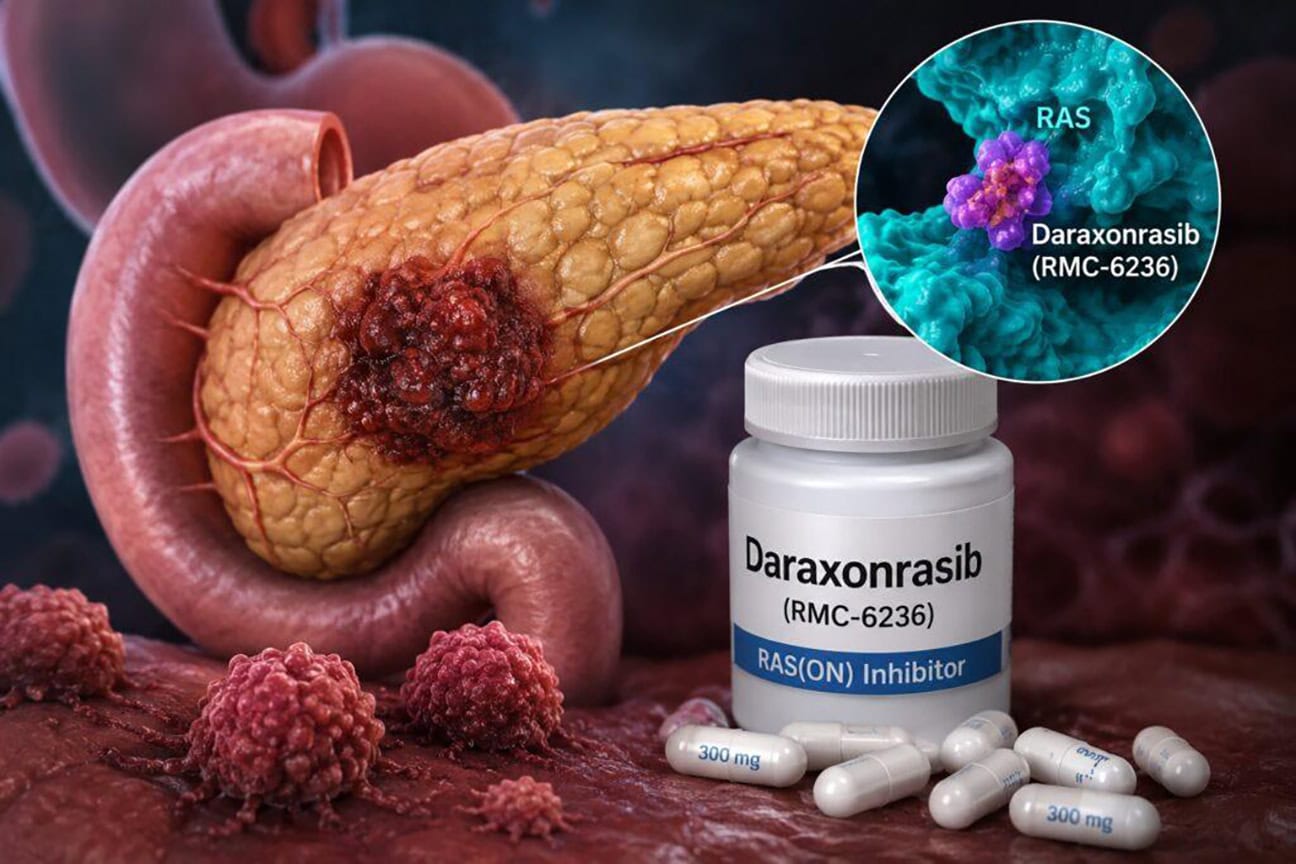
The new drug, daraxonrasib, was designed to target a specific genetic mutation that plays a central role in pancreatic cancer growth.
Researchers say more than 90 percent of pancreatic cancer cases involve mutations linked to the KRAS protein family.
These mutations effectively act like a stuck accelerator pedal inside cancer cells, continuously signaling tumors to grow and spread.
For decades, scientists referred to KRAS as “undruggable.”
The structure of the mutated protein made it extremely difficult for treatments to attach effectively and block its activity.
Many research efforts failed.
That is why this breakthrough carries such significance. Daraxonrasib appears capable of binding to multiple KRAS subtypes using what scientists describe as a molecular glue mechanism.
In simpler terms, the drug essentially locks onto cancer-driving proteins in ways previous treatments could not achieve.
Researchers believe this may finally provide a reliable method for slowing tumor growth in pancreatic cancer patients.
Study Results Shocked Cancer Specialists
The clinical trial involved approximately 500 patients with metastatic pancreatic cancer whose disease had stopped responding to previous treatments.
Participants were randomly assigned either the experimental pill or additional chemotherapy.
The results stunned many experts.
Patients receiving daraxonrasib survived for a median of 13.2 months compared with 6.7 months for patients receiving chemotherapy alone.
While an increase of several months may appear modest to outsiders, oncologists say the difference is highly significant within pancreatic cancer treatment.
For years, doctors have struggled to achieve meaningful survival improvements against this disease.
Beyond survival itself, researchers observed several other encouraging outcomes.
Patients taking the pill reported less pain, improved quality of life, and longer periods before disease progression worsened.
Many participants also remained on the treatment longer than those receiving chemotherapy, suggesting the drug provided more durable benefits.
Importantly, some patients were still continuing treatment even after the data analysis period ended, raising hopes that the survival advantage could grow further over time.
Doctors Describe Emotional Reactions
The emotional reaction among cancer specialists has become one of the most striking aspects of the announcement.
Several oncologists publicly described feeling overwhelmed after reviewing the study results.
Dr. Zev Wainberg from the University of California, Los Angeles, who helped lead the study, called the findings “a very large step forward.”
He emphasized that while the drug does not cure pancreatic cancer, it represents the first treatment in years to demonstrate a substantial advantage over chemotherapy in this setting.
Another cancer specialist, Dr. Rachna Shroff of the University of Arizona Cancer Center, revealed that she became emotional after seeing the data.
Having treated pancreatic cancer patients for years, she said the results felt different from previous disappointments that often ended with limited benefits.
What especially impressed doctors was the durability of patient responses.
Many patients were able to remain on the treatment because the drug continued helping them while producing fewer debilitating side effects compared with conventional chemotherapy.
For specialists accustomed to heartbreaking outcomes in pancreatic cancer care, these results felt unusually hopeful.
How the Drug Works Differently
Traditional chemotherapy works by attacking rapidly dividing cells throughout the body.
While chemotherapy can slow cancer growth, it also damages healthy cells, leading to significant side effects such as fatigue, nausea, immune suppression, and hair loss.
Daraxonrasib works differently.
Instead of broadly attacking dividing cells, the drug specifically targets mutated KRAS proteins driving tumor growth.
This precision approach allows the treatment to focus more directly on cancer cells while potentially reducing damage to healthy tissue.
Researchers believe this targeted mechanism explains why patients experienced fewer severe side effects overall.
The most common complications associated with the pill included skin rashes and mouth sores, which doctors say were generally more manageable than many chemotherapy-related toxicities.
This distinction matters enormously because quality of life is critically important for patients battling advanced cancer.
Extending survival while preserving comfort and daily functioning represents a major objective in modern cancer care.
A Turning Point for “Undruggable” Cancers
The significance of daraxonrasib extends beyond pancreatic cancer itself.
For decades, KRAS mutations represented one of the greatest unsolved challenges in oncology.
Scientists understood how important these mutations were in driving cancer growth, yet repeatedly failed to create effective treatments targeting them.
That frustration led many researchers to label KRAS an impossible target.
Now, momentum appears to be changing.
Recent advances in molecular engineering and protein targeting have opened new possibilities for attacking previously untreatable mutations.
Daraxonrasib is part of a broader wave of experimental therapies attempting to exploit these discoveries.
Researchers believe this progress could eventually influence treatment strategies not only for pancreatic cancer but also for lung cancer, colorectal cancer, and several other malignancies involving KRAS mutations.
Many experts now see pancreatic cancer research entering a potentially transformative period.
The FDA Is Fast Tracking the Drug
The promising study results have already prompted regulatory action.
The Food and Drug Administration plans to expedite its review of daraxonrasib in light of the clinical trial findings.
Meanwhile, an expanded access program is allowing certain eligible patients to receive the experimental drug before formal approval is completed.
This process has generated enormous interest among both patients and oncologists.
Cancer centers across the country are reportedly receiving increasing numbers of inquiries from individuals seeking access to the treatment.
Public awareness also grew after former United States Senator Ben Sasse discussed his personal experience taking the drug during a television interview.
He described reduced pain levels and improved daily functioning while receiving treatment.
Stories like these have further intensified interest surrounding the medication.
Researchers Are Already Looking Ahead
Despite the excitement, scientists emphasize that more work remains.
Researchers are now investigating whether the drug performs better against certain KRAS mutation subtypes compared with others.
Future studies will also explore whether daraxonrasib could help patients earlier in the disease process rather than only after previous treatments fail.
One especially intriguing possibility involves surgery.
If the drug can shrink tumors sufficiently, more patients might become eligible for surgical removal of their cancer, which currently remains one of the few potential paths toward long-term survival.
Researchers are additionally studying combinations involving vaccines, immunotherapies, and other targeted drugs.
Some experimental vaccines aim to train the immune system to recognize KRAS mutations and prevent cancer recurrence after surgery.
Scientists hope combining multiple approaches could eventually produce even stronger outcomes.
Why Patients and Families Are Watching Closely
For families affected by pancreatic cancer, the announcement carries emotional weight far beyond statistics.
Pancreatic cancer diagnoses often arrive suddenly and progress rapidly. Many patients face overwhelming uncertainty, limited treatment options, and devastating prognoses.
Any meaningful improvement therefore resonates deeply.
Doctors caution that daraxonrasib is not a miracle cure. Patients eventually develop resistance to the drug, and the disease remains extremely dangerous.
Still, experts say the results provide something pancreatic cancer desperately needs: momentum.
Hope matters in medicine.
Scientific breakthroughs rarely happen all at once. Progress usually occurs step by step, with each advancement building toward future discoveries.
Many oncologists believe this treatment could represent one of those important turning points that gradually changes expectations surrounding an entire disease.
A New Era May Be Emerging

The development of daraxonrasib may ultimately be remembered as more than simply another experimental cancer drug.
It represents the possibility that one of oncology’s most feared and stubborn enemies is finally beginning to crack.
For years, pancreatic cancer remained a symbol of medical frustration. Researchers understood the biology driving the disease yet repeatedly failed to translate that knowledge into effective therapies.
Now, for the first time in decades, doctors are seeing evidence that directly targeting KRAS mutations can produce meaningful improvements for patients.
The road ahead remains challenging.
Additional studies, regulatory reviews, and long-term monitoring are still required. Questions remain regarding durability, accessibility, cost, and how the drug will integrate into broader treatment strategies.
But the atmosphere surrounding pancreatic cancer research has changed noticeably.
Instead of focusing solely on limitations, doctors are now discussing possibilities.
For patients facing one of the deadliest cancers in the world, that shift alone represents something profoundly important.