

What do you expect when you glance out over an ocean?
Blue waves. Dark dorsal fins. Familiar silhouettes of whales leaping.
But on a crisp northern latitude off Japan’s Hokkaido coast, a photographer captured something that stopped hearts, broke norms, and rewrote expectations.
A whale with no black.
No typical coloration.
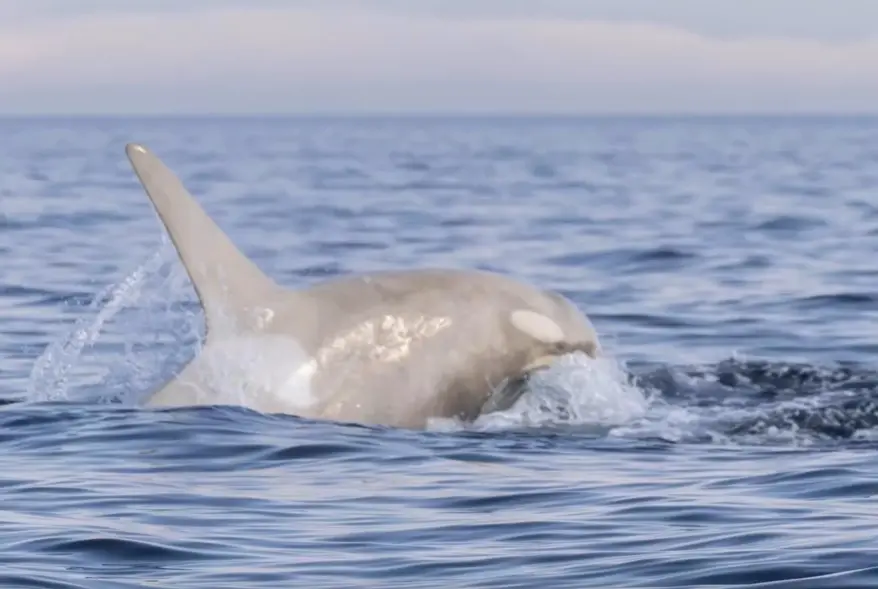
Just shimmering white—ghost-like, majestic, impossible to ignore.
This wasn’t just an orca.
It was a miracle wearing fins.
Table of Contents
- HThe Moment That Took the Photographer’s Breath Away
- Why White Orcas Are So Rare
- The Photographer’s Story — Years of Pursuit, One Moment of Magic
- Travel Meets Wilds — How This Whale Story Matters for Adventure Seekers
- Conservation, Science, and the Fragile Beauty of Rarity
- The Business of Nature Photography & View-Beyond Moments
- What We Can Learn from a Single Whale Jumping
- The Open Question — Will We See It Again?
- Final Thought
HThe Moment That Took the Photographer’s Breath Away
For decades, wildlife photographer Noriyuki Hayakawa had tracked orcas—rules of light, water, fins, and breaches followed like choreography.
He was aboard a whale-watching boat when a tourist vessel radioed him: “White orca on our starboard side.”
He pivoted his lens, and the world changed.
The whale breached—shooting out of the water, its body glistening, its whiteness blinding under the sun.
The typical black-and-white orca pattern was present, but the darks were pale greys, the whites were purer than any sea foam.
In that moment, he said his legs shook.
Not fear—but awe.
Because no photograph had ever looked like this.
Why White Orcas Are So Rare
Albino orcas.
Leucistic orcas.
Whatever you call them—they are virtually the unicorns of the sea.
Most orcas are born with characteristic pigmentation: jet black backs, a white belly, a dorsal patch. These help with camouflage and social identity.
But in albinism, pigmentation fails. In leucism, some pigments are lost. The result? A creature standing out in a world built for patterns and shadows.
Scientists estimate only a handful of all-white killer whales have ever been documented in the wild. Every sighting is extraordinary.
And every such whale teaches us not just about nature’s beauty—but about survival, adaptation, and vulnerability.
The Photographer’s Story — Years of Pursuit, One Moment of Magic
Hayakawa didn’t become a photographer overnight.
Years of cold decks, foggy seas, and blurred fins were part of his journey. He chased pods, studied breaches, learned timing.
He once joked: “I’ve shot thousands of orcas—but I thought I’d never shoot one this white.”
When he finally did, the moment was more than a photo.
It was validation.
It was nature whispering its deepest secret in his ear.
And the images he captured weren’t just for Instagram—they were proof of something rare and wild and utterly unrepeatable.
Travel Meets Wilds — How This Whale Story Matters for Adventure Seekers
For the modern traveler, the world is filled with “must-see” lists: towers, beaches, food locales.
But what about the oceans?
What about the creatures we rarely glimpse?
Imagine booking a trip to Hokkaido—not just for hot springs, snow festivals, or food—but for a chance to see this ghostly orca breach.
The thrill of wildlife tourism meets the investment of a once-in-a-lifetime experience.
And just like upgrading your home with a pool or new windows—this is upgrading your life with a memory.
Because while you can renovate a backyard, you cannot recreate a white orca breach in the wild.
Conservation, Science, and the Fragile Beauty of Rarity
Just because it looks beautiful doesn’t mean it’s safe.
White orcas face unique challenges:
- Their pale color makes them highly visible to prey and maybe predators.
- Their rarity means little data on health, genetics, lifespan.
- Human activity—pollution, fishing nets, boat collisions—threatens them like other marine life.
This white orca’s breach wasn’t just a tourist moment—scientists watched too. It’s a data point. A potential key to understanding orca genetics, social behavior, species survival.
When you look at images of one of nature’s rarest creatures, you’re not just admiring beauty—you’re glimpsing decline, risk, hope.
The Business of Nature Photography & View-Beyond Moments
Nature photography isn’t just hobby.
It’s business.
It’s art.
It’s investment.
One image of a white orca—published in major media—raises the photographer’s profile, increases licensing value, attracts sponsors.
For advertisers, wildlife content matters: high-engagement, click-throughs, longer view time.
For travel brands, showing a rare orca off Japan? Instant bucket-list content.
For education and conservation nonprofits? Proof that nature’s threats are real, visible—and urgent.
This moment becomes more than aesthetics—it becomes currency.
What We Can Learn from a Single Whale Jumping
A lone breach became a metaphor:
- Embrace rarity
- Pursue the unseen
- Respect the wild
- Upgrade our perspective
If you renovate your home for better light and space, think of how that white whale needs light to shine.
If you travel for one extraordinary moment, imagine being on deck when the sea throws up white thunder.
If you invest in conservation, remember that one image can awaken a global audience.
And if you deeply reflect, ask yourself:
When you witness rarity, do you simply watch—or do you help preserve it?
The Open Question — Will We See It Again?
White orcas are rare, but they’re alive.
This particular one breached. We got the shots. We shared them.
But what next?
Will it be photographed again?
Will scientists track its pod?
Will human activity chase it away?
And for you—the reader:
If you had front row on that deck, what would you do?
Would you simply click and post?
Or would you vow to protect the next rare creature you glimpse?
Because one image isn’t enough—it needs action too.
Final Thought

The ocean threw a white orca into the air.
The camera captured the moment.
Now the world holds its breath.
Rare as it was, the sighting becomes our reminder: nature does wonders when we don’t expect them.
And when we see them, our job isn’t just to click—it’s to care.