
Table of Contents
- When Alex Honnold Began Climbing Taipei 101, the World Held Its Breath
- Understanding the Man Known for Climbing Without Fear
- Why Taipei 101 Is Not a Normal Climbing Surface
- The Mental Discipline Required to Free Solo a Skyscraper
- Preparation Behind a Climb That Looked Spontaneous
- Public Reaction Ranged From Awe to Alarm
- The Ethical Debate Around Extreme Risk
- Urban Climbing as a New Frontier
- What the Climb Says About Human Limits
- Why This Moment Will Be Remembered
- Conclusion
When Alex Honnold Began Climbing Taipei 101, the World Held Its Breath
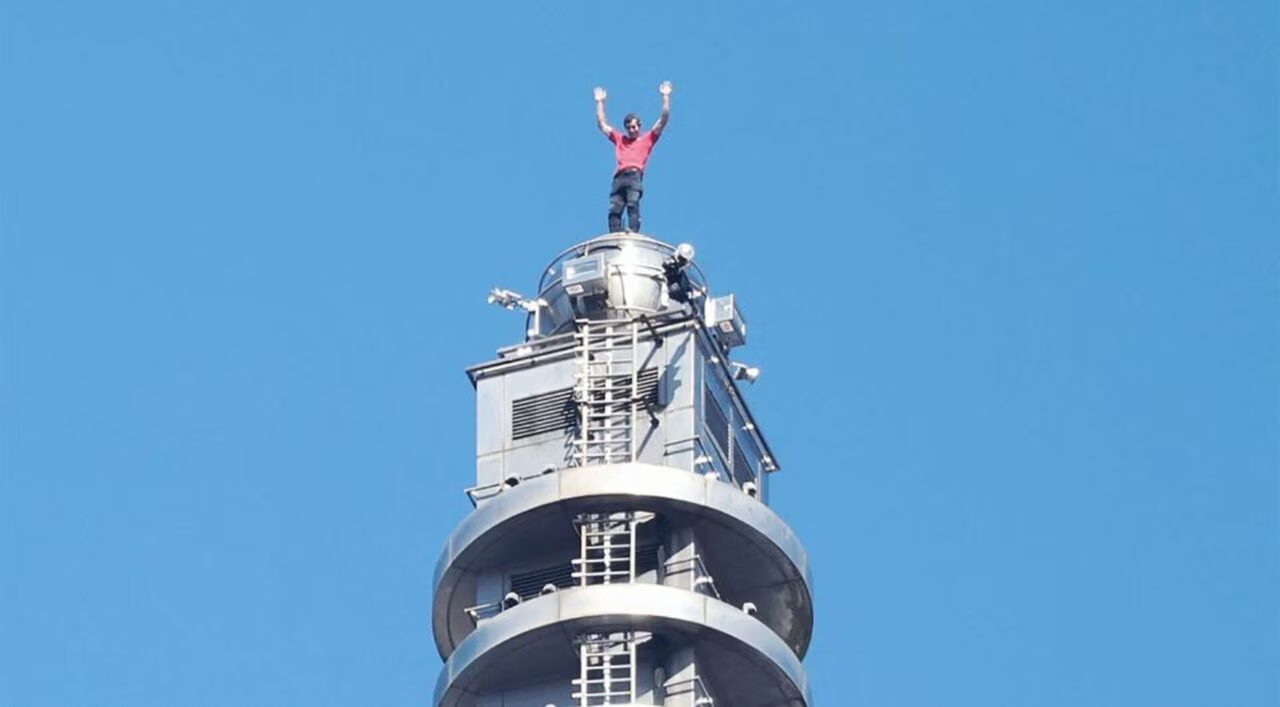
When footage surfaced showing Alex Honnold ascending the exterior of Taipei 101 without ropes or safety gear, the reaction was immediate and visceral. Viewers watched as one of the world’s most recognizable climbers moved steadily upward along glass, steel, and concrete, thousands of feet above the streets of Taiwan’s capital. For many, the sight was almost impossible to process. Taipei 101 is not a mountain face shaped by nature. It is a skyscraper engineered for finance, tourism, and seismic resistance. Seeing a human body scale it freely felt like a collision between modern architecture and ancient human instinct.
The climb was not merely a stunt or spectacle. It represented a moment where risk, discipline, and mental control intersected in one of the most extreme environments imaginable. Honnold’s ascent forced viewers to confront questions not just about what is physically possible, but about why someone would willingly place themselves in such danger.
Understanding the Man Known for Climbing Without Fear

Alex Honnold is no stranger to global attention. Long before Taipei 101, he had already cemented his reputation as the world’s most famous free solo climber, known for ascending towering rock faces without ropes or protective equipment. His climbs of Yosemite’s El Capitan and other monumental formations reshaped how the public understood extreme sports.
What separates Honnold from others is not recklessness, but preparation. He approaches climbs with obsessive detail, rehearsing routes repeatedly and analyzing every movement until it becomes instinctive. To him, fear is not ignored. It is managed, dissected, and minimized through repetition and calculation. The Taipei 101 climb carried this same philosophy, even though the setting was radically different.
Why Taipei 101 Is Not a Normal Climbing Surface
Taipei 101 is one of the tallest buildings in the world, designed to withstand typhoons and earthquakes. Its sleek exterior is composed of glass panels, metal framing, and architectural features never intended to be handholds. Unlike natural rock, the building offers little friction, no organic texture, and almost no margin for error.
Urban climbing introduces dangers that differ fundamentally from natural environments. Wind turbulence increases with height, surfaces can become slick without warning, and there is no natural variation to absorb mistakes. On a skyscraper, a single slip is catastrophic. The fact that Honnold chose such a structure elevated the climb from impressive to almost incomprehensible.
The Mental Discipline Required to Free Solo a Skyscraper
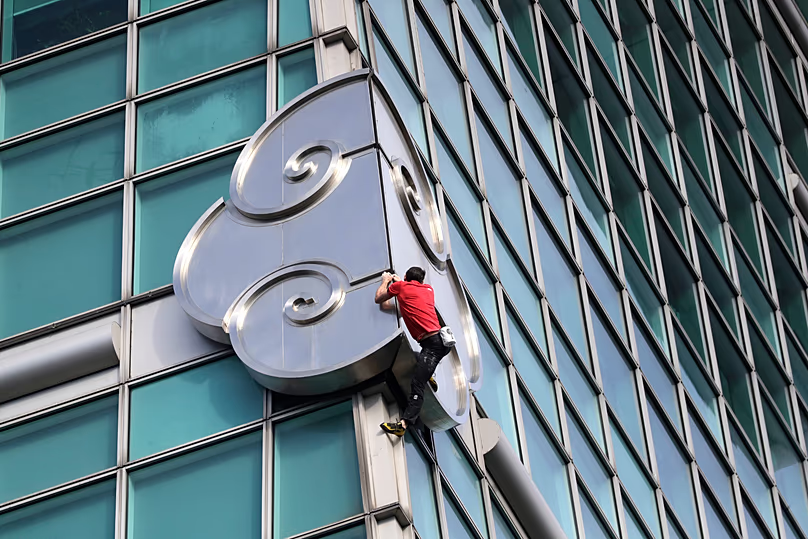
Perhaps the most extraordinary aspect of the climb was not the physical movement, but the psychological control required to execute it. Free solo climbing demands sustained focus, often for extended periods, with no external safety net. Every movement must be intentional. Every decision must be correct.
On Taipei 101, Honnold faced a vertical environment that offered no forgiveness. Unlike rock faces where climbers can rest on ledges or adjust to imperfections, the building’s uniformity meant there were few opportunities to reset mentally. Maintaining composure at such heights, with nothing but air beneath him, demonstrated a level of mental conditioning that few humans ever achieve.
Preparation Behind a Climb That Looked Spontaneous
To outside observers, the climb appeared sudden, even impulsive. In reality, it was the result of extensive planning and training. Honnold studied the building’s structure, identified viable routes, and tested movements at lower heights before committing to the full ascent.
This preparation underscores a critical truth about extreme feats: they are rarely impulsive. Honnold’s public persona may suggest fearlessness, but his approach is deeply methodical. Each climb is treated as a complex problem to be solved, not a gamble to be taken.
Public Reaction Ranged From Awe to Alarm

As videos circulated, reactions flooded social media and news platforms. Many viewers expressed admiration, describing the climb as breathtaking, inspiring, or unreal. Others reacted with anxiety, unable to watch without imagining the consequences of a single mistake.
Some critics questioned whether such climbs should be celebrated at all. They argued that glorifying extreme risk sends dangerous messages, particularly to younger audiences. Supporters countered that Honnold’s transparency about preparation and risk distinguishes his work from reckless imitation.
The Ethical Debate Around Extreme Risk
Honnold’s climb reignited a longstanding ethical debate surrounding extreme sports. At what point does personal freedom conflict with social responsibility? Should society celebrate feats that carry a high probability of death, even when executed by professionals?
Honnold himself has often addressed these questions, emphasizing that his decisions are personal and carefully weighed. He does not encourage others to follow his path without similar preparation. Still, the visibility of such climbs ensures that the debate remains unresolved, reflecting broader tensions around risk, autonomy, and spectacle.
Urban Climbing as a New Frontier

Climbing natural formations has a long history rooted in exploration and challenge. Urban climbing, by contrast, occupies a more controversial space. Skyscrapers are symbols of human progress, commerce, and control over environment. Scaling them without permission or protection disrupts those assumptions.
Honnold’s ascent blurred the boundary between sport and performance, transforming an iconic building into a canvas for human movement. In doing so, it suggested that the limits of climbing are no longer defined solely by nature, but by imagination and nerve.
What the Climb Says About Human Limits
Beyond shock value, the Taipei 101 climb forces a deeper reflection on human potential. It demonstrates how far mental training, physical conditioning, and discipline can push the boundaries of what appears possible. Watching Honnold ascend calmly, methodically, and without visible panic challenges conventional ideas about fear and capability.
Yet it also serves as a reminder of fragility. The same human body capable of such precision is still bound by gravity and consequence. The feat highlights both extraordinary control and unavoidable vulnerability.
Why This Moment Will Be Remembered
Alex Honnold’s free solo climb of Taipei 101 will likely be remembered not just as a daring act, but as a symbol of modern extremity. It represents a moment where human ambition intersected with architectural scale in a way rarely seen before.
Whether viewed as inspiration or warning, the climb left an undeniable mark on public consciousness. It reinforced Honnold’s status as one of the most extraordinary climbers in history and sparked renewed conversation about risk, mastery, and the lengths humans will go to test themselves against the vertical world.
Conclusion
Taipei 101 was designed to dominate a skyline, not to be climbed by hand. Yet for a brief moment, it became a stage for one man’s confrontation with gravity, fear, and control. Alex Honnold’s ascent was not about conquest, fame, or spectacle alone. It was about precision, discipline, and the relentless pursuit of personal limits.
In a world increasingly defined by safety nets and automation, the sight of a lone climber moving upward without protection felt almost anachronistic. And yet, it resonated deeply, reminding viewers that at the edge of fear lies a raw, unsettling, and profoundly human question: how far can we go, and why do we try?