

Table of Contents
- A Creature That Shouldn’t Exist — But Does
- A Long-Necked Antelope Unlike Anything Else
- How Does an Animal Survive Without Water?
- A Survival Blueprint Millions of Years in the Making
- Desert Lessons for Human Survival & Innovation
- An Animal Built for Harsh Climates Faces Its Greatest Threat
- The Economic Side of Saving a Species
- A Day in the Life of a Waterless Wanderer
- Would You Survive Like a Gerenuk?
- The Future of the Gerenuk — And Why It Matters
- A Final Reflection: What the Gerenuk Teaches Us
A Creature That Shouldn’t Exist — But Does
If you walked through the sun-scorched deserts of East Africa, you’d expect to see sand, thorny shrubs, and the long stretch of heat trembling above the ground. What you wouldn’t expect to see is an elegant antelope standing upright like a ballerina, stretching its neck toward a tree branch as if reaching for heaven.
That creature is the gerenuk, one of the strangest—and most impressive—survivors on the planet.
The first thing scientists noticed wasn’t just its unusual appearance. It was something far more unbelievable:
The gerenuk can live its entire life without ever drinking water.
In a world where even humans panic without a bottle of mineral water, how does an animal survive decades in desert heat without a single sip?
That question would launch decades of research, reshape our understanding of desert evolution, and even influence modern discussions about climate resilience, conservation economics, and sustainable travel.
A Long-Necked Antelope Unlike Anything Else

The gerenuk is instantly recognizable. Its name comes from the Somali word gáránúug, which means “giraffe-necked”—and one look explains why. With a neck longer than any other antelope relative and a slender body designed for agility, it looks like a delicate fusion of giraffe, impala, and deer.
But the real surprise comes when it stands upright on its hind legs.
Researchers have described this posture as “almost humanlike,” and it allows the gerenuk to reach vegetation far above the browsing height of other species. Where zebras and gazelles eat ground shrubs, the gerenuk reaches leaves that no one else can touch.
But this vertical stance isn’t just a feeding trick.
It’s a survival strategy that allows them to avoid competition—and avoid starvation during drought.
Yet even this isn’t the most impressive part of their biology—not even close.
How Does an Animal Survive Without Water?
This is the question scientists couldn’t ignore.
In regions where temperatures climb above 40°C (104°F) and rainfall is unpredictable, most animals must travel miles to find water sources. But gerenuks don’t seek rivers, ponds, or even muddy puddles.
They don’t need to.
They absorb all moisture from plants.
Every leaf, bud, and flower they eat contains tiny amounts of water, just enough to hydrate them. Their kidneys are so efficient that they extract every possible drop and waste almost nothing.
Their bodies conserve water like a living filtration system.
- They rarely sweat.
- They release minimal moisture when they breathe.
- Their urine is incredibly concentrated.
If humans had this ability, we could survive days in a desert with only a handful of vegetables—an idea that would revolutionize health, travel, and emergency survival planning.
Imagine hiking through Death Valley without the panic of dehydration.
The gerenuk does the equivalent every day.
A Survival Blueprint Millions of Years in the Making
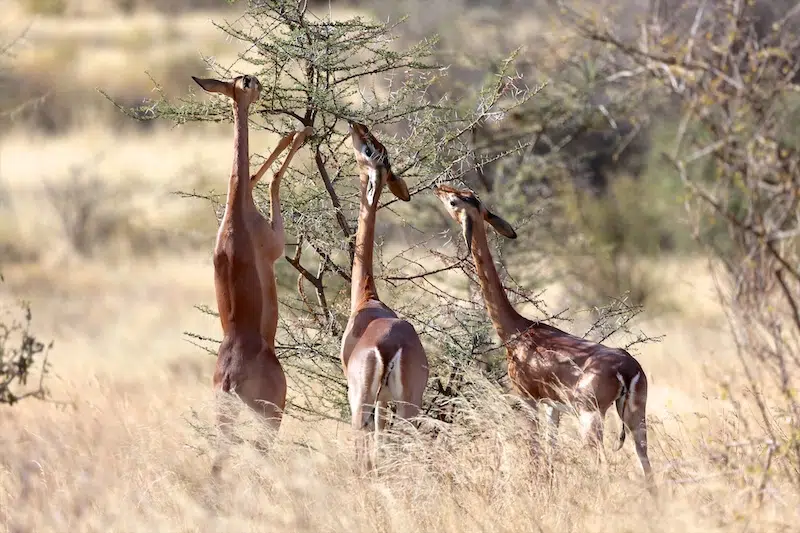
Evolution sculpted the gerenuk into the desert athlete we see today. Their incredibly long neck and thin legs aren’t aesthetic quirks—they’re solutions to environmental scarcity.
1. Height = Access to untouched resources
Standing upright, they browse from acacia trees and thorny shrubs that other species can’t reach. When drought wipes out ground vegetation, the gerenuk’s food supply remains untouched.
2. No water = No vulnerability
Animals that depend on watering holes become predictable targets for predators. Lions, leopards, and hyenas often lurk near water sources for this reason.
But the gerenuk?
It doesn’t visit rivers.
It doesn’t visit ponds.
It doesn’t form herds at waterholes.
Its independence is its protection.
3. Lean bodies = Heat resistance
With very little body fat and elongated limbs, they release heat efficiently—another key to surviving brutal climates.
And this leads to an important question:
If this antelope has mastered the desert, what can humans learn from it?
You may not have expected a wildlife story to connect to home improvement or finance, but surprisingly, it does.
Desert Lessons for Human Survival & Innovation
Scientists studying animals like the gerenuk have discovered insights that influence:
• Water-conservation model designs
Engineers have used biological inspiration (biomimicry) to design irrigation systems, cooling systems, and drought-resistant urban landscapes.
• Sustainable travel planning
Eco-tourism operators encourage trips to arid ecosystems not only for adventure but also for education on climate adaptation.
• Financial strategies for conservation
Donors increasingly fund wildlife that thrives in extreme conditions because they become models for understanding climate resilience.
The gerenuk teaches a powerful message about resource efficiency—something that matters in both wilderness survival and modern economics.
And that brings us to a surprising twist in this story.
An Animal Built for Harsh Climates Faces Its Greatest Threat

Despite their remarkable biology, gerenuk numbers are shrinking.
Their natural environment—dry bushlands in Kenya, Ethiopia, Tanzania, and Somalia—is facing unprecedented pressure due to:
- Expanding agriculture
- Habitat fragmentation
- Illegal hunting
- Climate change intensifying drought cycles
Ironically, the animal most capable of surviving a drought is vulnerable to the forces that create one.
Some populations have declined by more than 25% in recent decades, pushing conservationists to take action. Funding programs now support protected lands, anti-poaching patrols, and community-led land management that allows both livestock and wildlife to coexist.
If you’re wondering whether these efforts are working, keep reading—because the answer isn’t as simple as yes or no.
The Economic Side of Saving a Species
Wildlife conservation isn’t just about saving animals.
It’s about saving ecosystems—and the communities that rely on them.
Tourism revenue
Countries like Kenya and Tanzania depend heavily on safari travel. Iconic species bring millions in annual revenue, which then supports schools, infrastructure, and local jobs.
While the gerenuk isn’t as famous as lions or elephants, it contributes to biodiversity that keeps ecosystems healthy—a key selling point for eco-tourism packages.
Community wealth-building
Conservation programs increasingly include financial incentives:
- Payments for habitat protection
- Micro-loans tied to wildlife-friendly farming
- Revenue-sharing from tourist conservancies
The more people understand the Gerenuk’s unique value, the more likely they are to support its protection.
And that leads to the heart of the story:
A strange-looking antelope that drinks no water is part of a complex web of economic, ecological, and cultural life in East Africa.
A Day in the Life of a Waterless Wanderer
To truly appreciate how exceptional the gerenuk is, imagine shadowing one in the wild.
Dawn breaks over the savanna.
The air is cool for only a brief moment.
A female gerenuk begins her morning routine—not by seeking water, but by stretching onto her hind legs and nibbling fresh leaves from an acacia tree. Her young calf watches closely, learning the posture it will need for its own survival.
As the sun rises higher, most animals retreat to shade.
The gerenuk continues feeding.
Midday temperatures soar, but her lean body dissipates heat efficiently. She doesn’t pant. She doesn’t sweat much. Every drop spared is a drop saved.
By evening, she joins a loose group of females and calves. Gerenuks don’t gather in herds; they prefer small, flexible groups that reduce competition for scarce resources.
Night falls, and predators begin to move—but the gerenuk’s independence from waterholes keeps her away from the most dangerous hunting grounds.
Every part of her day is a study in efficiency.
Every movement is purposeful.
Every adaptation is a reminder of how life finds a way—no matter how harsh the environment.
Would You Survive Like a Gerenuk?
Here’s where the story becomes personal.
Imagine living in a place where rain is almost mythical. No streams. No lakes. No tap water. No bottled drinks.
Could you survive?
Most humans couldn’t last three days.
Even survival experts rely on water purification tools.
The gerenuk has done it for millions of years.
So now ask yourself:
If you faced an environment that seemed impossible, would you adapt—or would you give up?
This is why the gerenuk’s story resonates so deeply with readers.
It’s not just about an unusual antelope.
It’s about resilience.
Ingenuity.
Evolutionary brilliance.
The will to thrive in conditions that should defeat you.
The Future of the Gerenuk — And Why It Matters
We often assume that animals with extreme adaptations are invincible. But the truth is that even nature’s best survivors can be pushed beyond their limits.
Climate change is reshaping East African landscapes faster than evolution can keep up. Even the gerenuk’s ability to go without water cannot save it from disappearing habitats and human encroachment.
Researchers warn that if current trends continue, the species may become endangered in some regions.
But there is hope.
Conservation partnerships, local-led stewardship, and international funding are already stabilizing certain populations. Travelers seeking off-the-path wildlife experiences help bring resources to communities who protect habitats. And scientific discoveries about the gerenuk help shape global conversations about water scarcity and climate resilience.
If an animal can survive without water, it deserves a world where it can at least survive without fear.
A Final Reflection: What the Gerenuk Teaches Us
The gerenuk stands on two legs, reaches for a branch, and shows us that survival isn’t always about strength—it’s about adaptation.
In a world facing extreme weather, economic uncertainty, and shifting ecosystems, its message is clear:
Use what you have.
Waste nothing.
Rise above obstacles—literally if needed.
And never underestimate the power of resilience.
Some animals inspire awe.
This one inspires perspective.
And long after you finish reading, one question may linger:
If the gerenuk can survive the desert without water…
what untapped strength might you be carrying without realizing it?