
The first time you hear it, it sounds like a family myth: “You were the firstborn — that’s why you always excelled in school.”
But back in 2007, a scientific study threw fuel on that myth — suggesting maybe it wasn’t just talk after all.
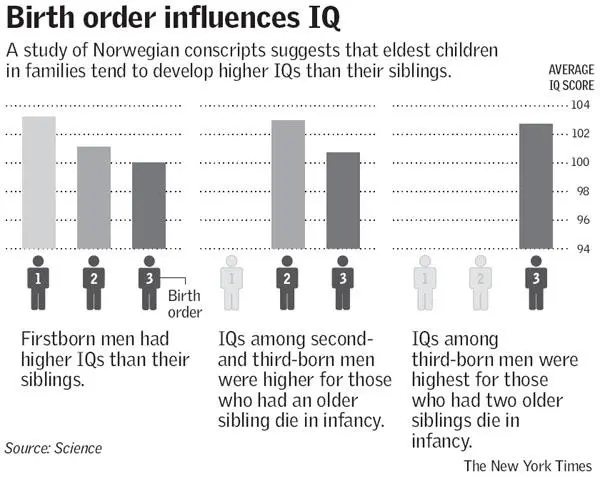
Researchers analyzed IQ data from over 240,000 young men and found that firstborn children scored 2–3 points higher than their younger siblings.
That’s not a giant leap — but it’s enough to shift outcomes over a lifetime. Enough to make people wonder: Does your place in the birth order really shape your brain?
Today, we dig deep — exploring the study, its critics, what the science does show, and why this old debate still grabs our attention.
Table of Contents
- The 2007 Study That Shook the Birth‑Order Debate
- But Not All Scientists Are Sold — Context Matters
- What Happens When Firstborn Becomes “Social Firstborn” — The Story Gets More Complicated
- Still, the Differences Are Small — And Shouldn’t Define Our Expectations
- Why the Birth Order Debate Still Grabs Headlines (and Parents’ Hearts)
- What Latest Research Suggests — Birth Order Is Less Powerful Than We Thought
- So — What Should Parents, Kids, and Siblings Take Away From This?
- If Birth Order Affects IQ — What About Personality, Creativity, Leadership?
- What If Birth Order Isn’t Just About Biology — But About How Society Values Order?
- The Final Truth: Firstborns May Have a Slight Edge — But Life Doesn’t Care About Birth Certificates
The 2007 Study That Shook the Birth‑Order Debate
Here’s how the 2007 research worked:
- The scientists studied 241,310 Norwegian men, all aged 18–19.
- These men had taken mandatory IQ tests at the time of military conscription — giving researchers a huge, unbiased data set.
- On average: firstborns scored ≈ 103.2, second-borns around 100.4, and third-borns even lower.
- But here’s the twist: when the “firstborn” role shifted (e.g. an older sibling died, making the second-born the first child raised), that child’s score jumped — almost equaling traditional firstborns.
This suggests the difference might not be biology, but environment and upbringing. The “firstborn advantage” may come from how families treat and nurture children — especially early on.
Researchers theorize that firstborns get more undivided parental attention, responsibility, mental stimulation, and expectations — advantages younger kids often don’t get.
In other words: being firstborn might not grant you a magic brain — but it might give you a head start.
But Not All Scientists Are Sold — Context Matters
As big as the findings were, many experts cautioned: this doesn’t mean birth order defines intelligence for everyone.
Why? Because when you dig deeper, many confounding factors pop up. Here’s a breakdown:
🔹 Family size & resources
In larger families, parental time, money, and attention get split more ways.
🔹 Socioeconomic background & maternal education
Families with fewer kids often have more resources — higher education, better nutrition, more stability. Those factors can boost cognitive development, regardless of birth order.
🔹 “Confluence” — the intellectual environment fades as siblings grow
Early-born kids grow up with adults or only themselves; as more children arrive, the “intellectual culture” can dilute.
🔹 Cultural & regional differences
That 2007 study was done in Norway — a fairly homogeneous population. Other studies in different cultures have produced mixed or contradictory results.
In fact, a major 2015 meta‑analysis on birth order and personality found no robust effect of birth order on personality traits at all — and only a small effect on test scores like IQ.
So while firstborns get a small statistical edge — the real world is messy. Homes, opportunities, parenting styles — those might matter far more than whether you came first, second, or third.
What Happens When Firstborn Becomes “Social Firstborn” — The Story Gets More Complicated
One of the most fascinating parts of the Norwegian data: when the actual firstborn sibling died, the next-born (raised as first child) performed just like a “real” firstborn on IQ tests.
That detail suggests the advantage isn’t genetic — it’s environmental.
Something about being the “first child in the family” — whether biologically or socially — seems to shape early development:
- More one-on-one time with parents
- More cognitive stimulation (talking, reading, responsibilities)
- More undivided focus before siblings arrive
In short: when the “firstborn treatment” applies, even the second-born can reap almost the same benefits.
This flips the birth‑order narrative upside down — it’s not “born first = smarter,” but perhaps “raised first = privileged in ways that support early learning.”
Still, the Differences Are Small — And Shouldn’t Define Our Expectations
Let’s be honest: an average difference of 2–3 IQ points isn’t a magic ticket to genius.
Even in the 2007 study, authors warned: not all firstborns outscore their siblings — just a slight statistical trend.
- The probability that the older brother scored higher wasn’t 100% — just slightly more likely.
- Many firstborns scored lower than their siblings.
- Many youngest siblings outperformed everyone.
In other words: birth order might influence — but it doesn’t determine.
Life outcomes depend on so many factors: education quality, social environment, personal drive, parental support, opportunities, even luck.
Want more proof? Look at the historical trail of innovators, Nobel winners, entrepreneurs, and creative geniuses — many are not firstborn. Later-born or middle siblings have made breakthroughs.
So if you’re second-born, middle-born, or youngest — take heart. Your potential isn’t limited by a birth order chart.
Why the Birth Order Debate Still Grabs Headlines (and Parents’ Hearts)
There are a few reasons this topic keeps coming back:
🧠 It challenges ideas about intelligence
We like thinking about IQ as stable, measurable, predictable. The idea that something as simple — and uncontrollable — as birth order could shift intelligence challenges that belief.
📚 Parenting guilt & sibling rivalry
Parents wonder: “Are we giving enough attention to younger kids?” Siblings wonder: “Do I get less just because I was born later?”
🎓 Life planning, education and social equity
If birth order influences cognitive potential — even slightly — that might matter for education, employment, and social mobility. Researchers once argued that even a 5‑point IQ shift explains part of economic and wage gaps in societies.
🧬 The nature vs nurture debate
Studies like this feed the eternal question: how much of intelligence is inherited, and how much is shaped by environment — up‑bringing, stimulation, resources, love?
This single thread — small IQ differences based on sibling order — touches deep societal beliefs about fairness, potential, parenting and success.
What Latest Research Suggests — Birth Order Is Less Powerful Than We Thought
More recent studies and reviews cast doubt on the magnitude of birth‑order effects — especially when you control for family size, socioeconomic status, parental education, and shared environment.
For example:
- A 2016‑2019 meta-analysis found that birth order has very little effect on personality traits like extroversion, openness, conscientiousness.
- Some research suggests differences fade as children age — by adolescence or adulthood, environmental and peer influences dominate.
- Factors like family resources, parental investment per child, quality of education, health, nutrition, and even birth spacing may matter more than whether you’re first or last.
In other words: birth order might give a small early boost — but life’s complexity dilutes it over time.
So — What Should Parents, Kids, and Siblings Take Away From This?
If I were summarizing for another parent, here’s what I’d say:
✅ Don’t overinterpret birth order
It’s just one small factor among many. Treat every child as an individual.
✅ Invest time and mental stimulation — equally — across siblings
Reading, talking, playing, teaching — these build brains, not birth certificates.
✅ Recognize the advantage of early one‑on‑one time — but don’t assume it lasts forever
Even kids born later can catch up with love, support, and opportunities.
✅ Use data — but focus on values
IQ isn’t everything. Emotional health, creativity, work ethic, empathy — often matter more than a test score.
✅ Encourage cooperation over competition among siblings
Sibling rivalry can be real, but so can shared success, unique strengths, and mutual support.
If Birth Order Affects IQ — What About Personality, Creativity, Leadership?
This is where things get fuzzy. Studies have consistently shown that birth order doesn’t have significant effects on personality traits like extroversion, emotional stability, or openness.
But what about creativity and leadership?
Some speculate firstborns might get leadership roles early (being “the leader” in the family), which could encourage organizational skills and confidence. Others note younger siblings often adapt differently — becoming more rebellious, creative, or socially savvy.
Ultimately — personality, talent, success — seems far more dependent on individual life experiences, opportunities, and choices than simply being first or last born.
What If Birth Order Isn’t Just About Biology — But About How Society Values Order?
A deeper question emerges: maybe this isn’t about genes at all — but about societal expectations, roles, and the way families distribute resources.
Think about it:
- Firstborns often get undivided attention at a formative age.
- Parents are new, cautious, attentive — maybe more likely to teach, read, and engage.
- Later on, as more kids arrive, time gets divided; energy and resources stretch thin.
So maybe the “firstborn advantage” is a byproduct of resource allocation, family size, socioeconomic stability — not a reflection of inherent superiority.
If that’s true — then anyone can level the field.
But it also raises inequalities: in large families, or lower-income households, every child may be disadvantaged compared to kids in smaller, wealthier families — regardless of birth order.
That’s why many scientists caution against over-generalizing birth-order findings beyond their specific sample.
The Final Truth: Firstborns May Have a Slight Edge — But Life Doesn’t Care About Birth Certificates
The 2007 Norwegian study gave firstborns a small but measurable IQ edge.
But whether those extra two or three points make a meaningful difference depends on so many other factors — upbringing, education, opportunity, personal drive.
Being firstborn doesn’t guarantee genius.
Being second-born — or middle — doesn’t guarantee mediocrity.
Life rarely hinges on one small statistical trend.
What matters more is: how much love, attention, and opportunity you get.
How much support you receive to learn, grow, and chase your potential.
Because in the end… birth order just means “when you arrived.”
But your success?
That depends on what happens after.