
Table of Contents
- A Shocking Discovery in the Zone of Silence
- The Dogs That Refused to Die
- The Viral Video That Shocked the World
- Radiation or Something Else?
- Scientists Step In
- The Mystery of the Blue Dogs Deepens
- Life Finds a Way
- Chernobyl’s Wildlife Rebellion
- A Lesson in Resilience
- What Scientists Hope to Learn Next
- Humanity’s Responsibility
- Final Thoughts: The Color of Survival
A Shocking Discovery in the Zone of Silence
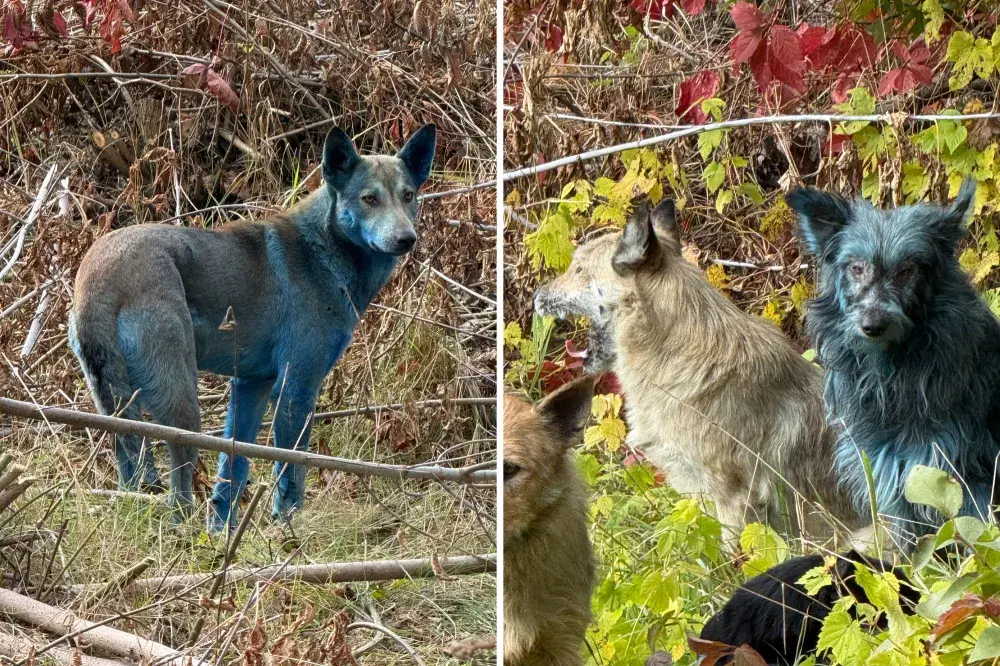
In the ghostly remains of Chernobyl — where time itself seems frozen — a haunting new mystery has emerged. Stray dogs, descendants of those left behind after the 1986 nuclear disaster, have been found wandering with bright blue fur.
The images, first captured by researchers and later circulated online, look almost unreal. Packs of glowing, cobalt-colored dogs trotting through abandoned buildings and rusted ferris wheels — the world immediately asked: What happened to them?
Is this nature’s warning, or proof of life adapting to one of Earth’s deadliest places?
The Dogs That Refused to Die
When the Chernobyl reactor exploded nearly four decades ago, over 100,000 residents were forced to evacuate in mere hours. Many left their beloved pets behind, assuming they’d return. But they never did.
Those abandoned dogs — against all odds — survived in the radioactive wasteland, forming packs and multiplying over generations.
Today, an estimated 800 to 1,000 stray dogs roam within the 30-kilometer Exclusion Zone. They scavenge, hunt, and somehow endure in an area deemed uninhabitable for humans for the next 20,000 years.
But never before had anyone seen them turn blue.
The Viral Video That Shocked the World
The footage, shared by Ukrainian animal rescuers, shows several stray dogs with bright blue fur wandering near a chemical waste plant inside the exclusion zone.
The dogs appeared otherwise healthy — alert, playful, even curious — but their electric-blue coats made them look like creatures out of science fiction.
At first, people thought it was a hoax. Then scientists confirmed it was real.
The question wasn’t whether the dogs were blue. It was why.
Radiation or Something Else?
Initial reactions from the public assumed the worst — radiation mutation. After all, Chernobyl remains one of the most contaminated places on Earth. Could the dogs’ fur color be a sign of genetic mutation caused by decades of exposure?
But experts say the truth might be more chemical than genetic.
Investigators believe the dogs may have come into contact with powdered pigment or industrial waste, possibly from an abandoned factory that once produced blue paint or fertilizers.
Their fur, it seems, had absorbed the color rather than changed at a cellular level.
Still, this explanation doesn’t make the story any less eerie — because it highlights something even more disturbing: these animals are still living amid toxins strong enough to dye their bodies.
Scientists Step In

A research team from the Clean Futures Fund and Ukrainian scientists have been studying Chernobyl’s dog population for years. Their work focuses on genetic adaptation, radiation resistance, and long-term health effects.
They’ve collected DNA samples from over 300 dogs — and found something astonishing.
The Chernobyl dogs have unique genetic markers not found in any other population. These differences could reveal how animals evolve in response to chronic radiation exposure.
In simple terms: these dogs might hold the key to understanding how life adapts in the most extreme conditions imaginable.
Would you risk walking into the Chernobyl zone just to see them up close?
The Mystery of the Blue Dogs Deepens
Even though chemical contamination remains the most likely cause, scientists can’t fully rule out the influence of environmental radiation.
Some researchers believe that decades of exposure could subtly alter the dogs’ metabolism, immune systems, and even their skin chemistry — potentially affecting how their fur reacts to external substances.
Imagine evolution happening not over millennia, but within just a few generations.
If that’s true, the blue dogs aren’t just victims — they’re pioneers of survival.
Life Finds a Way
Despite the dangers, these dogs have formed a fragile ecosystem inside the zone. They rely on tourists, workers, and cleanup teams who occasionally visit to bring them food.
Volunteers from animal welfare groups have established sterilization programs to manage the population and provide medical care. Some dogs are even adopted abroad, finding new lives far from the radioactive ruins of their birth.
But most stay — loyal guardians of a ghost town, living proof that life persists even in the shadow of catastrophe.
If a species can thrive in the heart of nuclear ruin, what else might the planet be capable of recovering from?
Chernobyl’s Wildlife Rebellion
The blue dogs aren’t the only creatures rewriting nature’s rules.
Since humans left, Chernobyl’s forests have exploded with wildlife. Wolves, bears, elk, bison, lynx, and even endangered horses roam freely.
The absence of humans, it seems, has done more for biodiversity than decades of conservation efforts.
Radiation, while dangerous, hasn’t stopped nature from reclaiming the land — proving that the most destructive force isn’t nuclear fallout, but human interference itself.
Could Chernobyl be a paradox — a toxic wasteland that has become an accidental wildlife sanctuary?
A Lesson in Resilience
The blue dogs of Chernobyl have become an unexpected symbol — not just of contamination, but of resilience.
Their story raises haunting questions: How do animals endure what humans cannot? What can their genetics teach us about survival? And at what cost do they live in a place we fled in fear?
Their glowing fur isn’t just a visual shock — it’s a metaphor. A reminder that beauty and danger, life and decay, can coexist in ways we barely understand.
They are the children of catastrophe — and the guardians of hope.
What Scientists Hope to Learn Next
Research continues, with biologists and veterinarians collaborating to map the genome of Chernobyl’s dogs. Their findings could impact medicine, radiation safety, and even future space exploration, where radiation exposure is a major challenge for astronauts.
If animals can evolve to resist radiation, could humans one day do the same?
That’s no longer science fiction — it’s a real scientific question inspired by stray dogs that refuse to die.
Humanity’s Responsibility
The world watches Chernobyl’s animals with fascination, but also guilt. They remind us of the human errors that caused the disaster, and the living beings that paid the price.
Yet, even in tragedy, there’s redemption. Efforts to rescue, feed, and study these dogs show that compassion still exists, even in the darkest corners of our history.
As one volunteer put it:
“They’re survivors of human mistakes — and somehow, they still trust us.”
Perhaps that’s the most radioactive truth of all — hope never really dies.
Final Thoughts: The Color of Survival

The blue dogs of Chernobyl are more than a viral curiosity. They are a biological mystery, a symbol of endurance, and a warning from history.
Whether their color came from chemicals, radiation, or nature’s own strange adaptation, their story forces us to look at what humanity leaves behind—and how life, stubbornly, finds a way through the ruins.
So next time you see those haunting blue eyes staring out from the wreckage, remember:
What glows in the dark isn’t always danger. Sometimes, it’s resilience.