
Table of Contents
- He Was Only 7 Weeks Old — And Completely Alone
- The Search That Led Rescuers to a Surprising Sight
- Offering Bread — The Puppy’s Silent Plea for Help
- How Long Had He Been Surviving Alone?
- The Condition Gunnar Was Found In
- Why This Story Resonates So Deeply
- The Emotional Power of Rescue Stories Like Gunnar’s
- The Long Road Back — Gunnar’s First Hours After Rescue
- Why Puppies Like Gunnar Need Immediate Intervention
- The Power of Kindness — Why His Story Matters Beyond the Moment
- Gunnar’s First Night in Safety
- The Social Media Wave — Millions React to His Story
- Did Gunnar Find a Forever Home?
- The Open Loop — What Would You Do If You Found Him?
- Final Reflection — A Piece of Bread, A Piece of Hope
He Was Only 7 Weeks Old — And Completely Alone
When Gunnar opened his eyes that morning, the world was painfully silent.
No mother’s warmth.
No siblings huddled together.
No familiar scents.
Just emptiness.
At only 7 weeks old, Gunnar had been left behind in the middle of nowhere.
Animal control had passed through the area earlier and rescued his mom and all of his siblings—
but in a heartbreaking mistake, Gunnar had been accidentally left behind.
One tiny puppy.
One huge wilderness.
No one coming back.
Until, hours later, he heard voices—
and did something that stunned the rescuers and broke the hearts of millions.
The Search That Led Rescuers to a Surprising Sight
The team had come back to double-check the area—something was nagging at them, a feeling that they had overlooked something.
Animals often hide, especially frightened puppies, and sometimes the weak ones lag behind.
But nothing prepared them for what they found.
Under a patch of dry brush, sitting completely still, was a puppy barely big enough to stand.
He wasn’t crying.
He wasn’t running.
He wasn’t barking.
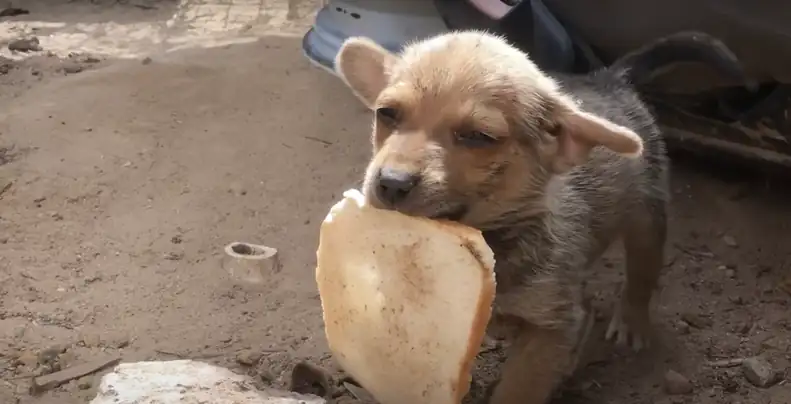
Instead, he had a piece of bread in his tiny mouth.
And as the rescuers approached, Gunnar walked forward—slow, gentle, trembling—
and offered the bread to them.
That moment told them everything.
Gunnar wasn’t fighting for himself anymore.
He was simply hoping someone would take care of him.
Offering Bread — The Puppy’s Silent Plea for Help
Dogs don’t offer food—ever.
Food is survival.
Especially for a starving, abandoned puppy.
So when Gunnar placed the piece of bread in front of the rescuers, it wasn’t a gift.
It was trust.
A tiny, heartbreaking act that said:
“Please take care of me. I have nothing else to offer.”
It was the moment rescuers knew he had been alone too long.
Long enough to understand hunger.
Long enough to understand fear.
But somehow, not long enough to lose faith in people.
How Long Had He Been Surviving Alone?

Rescuers estimated Gunnar had survived alone for nearly two full days.
Two days without his mom’s milk.
Two days without siblings to snuggle against for warmth.
Two days with predators nearby, darkness surrounding him, and silence pressing in.
For a puppy his age, that was nearly impossible.
Many puppies cannot regulate their temperature.
They cannot find food.
They cannot defend themselves.
But Gunnar found a piece of bread—likely discarded by someone long before—
and somehow stayed alive just long enough to be found.
The bread kept him alive.
And offering it helped save him.
The Condition Gunnar Was Found In
When rescuers picked him up, they realized just how vulnerable he had been:
- His fur was dusty and matted
- His stomach was empty
- His paws were sore
- He was dehydrated
- His body trembled from exhaustion
But he didn’t resist.
He didn’t struggle.
He didn’t try to escape.
He simply curled into the rescuer’s arms and let out a long, quiet breath—
the breath of a puppy finally safe.
Why This Story Resonates So Deeply
People across the world connected emotionally to Gunnar’s story because it touches something universal:
the need to belong.
A puppy offering food is the purest form of selflessness.
It’s innocence meeting fear.
It’s trust meeting abandonment.
It’s survival meeting hope.
Gunnar’s gesture wasn’t just cute.
It was symbolic.
It was heartbreaking.
And it brought attention to a truth many forget:
Animals feel everything—
fear, loneliness, confusion, desperation, and hope.
The Emotional Power of Rescue Stories Like Gunnar’s
Psychologists say humans respond strongly to:
- vulnerability
- innocence
- survival
- unexpected kindness
Gunnar’s story has all four.
A tiny puppy, abandoned by accident.
A piece of bread clutched in hope.
A gesture of trust despite starvation.
A rescue that came just in time.
It’s the kind of story that sits with you.
The kind that makes you think about the pets you love.
The kind that reminds you how fragile animal lives are.
And most importantly—
the kind that inspires people to adopt, donate, and speak up.
The Long Road Back — Gunnar’s First Hours After Rescue
The rescuers immediately took Gunnar to safety.
They gave him water first, knowing his tiny stomach couldn’t handle food right away.
Then they offered him soft meals, little by little.
They wrapped him in warm blankets.
They checked his vitals.
And Gunnar?
He didn’t leave their side.
Even after everything he went through, he craved closeness.
He nuzzled into arms.
He followed footsteps.
He whimpered whenever someone walked away.
He wasn’t just hungry for food.
He was hungry for connection.
Why Puppies Like Gunnar Need Immediate Intervention
A puppy alone at 7 weeks faces enormous risks:
- dehydration
- hypothermia
- attacks from wild animals
- inability to digest solid food
- parasites
- infections
- starvation
Without human intervention, Gunnar would not have survived.
His rescue wasn’t just fortunate—
it was lifesaving.
This is why animal welfare groups constantly emphasize:
always check for puppies when a mother dog and siblings are rescued.
One small oversight nearly cost Gunnar his life.
The Power of Kindness — Why His Story Matters Beyond the Moment
Gunnar’s story isn’t just emotional.
It carries larger lessons for society:
• Compassion requires awareness
Animal control didn’t mean to leave him behind—
but mistakes happen when people aren’t thorough.
• Vulnerable animals cannot advocate for themselves
A puppy cannot bark loud enough to be heard from a distance.
• Abandonment doesn’t always look intentional
Sometimes neglect is accidental—
but the consequences are the same.
• A single act of kindness can rewrite a life
The resident who spotted Gunnar changed his fate forever.
Gunnar’s survival is proof that small actions create massive impact.
Gunnar’s First Night in Safety
That night, Gunnar slept deeper than he ever had in the wilderness.
Wrapped in blankets, belly full, heart finally calm.
Rescuers reported that he curled tightly into a ball—
a habit he likely developed while trying to stay warm alone.
He had nightmares.
Whimpering.
Twitching.
Shaking.
But when a rescuer stroked him, he settled immediately.
He didn’t want to be alone again.
Not ever.
The Social Media Wave — Millions React to His Story
When Gunnar’s story was shared online, comments flooded in:
“Poor baby, he deserved better.”
“Offering the bread… I’m crying.”
“How could anyone leave a puppy behind?”
“This broke my heart. I hope he finds the best home.”
People donated.
People asked to adopt.
People shared the story to raise awareness.
Gunnar wasn’t just rescued physically.
He was embraced emotionally by thousands.
Did Gunnar Find a Forever Home?
Stories like Gunnar’s almost always have a strong adoption demand—
everyone wants to bring home the sweet puppy who never stopped believing in people.
And based on his temperament, rescuers believed he would find a home quickly.
He was loving.
He was gentle.
He was trusting.
He was emotionally in tune with humans.
Dogs like Gunnar don’t stay unadopted long.
His future was bright from the moment that piece of bread touched the ground.
The Open Loop — What Would You Do If You Found Him?
Imagine you walked through the wilderness and saw a tiny puppy sitting alone.
He looks up at you.
He wags his tail.
He offers you the only piece of food he has.
What would you do?
Walk away?
Call for help?
Pick him up and take him home?
Stories like Gunnar’s force us to examine the line between noticing and acting—
the difference between saving a life and leaving it to fate.
Final Reflection — A Piece of Bread, A Piece of Hope

In the end, Gunnar’s story reminds us of one powerful truth:
animals never stop hoping.
Even when humans fail them.
Even when they’re left behind.
Even when survival seems impossible.
Gunnar believed someone would come.
He believed someone would care.
He believed the world still held kindness.
And when rescuers arrived, he offered them the only thing he had left—
a piece of bread and a piece of trust.