
Table of Contents
- A Fireball Lit Up the Kyiv Sky — And Everything Changed in Seconds
- A Barrage Unlike Anything Seen Since the Early Days of the War
- Kyiv Wasn’t the Only Target — Russia Aimed for the Entire Country
- Why This Attack, Why Now? The World Tries to Decode Putin’s Motives
- The Human Toll — What Cameras Don’t Show
- A Nation Forced to Become Experts in Survival
- Air Defenses Worked Overtime — But Even the Best Systems Break Under Pressure
- Global Leaders React — And the Political Aftershocks Begin
- What Does It Mean for the World? More Than Most People Realize
- For Ukrainians, Resilience Isn’t a Choice — It’s a Way of Life
- What Happens Next? Uncertainty, Tension, and a Race Against Winter
- If You Lived Through This Night — What Would You Do?
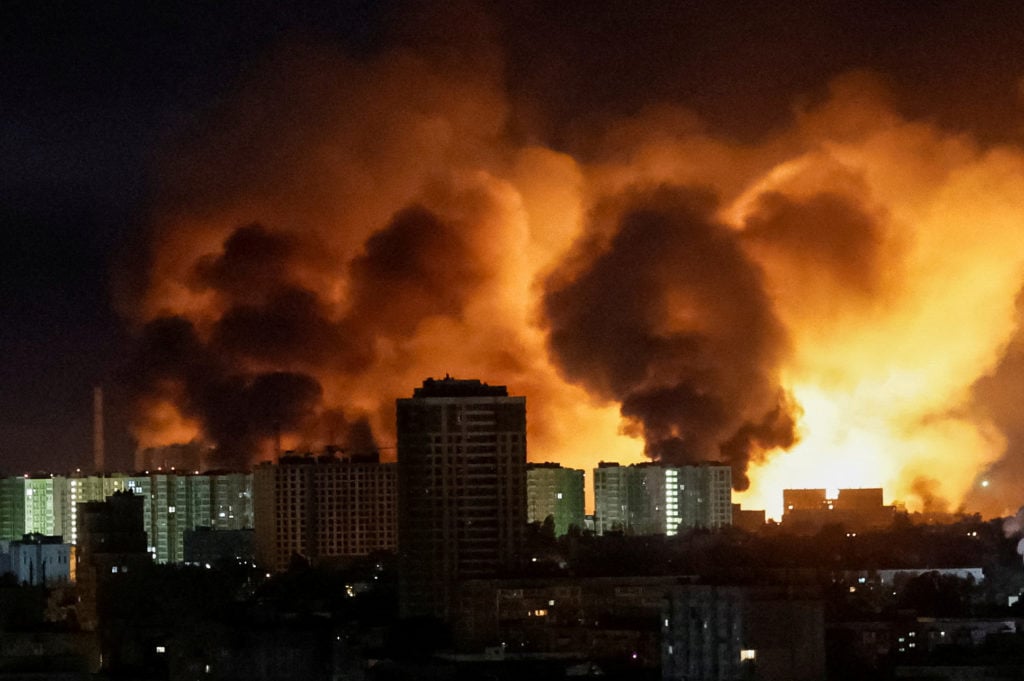
A Fireball Lit Up the Kyiv Sky — And Everything Changed in Seconds
The first explosion wasn’t subtle.
Residents of Kyiv described seeing a fireball split the sky open, followed by shockwaves powerful enough to rattle buildings miles away.
For a moment, people thought the nightmare of February 2022 was repeating itself.
But this time, it was different.
This was not an ordinary attack —
it was Russia’s largest, most coordinated aerial assault on Ukraine in more than three years of war.
And as the smoke rose over Kyiv, Ukraine, and the world watching beyond its borders, one question became impossible to avoid:
Why now — and what comes next?
A Barrage Unlike Anything Seen Since the Early Days of the War
Ukrainian officials reported dozens of missiles and drones launched toward the capital.
Air defenses tried to intercept as fast as they could, turning the sky into a deadly grid of light:
- Cruise missiles
- Ballistic missiles
- Iranian-built Shahed drones
- Hypersonic Kinzhal missiles — some too fast to stop
Explosions echoed across neighborhoods. Windows shattered. Fires erupted.
For civilians, it felt like the world was collapsing around them.
Some described hiding in hallways as dust showered down from ceilings.
Others said they awoke to the sound of emergency alerts and distant blasts —
a familiar nightmare they hoped would never return.
Kyiv Wasn’t the Only Target — Russia Aimed for the Entire Country
This wasn’t just a strike on one city — it was a countrywide offensive.
Missiles were reported over:
- Lviv
- Dnipro
- Odesa
- Kharkiv
- Smaller towns that rarely make the news but feel the war just as deeply
The level of coordination suggested months of planning.
Military analysts said the attack appeared designed to overwhelm Ukraine’s air-defense systems —
a strategy that could deal catastrophic damage if even a small percentage slipped through.
And some did.
A warehouse burned.
A residential building collapsed.
Several people were treated for injuries.
For many Ukrainians, the fear wasn’t just physical destruction —
it was the message behind the attack.
Why This Attack, Why Now? The World Tries to Decode Putin’s Motives
When a strike this large happens, analysts don’t ask what happened — they ask why.
And several theories are already emerging:
1. A Show of Strength During Stalled Frontline Fighting
With ground battles slowing, Russia may be using air power to regain momentum.
2. Testing Western Resolve
Winter approaches. Funding, weapons, and political patience are shifting in Europe and the US.
A massive attack could be a psychological tactic.
3. Punishing Ukraine for Attacks Inside Russia
Recent strikes on Russian oil depots and airbases might have provoked retaliation.
4. Disrupting Ukraine’s Power Grid Early Before Winter
Cold weather is one of Russia’s most powerful weapons.
Destroying energy infrastructure now leaves millions vulnerable.
Whatever the reason, one thing is clear:
this attack was intentional, calculated, and meant to send shockwaves far beyond Ukraine.
The Human Toll — What Cameras Don’t Show
Video footage captured explosions, sirens, and air-defense flares —
but what it didn’t show was the fear inside every shelter, apartment, and hallway.
A grandmother shielded her grandchild with her body.
A father raced across a dark apartment holding a flashlight between his teeth.
A woman recorded a voice message to her sister saying,
“If something happens to me, tell Mom I love her.”
These are the moments that rarely make headlines —
but they define the cost of war more than any military map ever could.
And they remind the world that the true victims always sit far from the negotiating tables.
A Nation Forced to Become Experts in Survival
As missiles fell, millions of Ukrainians repeated a routine they know too well:
- Grab a go-bag
- Move to the safest corner of the home
- Stay away from windows
- Track missile routes online
- Text loved ones to confirm they’re alive
Emergency workers ran into danger as others ran away.
Firefighters tried to contain flames between air-raid sirens.
Doctors triaged injuries in underground hospital wings.
Ukraine has become a nation of involuntary survival specialists —
something no country should ever have to be proud of.
Air Defenses Worked Overtime — But Even the Best Systems Break Under Pressure
Ukraine’s defensive systems intercepted many of the missiles — but not all.
Russian forces appeared to launch a mix specifically designed to confuse and overload detection:
- Slow drones distract radars
- Fast ballistic missiles strike before defenses react
- Hypersonic missiles bypass many interceptors
- Cruise missiles attack from multiple directions
No country on earth can perfectly defend against a storm like that.
And that raises a chilling question:
If this is Russia testing Ukraine’s defenses… what happens when they stop testing and start escalating?
Global Leaders React — And the Political Aftershocks Begin
As footage spread across social media, world leaders responded rapidly:
- Western officials condemned the attack
- NATO called it “a dangerous escalation”
- European nations discussed emergency support packages
- Analysts warned of rising instability across Europe
- Global energy markets reacted immediately
The timing of the strike made the geopolitical implications even sharper:
- Winter is coming
- Aid packages are being debated
- Elections are changing political landscapes
- Regions vulnerable to conflict are watching closely
War is not isolated — it sends tremors into global finance, travel, cybersecurity, energy markets, and even home-safety industries.
A single night in Kyiv can change investment decisions in London, travel plans in Berlin, or fuel prices in Jakarta.
What Does It Mean for the World? More Than Most People Realize
A major escalation in Ukraine does not stay in Ukraine.
It can trigger:
- Travel advisories across Europe
- Energy insecurity affecting global heating costs
- Cyberattacks linked to geopolitical retaliation
- Market volatility across major currencies and commodities
- Increased arms spending affecting national budgets
- Home-security and preparedness demand worldwide
Conflict is never local.
It is a ripple — and today’s ripple started with a fireball over Kyiv.
For Ukrainians, Resilience Isn’t a Choice — It’s a Way of Life
Despite the devastation, Ukrainians responded the only way they know how:
They dug through debris.
They held hands in shelters.
They reassured one another with humor and stubborn hope.
They lit candles during blackouts.
And when the sun rose after the attack, they did something remarkable:
They got up.
They checked on their neighbors.
They walked outside.
They continued living.
It’s the kind of resilience world leaders talk about but rarely witness firsthand.
You can destroy buildings.
But you cannot destroy a people who keep standing up after each strike.
What Happens Next? Uncertainty, Tension, and a Race Against Winter
No one knows whether this attack was a warning shot or the beginning of a new phase of war.
But several possibilities loom:
Scenario 1 — More Large-Scale Strikes
Russia may continue attempts to overwhelm Ukraine’s air defenses.
Scenario 2 — Ukraine Retaliates Inside Russia
This could escalate tensions rapidly.
Scenario 3 — Western Countries Accelerate Military Aid
Especially air defense and winter energy support.
Scenario 4 — Diplomatic Pressure Intensifies
But negotiations remain unlikely in the near future.
Whatever happens next, one fact is unavoidable:
The war is entering its most unpredictable phase yet.
If You Lived Through This Night — What Would You Do?
Imagine waking to an emergency alert.
Imagine your walls shaking.
Imagine the window glowing orange with fire from a missile miles away.
What would you grab first?
Your passport?
Your child?
Your phone?
Your courage?
That’s not a hypothetical for Ukrainians —
it’s the question they face every time the sirens sound.
So ask yourself:
If this happened to you, would you fight…
or just keep running?