

Table of Contents
- The Simple Habit That Could Change Your Child’s Future
- The Hidden Power of the Dinner Table
- The Science of Connection
- Better Grades — One Bite at a Time
- Happiness on the Menu
- The Magic Isn’t in the Meal — It’s in the Moment
- What Kids Learn Without Even Realizing It
- Why Families Stopped Eating Together
- The Modern Solution: Small but Consistent
- The Ripple Effect: From Dinner to Life
- A Glimpse Into the Future
- Final Thoughts: The Most Important 30 Minutes of Your Day
The Simple Habit That Could Change Your Child’s Future
If there were one simple habit that could make your kids happier, smarter, and more confident — would you do it?
Surprisingly, it doesn’t require money, tutors, or technology. Just a table, a meal, and a little time.
Because according to new research, regular family dinners could be one of the most powerful tools for improving your child’s academic performance and emotional well-being.
It sounds almost too simple — but the science behind it is anything but ordinary.
The Hidden Power of the Dinner Table
For generations, the family dinner has been more than just a daily routine — it’s been a cornerstone of connection.
But in the rush of modern life — long work hours, extracurriculars, and screens at every corner — that tradition is disappearing.
In the U.S., fewer than 40% of families eat dinner together regularly. And yet, study after study shows that children who do reap lifelong benefits.
According to a Harvard Family Dinner Project report, kids who eat with their families at least five times a week are not only happier and healthier, but also score higher in school and develop stronger emotional intelligence.
The question is — why?
The Science of Connection
Psychologists say that family meals work like an emotional anchor — a time when children feel seen, heard, and safe.
During dinner, the conversations that happen — no matter how small — teach kids to express themselves, listen actively, and resolve conflict.
In fact, researchers found that family dinner conversations help build a child’s vocabulary more effectively than reading aloud.
Think about that: a simple chat about your day could teach your child more words than a storybook.
And the benefits don’t stop there.
Better Grades — One Bite at a Time
Children who regularly share family meals are more likely to:
- Earn higher grades in school
- Score better on standardized tests
- Stay more engaged in class
- Develop stronger time management skills
One long-term Canadian study even found that kids who ate with their families frequently at age six showed better academic and social adjustment by the time they were in high school.
It’s not about what’s on the plate — it’s about what happens around it.
When parents talk about their day, ask questions, and encourage kids to share, they’re building communication, empathy, and problem-solving — the same skills that predict long-term success.
Happiness on the Menu
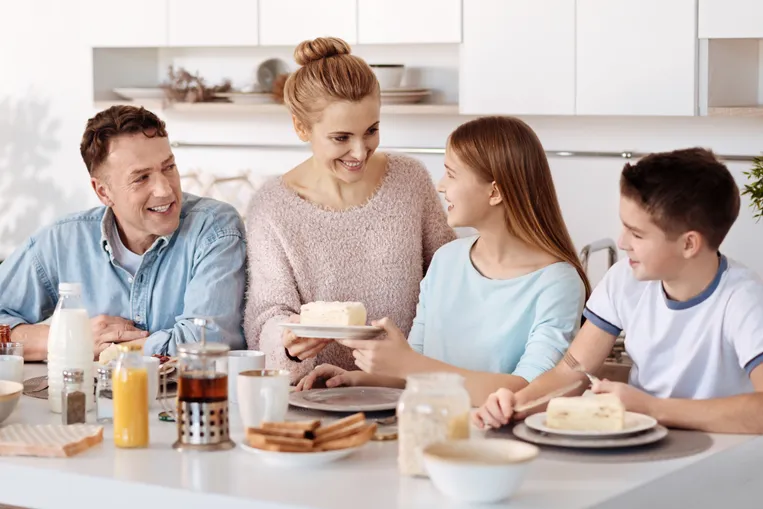
But perhaps the most powerful benefit of family dinners has nothing to do with grades — it’s emotional stability.
A 2021 study by the Journal of Adolescent Health found that kids who regularly eat with their families are less likely to experience depression, anxiety, and substance abuse.
Why? Because those shared meals create what psychologists call “protective rituals.”
They give children a sense of belonging — a safe emotional space that shields them from external stress.
In other words, dinner becomes more than a meal — it becomes medicine for the soul.
Wouldn’t you want your child to have that kind of emotional armor?
The Magic Isn’t in the Meal — It’s in the Moment
Many parents worry that they need to cook elaborate dinners or make every night special. But research says otherwise.
It’s not about what you eat — it’s about who you’re with.
Even a 20-minute meal with simple food can strengthen family bonds if it includes genuine conversation and active attention.
Put simply: your child doesn’t care about the menu. They care that you’re there.
A psychologist from Columbia University’s Center on Addiction noted that “what matters most isn’t the food — it’s the connection that happens during it.”
So, whether it’s spaghetti or takeout, every dinner together counts.
What Kids Learn Without Even Realizing It
When families eat together, kids subconsciously absorb habits and values that shape them for life.
They learn to:
- Wait their turn to speak (self-control)
- Ask questions (curiosity)
- Listen and empathize (emotional intelligence)
- Express gratitude (mental well-being)
These soft skills are increasingly recognized as critical for academic success and emotional resilience.
In fact, companies and schools alike now prioritize these traits more than raw IQ.
And it all begins — believe it or not — at the dinner table.
Why Families Stopped Eating Together
So if family dinners are so powerful, why do so few families do them?
The answer is simple: life got busier.
Parents are working longer hours. Kids are balancing sports, homework, and social media. Evenings are fractured, and attention is split across screens.
But experts argue that the cost of disconnection is far higher than the inconvenience of carving out 30 minutes for dinner.
Loneliness, anxiety, and burnout — in both parents and children — are reaching record highs. Family dinners may not fix everything, but they’re a start.
As one Harvard researcher put it:
“Families who eat together, stay together — emotionally, psychologically, and socially.”
The Modern Solution: Small but Consistent
You don’t need to eat together every night to see results. Even three times a week can make a measurable difference.
Here’s how to make it work in real life:
- Set one non-negotiable dinner night per week. Start small and build consistency.
- Make it screen-free. No phones, no TV — just people.
- Let kids help cook or serve. Involvement builds ownership and communication.
- Ask one question every meal. “What was the best part of your day?” opens powerful conversations.
- Keep it light. Not every meal has to be deep — laughter counts just as much as lessons.
It’s the rhythm of connection that matters, not the recipe.
The Ripple Effect: From Dinner to Life
When families eat together consistently, something subtle but profound happens — the atmosphere at home shifts.
Children become more confident in expressing themselves. Parents feel more connected to their kids’ world.
Even conflict becomes healthier. Families who share meals report better conflict resolution skills and less tension overall.
Because connection breeds empathy — and empathy changes everything.
A Glimpse Into the Future
Researchers are now exploring how family dinners could influence digital-age parenting, where screen time and social media dominate communication.
Some schools are even launching “family dinner challenges” to help rebuild habits of connection lost during the pandemic years.
And the results are promising: families who take part report not just closer relationships, but improved focus, better sleep, and greater emotional stability in children.
Maybe the next big innovation in education and mental health isn’t an app — it’s a table and a conversation.
Final Thoughts: The Most Important 30 Minutes of Your Day

The world moves fast. But around the dinner table, time slows down — just enough for families to reconnect, recharge, and remember what matters most.
Family dinners are not a luxury. They’re a lifeline.
They teach children that no matter how busy life gets, there’s always a place where they belong — where their voice matters, where love is served without condition.
And that might just be the best recipe for success — in school, and in life.
So tonight, maybe skip the scroll and set the table instead.
Because the best investment in your child’s future might just be waiting in the kitchen.