

Imagine taking a single sheet of paper, folding it in half repeatedly, and watching it grow exponentially. Fold it twice, four times, ten times, and suddenly, you’re holding a stack taller than your house. Sounds impossible? That’s because in the real world, paper has thickness and folds resist bending. But in the realm of theoretical math and exponential growth, this ordinary piece of paper could reach staggering heights—even the Moon.
It’s a problem that captures imaginations, challenges logic, and connects to some of the most important ideas in finance, technology, and even health science. Why? Because understanding exponential growth isn’t just a math exercise—it’s a way to grasp how money compounds, investments multiply, viruses spread, and even energy usage escalates.
So how does a simple piece of paper teach us lessons worth millions, or even billions? Let’s fold into the story.
Table of Contents
- The Paper-Folding Problem: Simple, Yet Insanely Complex
- Exponential Growth: The Secret Behind Paper and Money
- The Physical Limits: Why Folding Paper Isn’t That Easy
- From Paper to the Moon: The Numbers Are Mind-Blowing
- Real-Life Implications: Finance, Health, and Beyond
- The Mental Game: Exponential Thinking
- Why This Thought Experiment Goes Viral
- What If We Could Apply It Everywhere?
- Beyond the Moon: Space, Technology, and Curiosity
- Open Loops: The Lessons You Can’t Ignore
The Paper-Folding Problem: Simple, Yet Insanely Complex
At first glance, folding a sheet of paper seems trivial. Anyone can do it—or can they?
- One fold: easy.
- Two folds: manageable.
- Seven to eight folds: many people hit a wall. Paper resists.
In fact, in reality, most people can’t fold a standard sheet of paper more than seven or eight times. But the thought experiment isn’t constrained by physical reality. Mathematically, each fold doubles the thickness.
Let’s do a quick calculation:
- Standard paper thickness: 0.1 millimeters.
- One fold: 0.2 mm.
- Two folds: 0.4 mm.
- Ten folds: 102.4 mm (over 10 centimeters).
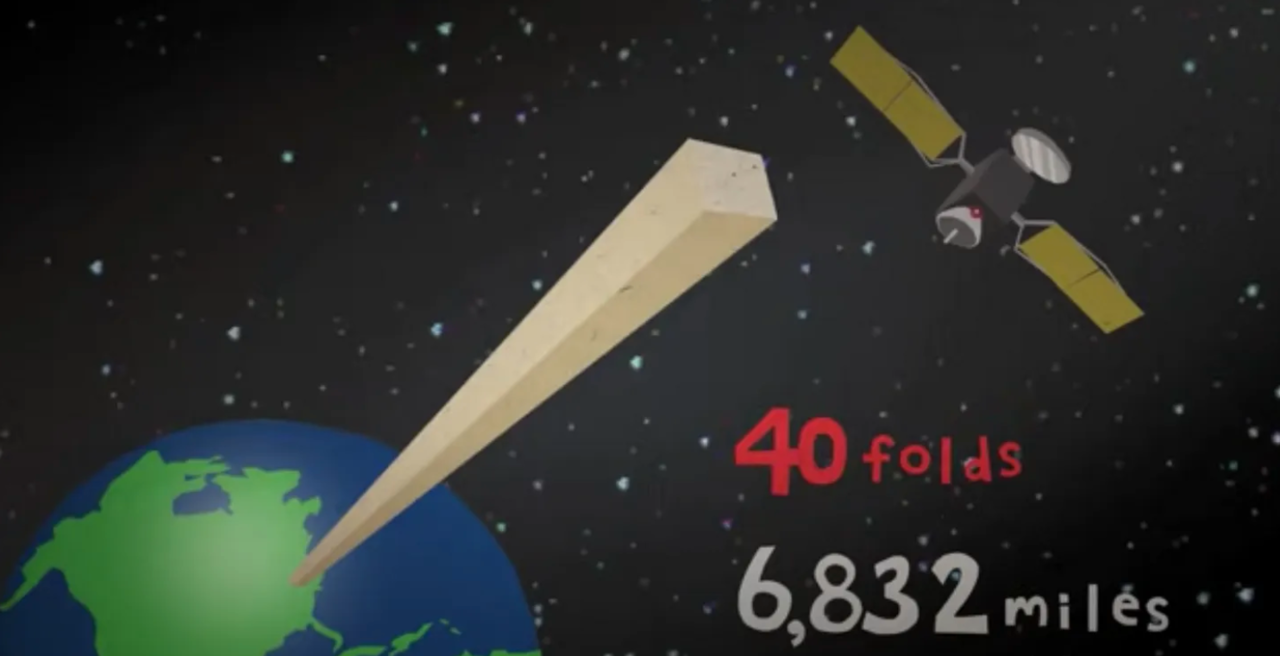
Here’s where it gets wild: with 42 folds, your paper would theoretically reach the Moon, over 384,400 kilometers away.
Think about that: an ordinary piece of paper, folded less than 50 times, spans the distance between Earth and its satellite. If you were to attempt this, what would you do first—measure, fold, or give up in awe?
Exponential Growth: The Secret Behind Paper and Money
The paper-folding problem isn’t just a fun trick—it’s a lesson in exponential growth, the same principle that drives:
- Compound interest in savings and investments
- Population growth in biology
- Viral spread of trends or health issues
Consider money. A single dollar that doubles every fold is like a penny that doubles every day. In 30 days, that penny would grow to over $5 million. Many investors underestimate this because we’re trained to think linearly: one step at a time. But doubling, doubling, doubling? That’s where fortunes are made—or lost.
If you’re thinking about your own investments, what would happen if you applied this concept to high-yield accounts, cryptocurrency, or real estate? Could small, consistent actions lead to astronomical results?
The Physical Limits: Why Folding Paper Isn’t That Easy
Of course, reality bites. Paper resists folding, creating practical limits. Materials bend, fibers tear, and eventually, physics says no. Engineers have tried: a team in 2002 managed to fold a 1-meter sheet 12 times using a hydraulic press. Twelve folds is incredible, but still far from 42.
Yet, the thought experiment matters because it forces us to think in exponential terms. In finance, ignoring exponential growth can lead to missed opportunities. In health, it can help us understand how small actions—like washing hands or taking medication—compound over time to produce dramatic results.
It’s a reminder that sometimes the limits we face aren’t just physical—they’re cognitive. Could we unlock more potential if we changed how we think about growth?
From Paper to the Moon: The Numbers Are Mind-Blowing

Let’s go back to the Moon scenario. A sheet of paper with thickness 0.1 mm, folded 42 times:
- Fold 20 times: thickness = ~105 km (roughly the distance from New York to Miami).
- Fold 30 times: thickness = ~107,000 km (almost a third of the way to the Moon).
- Fold 42 times: thickness = 384,400 km (reaching the Moon).
Notice how quickly the numbers escalate. One fold leads to 0.2 mm. Ten folds, 10 cm. Forty-two folds, and you’re orbiting the Earth.
This is exponential growth in action, the kind of growth that creates billionaires, viral sensations, and disruptive technologies. Every time we fold, invest, or innovate, we’re doubling our impact—or our losses.
Real-Life Implications: Finance, Health, and Beyond
Why does this matter outside of math class? Because exponential growth rules the real world:
- Finance: Compound interest, reinvestment, and stock growth all depend on exponential doubling. Missing the early folds can mean missing millions.
- Health: Vaccination campaigns, weight loss programs, and disease prevention all leverage small, repeated actions that compound over time.
- Home Improvement: Even small changes in energy efficiency, insulation, or maintenance compound into huge savings over years.
When you fold a piece of paper, you’re not just doubling thickness—you’re practicing a mental model for understanding the world. And if applied strategically, it can change everything from your savings account to your fitness routine.
The Mental Game: Exponential Thinking
One reason people struggle with folding paper—or with understanding growth—is that humans are linear thinkers. We think: one step, then another. Doubling doesn’t fit neatly into our intuition.
Yet, history shows that those who think exponentially thrive. Early tech investors in Amazon, Apple, or Tesla understood compounding potential. Entrepreneurs who reinvest profits instead of spending them multiply wealth. Even health experts who emphasize small, consistent improvements leverage the same principle.
So ask yourself: are you thinking linearly, or are you ready to fold your life into exponential growth?
Why This Thought Experiment Goes Viral
The paper-to-the-Moon problem is compelling because it combines:
- Simplicity: Anyone can visualize a piece of paper.
- Shock factor: Folding a paper to the Moon feels impossible.
- Insight: It teaches a principle with far-reaching real-world applications.
It’s the kind of story that spreads on social media, grabs attention, and encourages readers to click on related content—whether about cryptocurrency, financial literacy, health hacks, or DIY projects.
And here’s the kicker: while the physics may be impossible, the lesson is invaluable. The next time you fold paper, invest in stocks, or build a habit, remember: every fold counts.
What If We Could Apply It Everywhere?
Let’s imagine applying the paper-folding model to life:
- Saving $100 and doubling it every month? Millions in a few years.
- Planting a single tree, then multiplying the number each year? Entire forests within a decade.
- Learning a skill, teaching two people, who then teach four people? Knowledge spreads exponentially.
The principle is the same: small, repeated actions accumulate at an extraordinary pace. Exponential thinking is not just math—it’s a mindset, a superpower in finance, health, education, and beyond.
Are you using this principle in your own life—or ignoring it like most people do?
Beyond the Moon: Space, Technology, and Curiosity
The paper-to-the-Moon story also reminds us of human curiosity and imagination. People have always asked: what if?
- Space exploration: Rockets and satellites defy gravity in ways that seem impossible.
- Technology: Computers and smartphones evolved faster than anyone predicted.
- Finance: Digital currencies and fintech innovations grow exponentially, reshaping economies.
Just as folding paper teaches about growth, space exploration teaches about possibility, technology teaches about speed, and finance teaches about value. The Moon may seem distant, but the principles apply everywhere.\
Open Loops: The Lessons You Can’t Ignore

The next time you hold a piece of paper, ask yourself:
- How many folds can you make before giving up?
- What in your life is compounding silently, either wealth or opportunity?
- Are you ready to think exponentially, or are you still stuck in linear thinking?
One sheet of paper, folded 42 times, reaches the Moon. What could you reach if you doubled your efforts, investments, or knowledge every day?
The answer isn’t just in math—it’s in action. And the possibilities are literally astronomical.