

If you passed by Shibuya Station in Tokyo on a cold evening in 1925, you might have noticed a small Akita dog sitting patiently by the entrance. Nothing unusual at first glance — until you learned he wasn’t waiting for a train.
He was waiting for a person. One person.
A person who would never return.
That dog was Hachiko — and 100 years later, his story still makes millions cry, travel, reflect, and rethink what loyalty truly means.
This is not just a dog story.
It’s a story about devotion, culture, grief, travel, legacy, and how one dog from Japan became a global symbol of love that outlives loss.
Let’s dive into why Hachiko still matters — and why, one century later, the world continues to honor him.
Table of Contents
- The Beginning of a Bond That Changed History
- The Day Everything Changed
- Japan Falls in Love: The Moment Hachiko Became a Legend
- Hachiko’s Final Day — And The Monument That Made Him Eternal
- 100 Years Later: Why Hachiko Still Captivates the World
- Hachiko and Travel: Why His Story Moves Tourists Worldwide
- The Psychology Behind Hachiko’s Devotion
- Hachiko’s Legacy in Pet Ownership and Home Life
- Hachiko in Finance, Culture, and Modern Media
- What Hachiko Teaches Us 100 Years Later
- Final Reflection: Would You Have Waited Like Hachiko?
The Beginning of a Bond That Changed History
Hachiko was born in 1923 in Odate, Japan, and adopted by Professor Hidesaburo Ueno, a warm-hearted agricultural science professor at the University of Tokyo.
What made their bond so extraordinary wasn’t dramatic moments — but the simplicity of their daily routine.
Every morning:
- Hachiko walked Ueno to Shibuya Station.
Every afternoon: - He returned, sat by the station gates, and waited for his master to step off the train.
A simple ritual.
But a ritual that carved itself into history.
Think about this:
Isn’t it strange how the small routines — not the big events — end up defining the greatest stories of love?
The Day Everything Changed
On May 21, 1925, Professor Ueno left home for lecture duty.
He never returned.
A sudden brain hemorrhage took his life at the university. The news traveled quickly.
But to Hachiko — who could not read newspapers nor hear announcements — nothing changed.
That afternoon, he sat at the station.
He waited.
But the professor did not come home.
The next day he returned.
He waited again.
Still no professor.
Then the next day. And the next.
For nearly 10 years, Hachiko repeated the ritual — rain, snow, heat, typhoons — sitting by the exact spot where he last saw his beloved human.
He didn’t know Ueno was gone.
He only knew one thing:
His friend had not come home yet.
Think of your own life.
If you waited for someone for a decade — would you still stay, believing in hope rather than accepting loss?
Japan Falls in Love: The Moment Hachiko Became a Legend
At first, people saw a lonely dog waiting for someone who would never return.
Then the story spread through newspapers.
In 1932, an article titled “The Story of a Faithful Dog” captured national attention.
Suddenly, Hachiko became a symbol — not just of loyalty, but of a uniquely Japanese cultural value:
makoto (真心) — true, sincere devotion.
Crowds began gathering around him.
Children brought food.
Commuters bowed their heads.
Visitors traveled from afar just to see him wait.
He wasn’t just a dog anymore.
He was Japan’s reminder that love, in its purest form, is unwavering.
Hachiko’s Final Day — And The Monument That Made Him Eternal
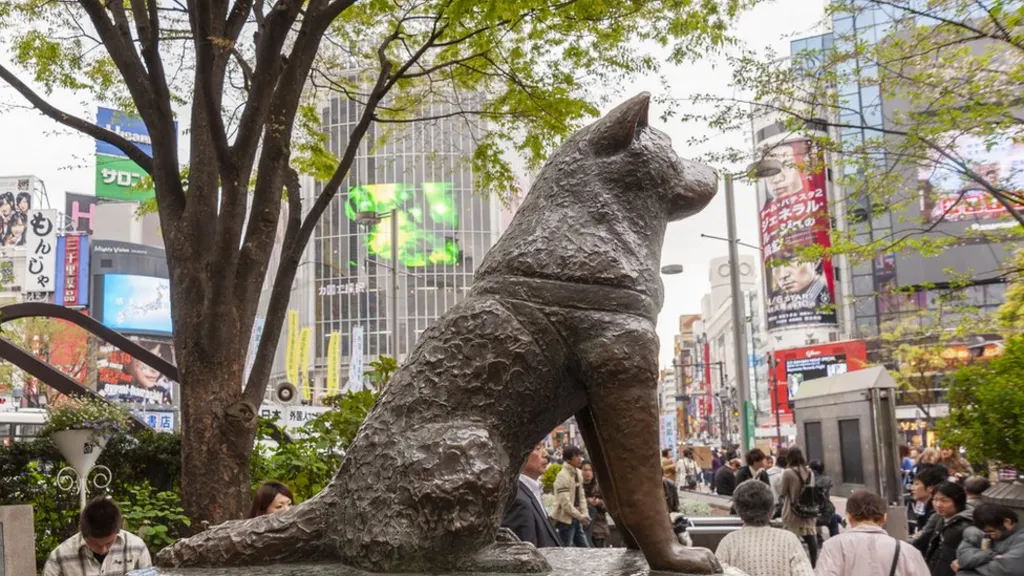
On March 8, 1935, Hachiko passed away near Shibuya Station.
Japan mourned like it had lost a national treasure.
A bronze statue was erected at the exact spot where he waited.
During WWII, metal shortages forced its removal —
but after the war, Japan rebuilt it.
Why?
Because Hachiko’s spirit had become a part of the nation’s identity.
Today, the statue is one of the most photographed landmarks in Tokyo.
Travel agencies report that Hachiko’s statue is one of the top 10 tourist stops for first-time travelers.
Hotels, cafés, and walking tours mention him by name.
He is not forgotten.
In fact — his impact is bigger than ever.
100 Years Later: Why Hachiko Still Captivates the World
Hachiko’s centenary celebration in 2023 brought the world together — from pet lovers to historians, from travelers to cultural scholars.
But what keeps his story alive after a century?
1. Because loyalty is timeless
In a world where everything moves fast, where friendships drift and routines break, Hachiko reminds us of something simple:
Loyalty doesn’t need explanations.
It only needs presence.
2. Because grief is universal
Hachiko teaches us that loss is not the end of love.
Love continues — through memory, through ritual, through devotion.
3. Because animals touch us in ways humans sometimes can’t
Dogs love without condition.
Hachiko showed that love outlives life itself.
4. Because Japan honors stories that teach moral values
Hachiko symbolizes sincerity, duty, and emotional purity — traits deeply embedded in Japanese culture.
5. Because travel culture transformed him into a global icon
Millions visit Japan for Hachiko.
Tourism boards use his image.
Books, movies, and documentaries amplify his legacy.
If you traveled to Tokyo, would you visit his statue and feel the weight of his story?
Hachiko and Travel: Why His Story Moves Tourists Worldwide
Hachiko’s impact on travel is astonishing.
Shibuya Station is now a pilgrimage site
Travelers don’t just take photos — they stand silently, imagining the dog waiting day after day.
Odate, Hachiko’s hometown, built a museum in his honor
Tourists visit year-round to learn his origins, study Akita breeds, and walk the same paths he once walked.
Movies like “Hachi: A Dog’s Tale” drew global attention
Richard Gere’s adaptation turned the Japanese legend into an international phenomenon.
Travel agencies offer “Hachiko Tours”
Including:
- Shibuya statue
- Hachiko mural
- Memorial plaques
- Museums and exhibitions
This one dog significantly influenced Japan’s tourism economy — a rare cultural legacy for an animal.
The Psychology Behind Hachiko’s Devotion
Scientists and behaviorists studied Hachiko for decades.
Their conclusion?
This wasn’t just routine.
This was attachment, the same kind humans feel toward their loved ones.
Dogs are capable of:
- Anticipation
- Memory
- Emotional bonding
- Ritualized behavior
- Loyalty that mirrors human relationships
In other words, Hachiko didn’t just wait.
He believed.
What would your life look like if you believed in someone — or something — with the same unshakeable conviction?
Hachiko’s Legacy in Pet Ownership and Home Life
Hachiko didn’t just move hearts.
He changed how people live with animals.
1. Japan implemented better animal welfare laws
His story inspired public empathy toward pets.
2. Akita dog adoption increased worldwide
People sought loyal, intelligent companions.
3. Homes began to accommodate pets more intentionally
Pet-friendly home design rose in popularity:
- safer fencing
- soft flooring
- temperature-regulated rooms
- pet comfort stations
Home improvement studies show pet owners spend 20–40% more on comfort upgrades — a trend partly shaped by famous animal stories like Hachiko.
Love changes architecture too.
Hachiko in Finance, Culture, and Modern Media
You’d never think a dog’s loyalty has financial impact — but it does.
1. Travel revenue
Japan earns millions annually from Hachiko-related tourism.
2. Merchandise and film rights
Statues, books, movies, figurines — all contribute to Japan’s cultural economy.
3. Pet industry growth
Hachiko boosted global fascination with Akita dogs, increasing adoption and demand for training programs.
4. Home and lifestyle markets
Pet-focused home improvements became mainstream:
- dog ramps
- ergonomic pet beds
- robotic vacuums designed for pet hair
- pet-safe cleaning supplies
Hachiko didn’t just touch hearts — he touched industries.
What Hachiko Teaches Us 100 Years Later
When you peel away the tears and emotion, Hachiko’s story leaves behind life lessons:
1. Love is not measured in time. It’s measured in devotion.
2. Loyalty can be quiet and still be powerful.
3. Grief doesn’t erase connection — it deepens it.
4. Routines can become memories that outlive us.
5. The smallest life can make the biggest impact.
A century later, Hachiko is more than a loyal dog.
He is the world’s reminder that love — real love — does not disappear.
It waits.
Final Reflection: Would You Have Waited Like Hachiko?

If someone you loved never came home, would you still show up for them every day?
Hachiko didn’t know that the professor had passed.
He only knew love.
And for him, love meant:
I will wait for you. No matter how long it takes.
That one idea — expressed not through words but unwavering loyalty — turned a humble Akita dog into one of the most iconic figures of the last 100 years.
Hachiko will never leave Shibuya Station.
Not in memory.
Not in culture.
Not in the hearts of millions.
And maybe that’s why, a century later, his story still makes us stop…
and ask ourselves:
Do we love with the same loyalty that he showed?