

You’re standing on a frozen desert.
Wind howls across the Antarctic ice sheet, and the temperature is so cold it can shatter steel.
Now imagine this:
Two miles beneath your feet, in pitch-black darkness, an entire ecosystem is alive.
And until recently, no one even knew how long it had been there.
When scientists finally drilled into this mysterious lake—sealed off for up to 34 million years—they expected to find silence.
Instead, they found something that shocked the scientific world…
It was full of life.
But not the kind of life we’re used to.
And when they discovered how young (and how active) these microbes really were, it opened the door to questions that could reshape everything we think we know about Earth, climate change, future clean energy, and even life on other planets.
Let’s dive into that hidden world together.
A LAKE THAT SHOULDN’T EXIST — BURIED BENEATH A CONTINENT OF ICE
Antarctica looks like a giant block of frozen land, but underneath that ice sheet is a secret landscape.
There are mountains.
There are rivers.
And yes—there are lakes, hundreds of them.
One of these is called Lake Whillans, the star of this story.
It lies:
- 800 meters (2,600 feet) below the surface
- Completely cut off from sunlight
- Without oxygen
- With crushing pressure
- And temperatures just below freezing
In other words, a place so hostile that nothing on the surface should survive.
But life has a way of surprising us.
When researchers melted a borehole into the ice and collected the first samples, they expected to find ancient microbes that had been stuck here for millions of years.
But what they found instead was stranger.
THE MICROSCOPIC “SURVIVORS” THAT SHATTERED SCIENTIFIC EXPECTATIONS

The lake was teeming with microbial cells—thousands in every milliliter of water.
But here’s the twist:
They weren’t ancient. They were young.
These microbes were estimated to be only decades old, not millions.
How is that even possible in a place sealed off from the world?
Because the lake isn’t as isolated as scientists once thought.
Subglacial lakes like Whillans aren’t stagnant pockets of water—they’re part of a hidden plumbing system beneath Antarctica.
Fresh meltwater flows in.
Old water flows out.
Minerals dissolve and feed strange life forms.
It’s a moving, breathing, evolving ecosystem—one that could be changing faster than we realize.
And this is where the story gets even more intriguing…
If life can thrive in a place like this, what other extreme environments might be full of hidden activity?
THE REAL QUESTION: WHAT ARE THESE MICROBES EATING?
If there’s no sunlight and no oxygen, how do these organisms stay alive?
Scientists discovered that these microbes rely on energy from the Earth itself.
They survive using:
- Iron
- Ammonia
- Sulfur
- Methane
- Minerals scraped from rocks by the moving ice
It’s a survival strategy that rewrites what we know about ecosystems.
Imagine living in a house with no food deliveries, no sunlight, and no air—but the walls themselves slowly feed you.
That’s what these microbes are doing.
And it leads to a bigger question:
If microbes can thrive in places like this on Earth… what about on Mars? Or the icy moons Europa and Enceladus?
Hold on to that thought—because the implications stretch far beyond Antarctica.
A GLIMPSE INTO EARTH’S PAST — AND OUR FUTURE
This frozen lake didn’t just reveal life.
It revealed patterns—clues about our planet’s climate history.
Scientists believe that studying these lakes can help us understand:
- Past melting events
- Ancient climate cycles
- How quickly ice sheets can collapse
- The future of rising sea levels
- The stability of global coastlines
- How Earth responds to warming temperatures
Remember: Antarctica contains 70 percent of the planet’s freshwater.
If even a fraction of that ice melts, major cities—from New York to Jakarta—could be transformed.
But buried lakes like Whillans hold the “diary entries” of Earth’s climate written over millions of years.
What we read in those pages could impact:
- Real estate and property markets
- Insurance and risk forecasting
- National disaster planning
- Energy policy
- Future immigration patterns
This is where finance meets science.
Because climate change isn’t just an environmental issue—it’s an economic one.
And Antarctica is holding the receipts.
HOW A LAKE UNDER ANTARCTICA COULD SHAPE FUTURE CLEAN ENERGY

Here’s something most people don’t realize:
Microbes in extreme environments often produce chemicals we can use.
Scientists are studying subglacial microbes because they may help develop:
- New antibiotic compounds
- Enzymes that work in extreme cold
- Innovative biotech materials
- Clean energy solutions using methane cycling
- New filtration and water purification systems
Imagine a world where:
- Homes stay warm using microbe-powered heating
- Remote communities use biological batteries
- Travel and shipping industries rely on microbe-based fuels
- Hospitals use cold-adapted enzymes for faster diagnostics
- Food storage becomes safer thanks to microbial tech
It sounds futuristic, but the groundwork is already being laid—right beneath Antarctica.
If an ecosystem can survive in a place like this, maybe it holds the key to helping us survive in a rapidly changing world too.
THE DRILL THAT CHANGED ANTARCTICA FOREVER
The research team used a hot-water drill to melt a shaft straight down to the lake.
Imagine drilling a hole through an entire mountain of ice.
It took:
- One million watts of power
- Boiling water pumped at extreme pressure
- Constant sterilization to avoid contamination
- Perfect timing before the hole refroze
When they finally reached the lake, the water they collected had been untouched by the surface world for millennia.
But the lake itself wasn’t ancient and frozen in time—it was moving, pulsing, and alive.
And that discovery is pushing scientists to rethink Antarctica’s entire subglacial network.
Some even believe there may be organisms deeper and stranger than anything we’ve seen yet.
Which leads to the next big question…
COULD THERE BE “ALIEN-LIKE” ECOSYSTEMS HIDING UNDER THE ICE?
NASA has taken a special interest in Antarctica’s hidden lakes.
Why?
Because they are the closest natural analog to oceans believed to exist under the ice of:
- Europa (a moon of Jupiter)
- Enceladus (a moon of Saturn)
Both have liquid water oceans sealed beneath miles of ice.
If life can thrive in Lake Whillans with:
- No sunlight
- Extreme cold
- Limited nutrients
- Total isolation
…then similar organisms might be living in those oceans right now.
Imagine that:
The discovery of a tiny Antarctic bacterium hinting that we might not be alone in the universe.
If that happened to you—if you were the researcher holding that vial—would you feel excited? Nervous? Or stunned into silence?
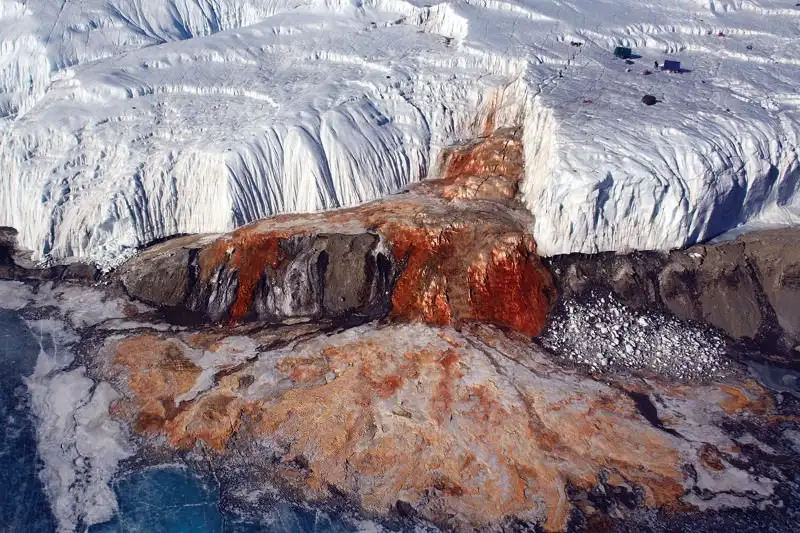
ANTARCTICA’S SECRET RIVERS AND WATERFALLS — A FLOW SYSTEM NO ONE KNEW EXISTED

Subglacial lakes aren’t just still pools of water.
They’re connected by rivers, “waterfalls,” and fast-moving channels.
Every so often, lakes drain into one another or burst water upward, lifting the ice sheet by several meters.
This hidden hydraulics system affects:
- Global sea levels
- Glacial flow speeds
- Ice shelf stability
- Ocean nutrient cycles
- Antarctic wildlife migration
For homeowners living in coastal areas—or anyone thinking about buying property—understanding this system isn’t optional.
It’s essential.
Real estate markets from Miami to Sydney already price in “flood risk zones.”
But the deeper Antarctic plumbing system might determine the future shape of global coastlines.
WHAT THE DISCOVERY MEANS FOR CLIMATE PREDICTIONS
Climate scientists now believe Antarctica’s lakes and rivers may respond much faster to warming temperatures than expected.
This means:
- Ice shelves could collapse sooner
- Sea levels could rise more rapidly
- Weather patterns could shift unpredictably
- Marine ecosystems might change within decades, not centuries
- Insurance rates and home values could transform dramatically
Imagine buying your dream beach house—only to discover that the ice beneath Antarctica accelerated melting faster than anyone predicted.
This is why governments, financial institutions, and climate researchers are watching Antarctica more closely than ever.
The world’s economic stability might depend on what happens under the ice.
HOW THIS DISCOVERY COULD CHANGE TRAVEL AND EXPLORATION
If you dream about travel, exploration, or adventure, here’s something exciting:
This discovery is igniting new interest in Antarctic science tourism.
In the future, travelers might be able to:
- Visit research hubs near subglacial drilling sites
- Explore newly mapped subglacial landscapes in VR
- Watch real-time underwater footage of hidden Antarctic ecosystems
- Participate in citizen-science expeditions
- Fly over regions that were once a mystery to the world
Just imagine standing on the ice above Lake Whillans, knowing an entire world is alive beneath you.
Would you take that trip?
THE FUTURE: WHAT’S STILL HIDING UNDER ANTARCTICA?
Scientists believe they’ve explored less than 2 percent of Antarctica’s subglacial lakes.
That means:
- 98 percent is still unknown.
- The largest lakes may dwarf Lake Whillans.
- Some could be millions of years older.
- Others might contain entirely unique ecosystems.
- Some may connect to the ocean through secret channels.
- And the most extreme ones may hold organisms unlike anything on Earth’s surface.
What they find next could change textbooks forever.
Will it be a lake with even stranger microbes?
Evidence of methane-based ecosystems?
A new climate archive buried in ice?
Something we don’t even have a name for yet?
If you were on the research team, what would you hope to discover?
FINAL THOUGHTS: A HIDDEN WORLD WITH GLOBAL IMPACT
A single lake beneath Antarctica did more than reveal microbial life.
It changed how we:
- Understand climate risk
- Study life’s limits
- Explore the solar system
- Predict sea-level rise
- Plan for future home values and insurance
- Develop clean energy
- Reimagine travel and exploration
- Unlock extreme biotech innovations
All because scientists melted a narrow window into the ice…
and found that life had already figured out how to survive there.
Antarctica is no longer just a place of ice.
It’s a living laboratory, a climate time machine, and a roadmap to our planet’s future.
And we’ve only scratched the surface.