

When news broke that the United States had carried out additional large-scale strikes against ISIS targets in the Middle East, the announcement reverberated far beyond military briefings and official statements. The strikes were not framed as a single retaliatory action, nor as an isolated show of force. Instead, they were presented as part of a broader, ongoing campaign designed to prevent the extremist group from regaining momentum after years of territorial and leadership losses.
For many observers, the development raised a familiar but unsettling question. After more than a decade of military operations, intelligence campaigns, and international coalitions aimed at dismantling ISIS, why does the group remain a persistent threat? And more importantly, what does this renewed escalation reveal about the evolving nature of modern warfare, regional instability, and the limits of military solutions in confronting extremist movements?
What follows is an exploration not only of what happened, but why it matters, how it fits into a longer strategic arc, and what it may signal about the future of conflict in the Middle East.
Table of Contents
- The Announcement That Reignited Global Attention
- Why ISIS Remains a Persistent Threat
- A Shift From Occupation to Containment
- The Role of Regional Instability
- What the Strikes Were Designed to Achieve
- The Intelligence Dimension of Modern Counterterrorism
- Global Implications Beyond the Battlefield
- Public Fatigue and Political Constraints
- The Risk of Perpetual Conflict
- What Happens Next
- Conclusion
The Announcement That Reignited Global Attention
U.S. officials confirmed that American forces conducted additional large-scale strikes targeting ISIS positions, infrastructure, and operatives across multiple locations. The strikes were described as deliberate and intelligence-driven, aimed at disrupting the group’s ability to plan, coordinate, and carry out attacks.
Unlike earlier phases of the campaign against ISIS, these operations did not accompany headlines about cities falling or territory changing hands. Instead, they occurred largely out of public view, reflecting how the conflict has shifted from conventional battles to a shadow war of surveillance, precision strikes, and counterterrorism operations.
The absence of dramatic territorial maps, however, does not diminish the significance of the strikes. In many ways, it underscores a more sobering reality. ISIS may no longer control large swaths of land, but it remains capable of adapting, regrouping, and exploiting instability wherever governance is weak.
Why ISIS Remains a Persistent Threat

The territorial defeat of ISIS’s so-called caliphate marked a major milestone, but it did not eliminate the conditions that allowed the group to rise in the first place. Militants dispersed into rural areas, border regions, and underground networks, maintaining the ideological core of the organization while shedding its visible state-like structure.
Intelligence assessments have repeatedly warned that ISIS operates less as a centralized force and more as a flexible network. This structure allows it to survive leadership losses, evade detection, and inspire or direct attacks through affiliates and lone actors.
The latest U.S. strikes were aimed at interrupting this decentralized model, targeting not just fighters, but logistical hubs, communication channels, and safe havens that allow the group to function beneath the surface.
A Shift From Occupation to Containment
One of the most striking aspects of the renewed campaign is what it does not involve. There is no indication of large-scale troop deployments or long-term occupation strategies. Instead, the approach reflects a containment model focused on precision, intelligence sharing, and regional partnerships.
This shift reflects lessons learned from previous conflicts, where prolonged military presence often produced unintended consequences, including civilian casualties, political backlash, and radicalization. By relying on targeted strikes, U.S. officials aim to neutralize threats while minimizing broader escalation.
However, this strategy also carries risks. Precision operations depend heavily on accurate intelligence and cooperation with local actors, both of which can be compromised in volatile regions.
The Role of Regional Instability

The Middle East remains marked by overlapping conflicts, fragile governments, and humanitarian crises. These conditions create openings for extremist groups to recruit, reorganize, and exploit grievances.
ISIS has historically capitalized on power vacuums, positioning itself as both an enforcer and a provider in areas where state authority collapses. Even when driven out militarily, the group has demonstrated an ability to re-embed itself within local dynamics.
The latest strikes reflect an acknowledgment that military action alone cannot address these root causes. Yet officials argue that allowing ISIS the space to operate unchecked would only deepen instability and increase the risk of regional and international attacks.
What the Strikes Were Designed to Achieve
According to U.S. defense officials, the objectives of the strikes were narrowly defined but strategically significant. They aimed to disrupt planning cycles, degrade operational capabilities, and send a clear signal that ISIS activity will not go unanswered.
Such strikes are also intended to reassure regional allies who rely on U.S. support to counter extremist threats within their borders. In regions where local forces are overstretched or under-resourced, American intervention remains a critical backstop.
At the same time, the operations were calibrated to avoid provoking broader confrontation with other armed actors operating in the same theaters, reflecting the complex balance of power in the region.
The Intelligence Dimension of Modern Counterterrorism
Behind every strike lies a vast intelligence apparatus involving surveillance drones, signal interception, human sources, and international cooperation. The effectiveness of the campaign depends less on firepower than on information.
Advances in intelligence technology have enabled more precise targeting, reducing collateral damage and improving response times. However, they also raise ethical and legal questions about transparency, accountability, and civilian risk.
The renewed strikes highlight how counterterrorism has evolved into a largely invisible contest, fought through data streams as much as through weapons.
Global Implications Beyond the Battlefield
Although the strikes occurred in the Middle East, their implications extend far beyond the region. ISIS has demonstrated the ability to inspire or direct attacks across continents, using online propaganda and decentralized networks.
U.S. officials argue that preventing the group’s resurgence abroad requires sustained pressure at its core. Disrupting leadership and infrastructure reduces the group’s ability to project influence globally.
For Western nations, the campaign serves as a reminder that extremist threats are not confined by borders, and that international security remains deeply interconnected.
Public Fatigue and Political Constraints
Despite the strategic rationale, renewed military action faces public skepticism. Years of conflict have left many citizens wary of open-ended engagements, questioning whether such operations truly make the world safer.
Political leaders must navigate this fatigue while responding to evolving threats. The emphasis on limited strikes reflects an attempt to balance security imperatives with domestic concerns about prolonged warfare.
This tension shapes not only military decisions, but also how such actions are communicated to the public.
The Risk of Perpetual Conflict
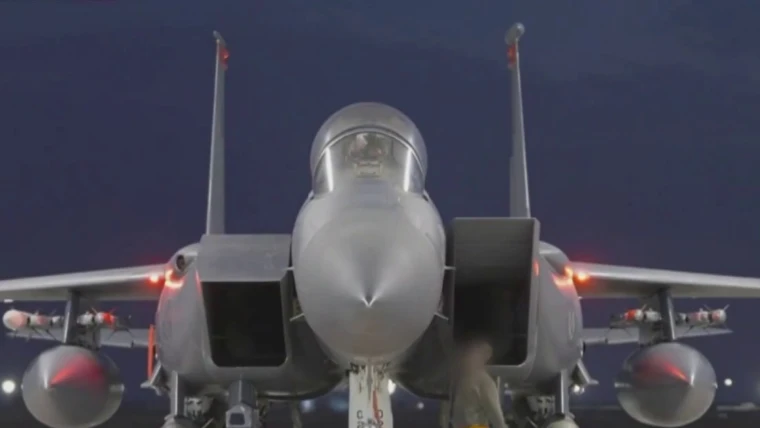
Critics warn that repeated strikes risk normalizing a state of perpetual conflict, where military action becomes a default response rather than a last resort. They argue that without parallel efforts in diplomacy, development, and governance, the cycle of violence may continue indefinitely.
Supporters counter that failing to act would invite greater instability and embolden extremist groups. The debate reflects a broader question facing modern societies: how to confront non-state threats without becoming trapped in endless war.
What Happens Next
U.S. officials have emphasized that the latest strikes do not represent a new war, but a continuation of an existing effort to keep ISIS off balance. Future actions will likely depend on intelligence assessments and developments on the ground.
At the same time, the campaign underscores the importance of long-term strategies that address political grievances, economic deprivation, and social fragmentation. Military pressure can suppress threats, but it cannot eliminate the conditions that allow them to emerge.
Conclusion
The additional large-scale strikes on ISIS targets mark a significant moment in the ongoing effort to contain one of the world’s most resilient extremist groups. They demonstrate a commitment to vigilance, adaptability, and precision in an era where threats are diffuse and constantly evolving.
Yet they also raise enduring questions about the limits of force, the nature of modern conflict, and the path toward lasting stability. As the world watches these developments unfold, the challenge remains not only to defeat ISIS militarily, but to prevent the conditions that allow such movements to take root in the first place.
In that sense, the strikes are not an endpoint, but a reminder that the struggle against extremism is as much about the future as it is about the present.