

Table of Contents
- The Anatomy of Mantis Shrimp Eyes
- The Secret of Seeing Beyond Human Capabilities
- How Mantis Shrimp Eyes Aid in Survival
- A Window Into the Evolution of Mantis Shrimp Vision
- Mantis Shrimp as Natural Scientists’ Dream
- Polarized Light and the Science Behind It
- Comparing Mantis Shrimp Eyes to Other Animal Eyes
- Applications of Mantis Shrimp-Inspired Technology
- Conclusion
The Anatomy of Mantis Shrimp Eyes
Mantis shrimp eyes are unlike anything seen in the human world, and even among animals, they stand out. These creatures have two highly specialized eyes that work independently, giving them a 360-degree view of their surroundings. What makes their eyes truly extraordinary, however, is their complex structure. Each eye is equipped with 16 types of photoreceptor cells, whereas humans only have three. This means mantis shrimp can see a spectrum of light that is simply unimaginable to us, including ultraviolet light and polarized light.
Their eyes also possess a unique ability to see both in the front and behind them, with each eye moving independently. This gives mantis shrimp a level of visual awareness that’s unmatched in the animal kingdom. Their eyes are constantly scanning their surroundings, providing them with crucial information for hunting and avoiding predators.
The Secret of Seeing Beyond Human Capabilities
The most striking feature of mantis shrimp vision is their ability to perceive ultraviolet (UV) light and polarized light. While humans are limited to seeing three primary colors—red, green, and blue—mantis shrimp have the ability to see up to 12 different colors in the ultraviolet spectrum, opening up an entirely new world of visual possibilities. This capability allows them to detect subtle differences in light that other creatures, including humans, simply cannot.
Furthermore, mantis shrimp can perceive polarized light, which is light that has been filtered in a particular way, making it possible for them to see the world through a completely different lens. This polarization vision allows them to detect the body patterns of other animals, helping them to locate prey and avoid predators, even in murky waters where light is filtered and scattered.
How Mantis Shrimp Eyes Aid in Survival
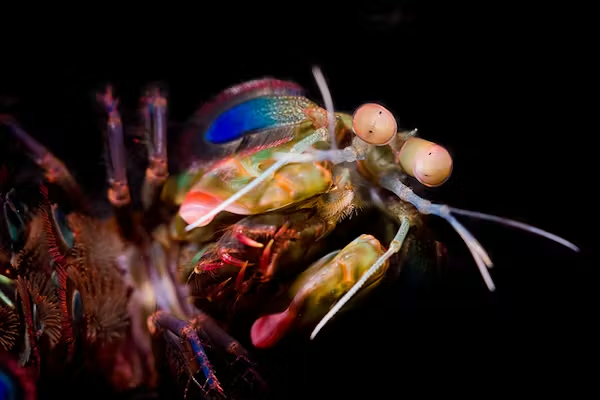
Mantis shrimp vision is not just a fascinating curiosity; it is essential to their survival. These powerful eyes give them a critical advantage when hunting and defending themselves. For starters, their ability to detect polarized light is particularly useful in identifying the body patterns of other animals. This is vital for finding prey, such as small fish and crustaceans, who might otherwise blend into the background.
But their vision is also key to avoiding predators. By detecting UV and polarized light, mantis shrimp can see through the water’s natural light filtering and identify potential threats from far away. The ability to detect changes in the light also gives them an edge when navigating coral reefs or rocky areas, where ambush predators might lie in wait.
A Window Into the Evolution of Mantis Shrimp Vision
The evolution of mantis shrimp vision is as intriguing as the eyes themselves. Researchers have long been fascinated by how these creatures evolved such advanced visual capabilities. Mantis shrimp belong to a group of crustaceans that likely developed their exceptional vision over millions of years to help them survive in the complex and competitive environments of the ocean.
Scientists believe that the unique visual systems of mantis shrimp may have evolved due to the challenges posed by living in colorful, diverse ecosystems. Their ability to distinguish between different colors, patterns, and light polarizations is thought to have given them an evolutionary edge, allowing them to thrive in their highly competitive niche.
Mantis Shrimp as Natural Scientists’ Dream
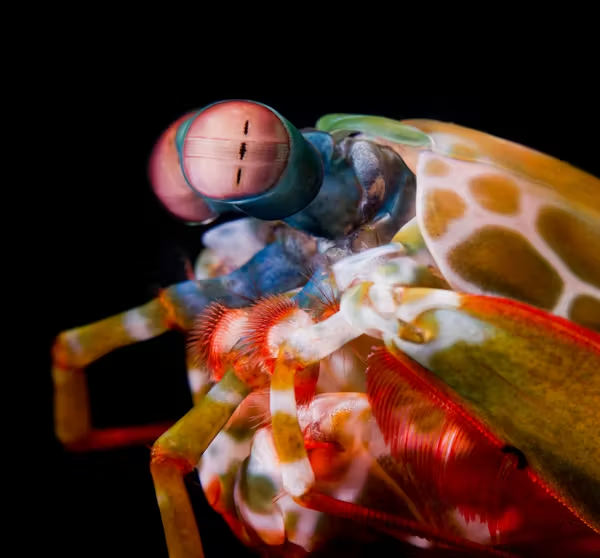
The extraordinary visual system of the mantis shrimp has piqued the interest of scientists and engineers alike, especially those working on the development of advanced optical technologies. Researchers are keen to study how the mantis shrimp processes light, color, and polarization, as their eyes offer clues to new technologies in imaging, optics, and light detection.
One of the most exciting possibilities lies in the development of new types of cameras and sensors that could detect polarized light or work across multiple spectra of light. By mimicking the mantis shrimp’s visual capabilities, scientists are hoping to create more sensitive, accurate imaging systems for use in everything from medical diagnostics to environmental monitoring.
Polarized Light and the Science Behind It
While humans can’t directly experience polarized light, understanding it is crucial to understanding the mantis shrimp’s incredible abilities. Polarized light is light that has been filtered in a way that it vibrates in one direction, and many animals, including mantis shrimp, have developed the ability to detect this unique form of light.
In the wild, polarized light helps mantis shrimp see details that would otherwise be invisible. For instance, when light reflects off water or certain surfaces, it becomes polarized. This gives the mantis shrimp an edge in hunting or navigating through its environment, where other predators might miss subtle cues that indicate prey or danger.
The ability to see polarized light is so advanced that it allows the mantis shrimp to locate prey that would otherwise be hidden in murky water. They can even detect tiny movements or changes in light that would be invisible to other animals, allowing them to react quickly to any changes in their environment.
Comparing Mantis Shrimp Eyes to Other Animal Eyes
While mantis shrimp have the best eyes in the animal kingdom, their vision system is in a league of its own. In comparison, other animals, such as eagles, owls, and humans, rely on different visual adaptations that suit their specific needs. Eagles, for instance, have extremely sharp eyesight, allowing them to see prey from great distances, while humans have color vision, which helps us navigate our environment and distinguish between objects.
However, no other animal has been observed to possess the same range of visual abilities as the mantis shrimp. Their ability to detect polarized light and perceive UV light gives them an advantage that no other creature has. While other animals may excel in specific areas of vision, the mantis shrimp’s visual prowess remains unparalleled.
Applications of Mantis Shrimp-Inspired Technology
The insights gained from studying the mantis shrimp’s vision have practical applications in a variety of fields, particularly in technology and science. Engineers and scientists are exploring how to harness the mantis shrimp’s capabilities to improve current technologies, such as cameras and medical imaging devices.
For example, creating sensors that can detect polarized light could lead to improved imaging systems in fields like medicine, where detecting subtle differences in light could help identify problems such as tumors or abnormalities. Similarly, mantis shrimp-inspired technology could help improve surveillance systems, enabling them to detect threats hidden in challenging environments.
Conclusion
Mantis shrimp eyes are truly the gold standard in the animal kingdom. Their ability to see the world in ultraviolet and polarized light, combined with their 360-degree vision, makes them the most complex and capable visual systems found in nature. Through their extraordinary eyes, mantis shrimp have developed skills that allow them to thrive in one of the most competitive and dangerous environments on Earth.
Beyond their fascinating biology, mantis shrimp eyes provide us with insights that could revolutionize technology and improve our understanding of vision itself. Whether it’s in the field of imaging, medicine, or environmental monitoring, the mantis shrimp’s vision system offers a glimpse into a world of possibility, showing us that nature’s solutions can inspire the next great advancements in human technology.
As we continue to explore the depths of the natural world, the mantis shrimp’s extraordinary eyes will undoubtedly remain a beacon of innovation, proving that sometimes, the most brilliant solutions come from the most unexpected sources.