

Imagine a fusion reactor humming along, not only generating clean energy—but also producing gold as a byproduct. Sounds like the stuff of legend? Yet, a Silicon Valley startup says it might really be possible.
Table of Contents
- The Ancient Dream Meets 21st-Century Physics
- How Much Gold Are We Talking About?
- On Paper It Looks Great—but Reality? More Complex
- Seen in Science Fiction—or Maybe Not Anymore
- What Experts Say—and Why Some Still Stand Tall
- If You Had a Fusion Reactor… Would You Mine Gold or Just Power Cities?
- What This Could Mean—for Energy, Mining, and Finance
- The Final Loop: Are We on the Verge of a 21st-Century Gold Rush?
The Ancient Dream Meets 21st-Century Physics
For thousands of years, alchemists chased the elusive Philosopher’s Stone, believing it could turn base metals into gold.
Marathon Fusion, founded in 2023, may have stumbled on that dream—through nuclear transmutation powered by fusion energy. They propose introducing a mercury isotope—mercury‑198—into the breeding blanket of a fusion reactor, where it would be bombarded with neutrons. The mercury transforms into mercury‑197, decaying into stable gold‑197 in about 64 hours.
How Much Gold Are We Talking About?

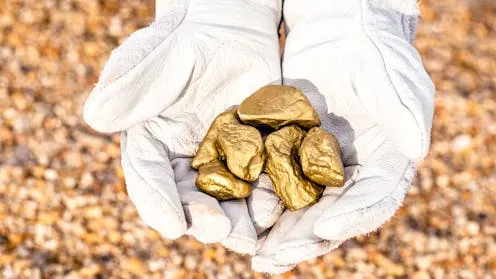
Simulations suggest a gigawatt-scale fusion plant could generate up to 5 tonnes of gold per year—potentially doubling the revenue of a fusion facility.
If correct, that yield dwarfs traditional mining output—and might finally make fusion economically enticing beyond its clean energy promise.
On Paper It Looks Great—but Reality? More Complex
As enticing as it sounds, this vision comes with major caveats:
- Fusion reactors that consistently produce net-positive energy don’t yet exist. Designing them at scale remains one of science’s biggest challenges.
- Gold may initially be radioactive, demanding a storage (decay) period of 14–18 years before safe handling.
- The process has not been peer-reviewed yet, and relies on complex simulations—but lacks real-world validation.
Seen in Science Fiction—or Maybe Not Anymore

The concept isn’t pure fantasy. Scientists affirm the underlying physics is sound: neutron bombardment can change element nuclei, a principle already observed in labs—albeit at tiny scales.
Yet implementing this at scale is where engineering meets alchemy, and skepticism remains.
What Experts Say—and Why Some Still Stand Tall
- Dr. Ahmed Diallo, a DOE plasma physicist, calls the process “on paper…it looks great,” and confirms the scientific basis is solid.
- Dan Brunner, an ex-CTO at Commonwealth Fusion Systems, sees it as a clever ROI model—but underscores that real breakthroughs will come from engineering, not equations.
- Other physicists question scalability and the costs tied to neutron production, reactor complexity, and radioactive decay management.
If You Had a Fusion Reactor… Would You Mine Gold or Just Power Cities?

Pause and ponder:
Would you use fusion for energy, or tap into its potential to pay for itself through gold production?
Your answer may reveal whether you’re an optimist, a pragmatist, or a believer in modern alchemy.
What This Could Mean—for Energy, Mining, and Finance
- Clean-energy industries would gain a high-value byproduct, shifting investment models overnight.
- Gold markets could be disrupted—abundance may shake pricing and value structures.
- Mining could be redefined, freeing gold from the ground in nuclear reactors, not mines.
The Final Loop: Are We on the Verge of a 21st-Century Gold Rush?
Only when fusion becomes reliable—and technical barriers fall—will this alchemical vision become reality.
Will we look back in decades and say: “That was when the golden age of fusion began”?
Stay tuned—and let this article be your front-row seat to history in the making.