
Table of Contents
- He Was There When the Sky Turned Black — and He Has Never Forgotten
- A Quiet Sunday Morning That Turned Into Hell
- The Sound He Can Still Hear — Even Now
- A Harbor in Flames: The Attack He Can’t Forget
- Courage in the Midst of Chaos
- A Nation Changed Forever
- What He Wants Younger Generations to Remember
- The Memory He Still Carries: A Friend He Couldn’t Save
- How He Lives Now: Carrying History in His Heart
- Why His Story Still Matters 84 Years Later
- “Never Forget” Isn’t a Slogan — It’s a Promise
He Was There When the Sky Turned Black — and He Has Never Forgotten
Eighty-four years later, the memory still wakes him at night.
The sound of explosions.
The fire.
The screams.
The planes overhead.
The feeling that the world was ending in front of his eyes.
A Pearl Harbor survivor — now one of the last living Americans who witnessed the attack firsthand — sits quietly as he recalls the morning of December 7, 1941. He has told the story hundreds of times. But there is always a moment when his voice catches, as if he has been transported back in time.
Because some memories never fade.
And some moments are so powerful that they stay carved into the mind forever.
He remembers exactly what he “can’t forget” — the details that shaped not only his life, but the future of an entire nation.
A Quiet Sunday Morning That Turned Into Hell
He starts his story the same way every time:
“It was calm. Too calm.”
The sun was just beginning to rise over the harbor. Many sailors were just waking up, preparing for what they assumed would be an ordinary Sunday. Some planned to attend church. Others planned to relax, write letters, or play cards on deck.
Then, at 7:55 a.m., everything changed.
The first bombs fell with a force so violent that the ground shook. Men rushed out of their bunks, unsure whether they were dreaming or dying. And within seconds, the sky filled with the unmistakable roar of aircraft.
Japanese planes — dozens of them — screamed overhead, flying low and fast.
The survivor remembers looking up and feeling his heart freeze.
“I saw the red sun insignia on the wings. That’s when I knew — this was real.”
He knew the world would never be the same again.
The Sound He Can Still Hear — Even Now
When asked what he remembers most vividly, he doesn’t hesitate.
“The sound,” he says quietly. “The sound is what stayed with me.”
It wasn’t just one sound.
It was a symphony of destruction:
- the scream of dive-bombers
- the thunder of exploding ships
- the clatter of machine-gun fire
- the frantic shouts of sailors rushing to battle stations
- the sound of metal tearing apart under the heat of flames
It was chaos — overwhelming, deafening, and unforgettable.
He closes his eyes as he recalls it. Even after more than eight decades, the memory is as sharp as the day it happened.
A Harbor in Flames: The Attack He Can’t Forget
Pearl Harbor that morning became a nightmare of smoke and fire.
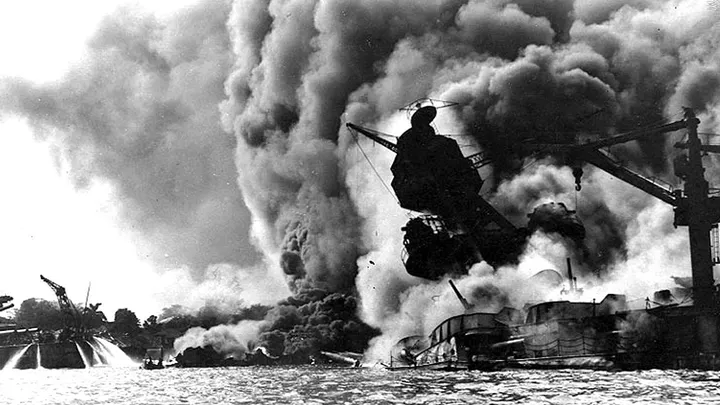
He saw the USS Arizona explode in a ball of flame so massive it shook the entire harbor. Hundreds of sailors were gone instantly. Others struggled in the water, oil burning around them.
He remembers the smell — smoke, fuel, fire, and something else he chooses not to describe.
He remembers the heat — so intense it felt like the air itself was burning.
He remembers the fear — not just of dying, but of watching friends fall beside him.
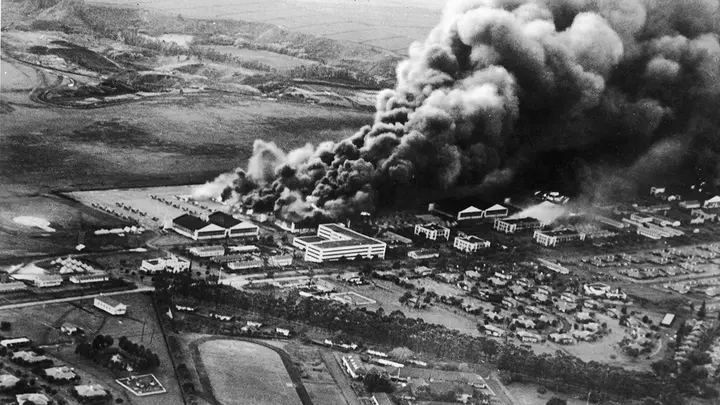
And he remembers the moment he realized the attack was coordinated, precise, and devastating. The Japanese planes targeted:
- battleships
- airfields
- hangars
- fuel depots
Everything the U.S. Navy needed to fight back.
The attack lasted less than two hours — but those two hours felt like a lifetime.
Courage in the Midst of Chaos
The survivor also remembers something else — something he says Americans must never forget.
The courage.
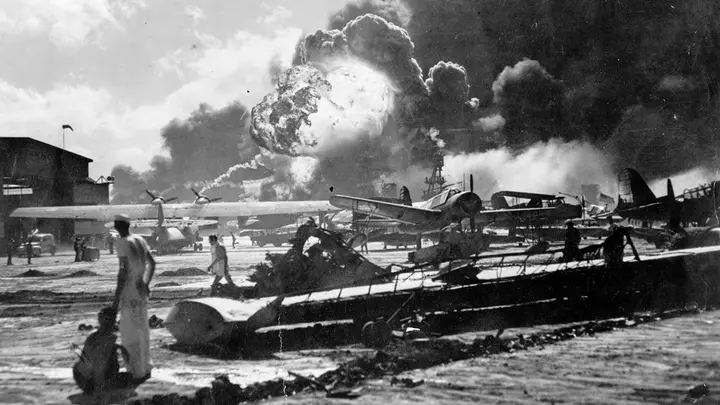
Men who had never seen combat ran toward danger, not away from it.
Sailors pulled wounded friends through burning oil slicks.
Others climbed aboard sinking ships to help whoever they could.
Some fired anti-aircraft guns with no training, simply because someone had to do it.
“Everyone became a hero that day,” he says.
“Even the ones who never made it home.”
He pauses when he says this.
Because those are the memories that still hurt.
A Nation Changed Forever
By the end of the attack:
- more than 2,400 Americans were dead
- nearly 1,200 were wounded
- the Pacific Fleet lay crippled
- and the United States had been pulled into a global war
The survivor remembers hearing President Franklin D. Roosevelt’s speech the next day. The words “a date which will live in infamy” echoed through every home, every barracks, every heart.
For him, they hold even deeper meaning.
Because he lived it.
And he remembers something else he can’t forget:
The unity that followed.
Americans rallied together, enlisting in record numbers, donating supplies, and preparing for a war that would reshape the world.
What He Wants Younger Generations to Remember
Today, he is older — the kind of age that makes every day a gift. But his voice is still firm when he speaks about the importance of remembering Pearl Harbor.
Here is what he wants younger generations to know:
1. Freedom is never guaranteed.
It must be defended, protected, and valued.
2. Peace can shatter in an instant.
December 7th began like any other day — then history erupted.
3. Sacrifice should never be forgotten.
Thousands died in minutes. Their stories matter.
4. Comfort and prosperity were built on the courage of others.
The world today exists because of what Americans did after that attack.
5. Remembering the past keeps the future safer.
History ignored is history repeated.
And that message becomes more urgent each year as the number of living survivors dwindles.
The Memory He Still Carries: A Friend He Couldn’t Save
Every survivor carries a personal moment they cannot shake.
For him, it is the memory of a friend — a fellow sailor — who didn’t make it.
He does not share the man’s name often. It is private, sacred. But he shares the story:
They were only feet apart when a second wave of planes descended. A bomb detonated near their position. Smoke, fire, confusion — and then silence.
He searched for his friend through the flames.
He called his name over and over.
But deep down, he knew.
That is the memory he “can’t forget.”
A memory that shaped the rest of his life — and still shapes him today.
How He Lives Now: Carrying History in His Heart
Today, he attends memorial events when he can.
He speaks to schoolchildren.
He talks to journalists.
He shares his story even when it hurts.
Because he believes silence is more dangerous than pain.
He wants the world to remember — not just the attack, but the bravery, the unity, and the lessons that emerged from the ashes.
He wants people to understand that Pearl Harbor was not merely history.
It was a turning point, a moment when the world held its breath — and then changed forever.
And he wants Americans to know the most important truth of all:
The cost of freedom is written in the stories of those who lived — and those who didn’t return.
Why His Story Still Matters 84 Years Later
In a world of fast news cycles, social media noise, and shrinking attention spans, stories like his remind us of something essential:
Some events demand to be remembered.
Some voices deserve to be heard.
And some sacrifices must never fade into history’s shadows.
Pearl Harbor shaped a generation.
It shaped a nation.
It shaped the course of World War II and the future of global politics.
But more than anything, it shaped the lives of the young men who were there — ordinary Americans who faced extraordinary circumstances.
Their stories remind us what courage looks like.
What resilience looks like.
What unity looks like.
And what it means to carry memories that never leave.
“Never Forget” Isn’t a Slogan — It’s a Promise
When the survivor finishes sharing his memories, he is quiet for a long moment.
Then he says the same words he always says:
“I tell this so people won’t forget. We can’t forget.”
Because forgetting, he believes, dishonors the men who fell, the families who suffered, and the country that rose from the ashes of that infamous morning.
And so he keeps telling the story.
Again and again.
Year after year.
Because the world may change —
technology, politics, generations —
but the truth of Pearl Harbor remains.
It is a story of loss.
A story of courage.
A story of a moment America can never afford to forget.