
Table of Contents
What Happened in the Rare Planetary Parade
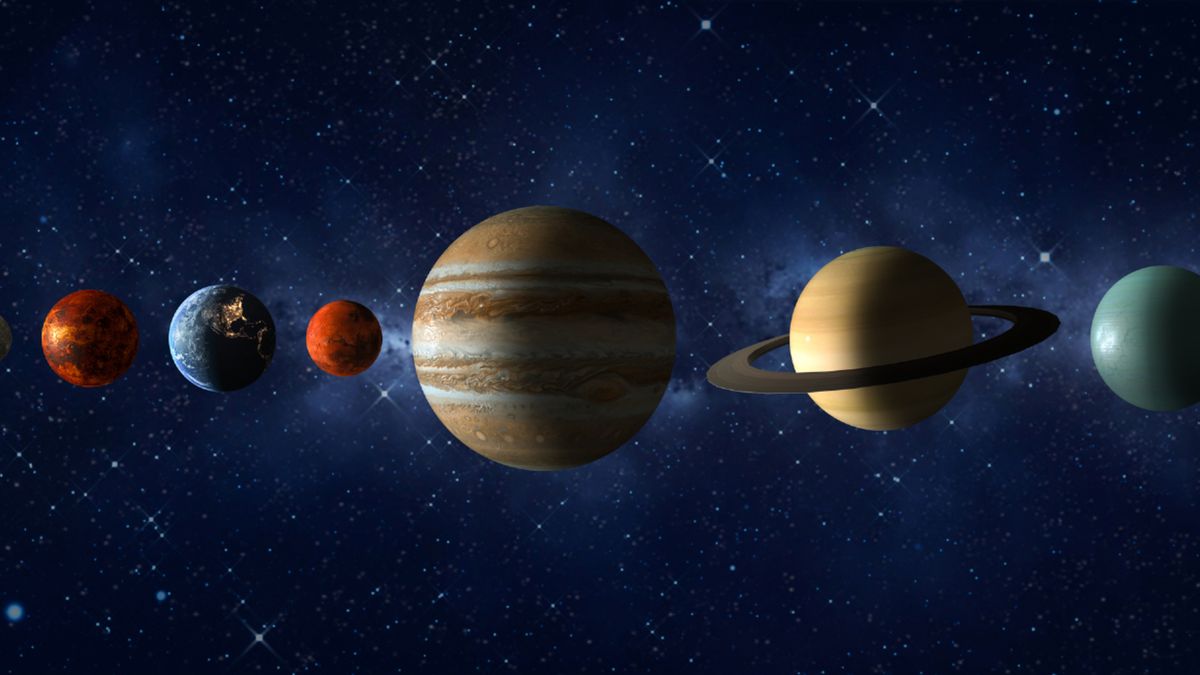
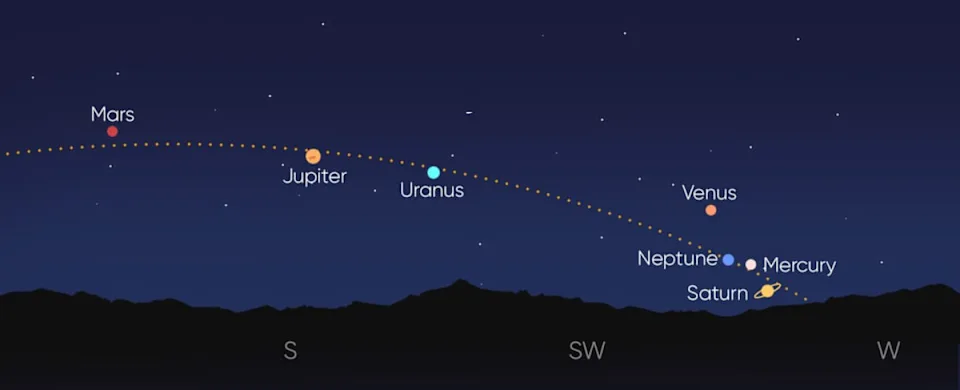
On the evening of February 28, 2025, residents of the United Kingdom and many parts of the Northern Hemisphere experienced a rare celestial alignment that placed seven planets visible to the naked eye across the night sky all at once. Skywatchers reported that Mercury, Venus, Mars, Jupiter, Saturn, Uranus and Neptune appeared to stretch across the horizon after sunset in what many described as a planetary parade — an apparent grouping of planets along the ecliptic, the path the Sun follows through the sky .
This parade was visible just after dusk, when twilight had faded but before the sky had fully darkened. Under clear skies, observers could see the brighter planets without optical aid while the fainter ones, especially the more distant Uranus and Neptune, required binoculars or telescopes for confident detection. Because each planet moves at its own pace around the Sun, this kind of multi‑planet sighting does not reflect a true physical alignment in space but rather a perspective effect seen from Earth that aligns them from our viewpoint.
Astronomy enthusiasts and casual stargazers gathered in public spaces, parks and observatories to share the spectacle, exchanging tips on how to spot each world and marveling at how our solar system’s wandering objects can sometimes form such a striking visual arc.
The Mechanics Behind Planetary Parades
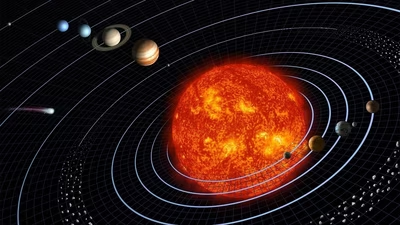
A planetary parade — often called a planetary alignment — occurs when several planets in our solar system appear to lie along the same general path across the sky from an Earth‑based perspective. This phenomenon happens because the planets orbit the Sun in slightly different planes and at different speeds. When viewed from our vantage point, those orbits sometimes project the planets into a similar region of the sky at the same time — even though in three‑dimensional space they may be far apart. Parades of three, four or five planets are relatively common, but seeing seven in one stretch of sky is rare and particularly striking.
These events are predictable using celestial mechanics and orbital mathematics, and they often become calendar highlights for astronomers and skywatchers worldwide. Despite all planets orbiting the same star, the planes of their orbits differ subtly — and planetary movements relative to Earth’s position determine when they appear close together along the ecliptic.
It’s important to note that a parade does not mean the planets are physically close in space. Instead, the alignment is an apparent grouping created by Earth’s viewpoint and the projected positions of the planets in the sky. This visual alignment offers a stunning demonstration of how orbital geometry can produce rare moments of beauty for observers on the ground.
Why the 2025 Parade Was Special
While smaller planetary groupings happen with some regularity, the event on February 28, 2025 stood out because it included all seven classical planets visible from Earth — an occurrence that won’t be matched in the same way again until at least 2040 according to astronomers who tracked and reported on the phenomenon for the UK and other regions.
Seven‑planet parades require a very specific sequence of orbital and observational conditions: each planet must be above the horizon at a similar time, the sky must not be too bright, and the planets have to be spaced in a way that makes them all accessible to human eyes. These conditions aligned perfectly for a brief window of time in late February, giving observers a chance to see Venus and Jupiter shining brightly, Saturn and Mercury near the western horizon, Mars visible in its characteristic reddish hue, and distant Uranus and Neptune detectable with optical aids. For many participants this became a once‑in‑a‑generation experience.
For the UK in particular, where cloud cover and weather often limit astronomy outings, the clear skies over several evenings allowed observers to catch different portions of the parade over multiple nights — a rare bonus that deepened interest and participation.
How and When to Observe a Planetary Parade
Seeing a planetary parade requires knowing where and when to look. The ideal time for the February 2025 parade was shortly after sunset, when sunlight had faded but the sky was still dark enough for planets to be visible. Observers were advised to look toward the southwestern horizon with a clear and unobstructed view; this direction offered the best vantage for spotting the lower‑horizon planets like Mercury and Venus.
Tools such as star charts astronomy apps and even casual binoculars helped people identify the brighter planets first. Venus stood out as the brightest object in the parade after the Moon, followed by Jupiter’s unmistakable brilliance. Saturn, lower on the horizon, displayed its soft golden glow, while Mercury was dimmer and closer to the setting Sun — requiring a bit of patience and a clear view for those trying to catch it in twilight.
For the more distant planets like Uranus and Neptune, binoculars or telescopes brought them into view — tiny points of light that, without optical instruments, would have been impossible for most observers to detect. These tools elevated the experience from a simple skywatch to a deeper engagement with the Solar System’s structure and the challenges of visual astronomy.
Scientific and Cultural Reactions
The planetary parade captured public imagination not just because of its rarity, but because it brought a centuries‑old human fascination with the night sky into the present, linking amateur skywatchers with professional observatories and science communicators alike. Many astronomy clubs hosted public viewings, guiding participants through each of the visible planets and explaining how their movements relate to Earth’s position around the Sun.
Astronomers noted that such events are excellent opportunities to educate about orbital mechanics, planetary science, and the distinction between visual alignments and physical celestial configurations. They highlighted that while such parades are visually striking, the planets themselves are separated by vast distances and do not exert unusual gravitational effects on Earth — a common misconception that occasionally circulates in social conversation about astronomical alignments.
Cultural reactions reflected a mix of awe nostalgic reflection and scientific curiosity. In some communities, groups gathered to watch together, turning an astronomical event into a shared social experience as much as a scientific one. In educational settings, teachers and science communicators used the parade to launch discussions about the solar system, planetary motion, and how human beings have long looked to the sky for meaning and wonder.
Historical Context and Frequency of Planetary Alignments
While rare, large planetary parades are not unique in human astronomy history. Similar events were observed in previous years and recorded in astronomical annals. Notably, in 2025, observations earlier in the year captured a six‑planet alignment that preceded the seven‑planet parade — a reminder that multiple parades of varying sizes can occur as the Earth and its planetary neighbors dance around the Sun
Ancient civilizations also watched the planets, crafting myths and calendars around celestial movements. While historical records of specific alignments may be sparse, cultural lore often points to people across time finding meaning whenever planets and stars moved in visually striking patterns.
The rarity of a seven‑planet parade in modern times — with current observational accuracy and public engagement — provides a bridge between historical skywatching traditions and contemporary science, showing that even in an era of satellites and space probes, simple observation with the naked eye can still enthrall and educate.
What This Means for Future Skywatchers
Events like the 2025 planetary parade encourage a wider appreciation of astronomy and serve as invitations for people to look up more often. The predictability of celestial mechanics means that future planetary parades and other sky events — such as eclipses meteor showers and conjunctions — can be anticipated and shared well in advance, fostering community interest and global engagement.
Astronomy enthusiasts are already sharing dates for upcoming conjunctions and alignments that will occur in later years, and applications and interactive sky maps offer tools for observers of all ages to learn where to look and what to expect. The parade of seven planets in 2025 helped ensure that stargazing remains not just a scientific hobby but a connective practice that draws together people from many walks of life under a common sky.
Conclusion
The rare planetary parade that allowed seven planets to appear simultaneously in the UK night sky captivated both seasoned astronomers and casual skywatchers alike, offering a moment of shared wonder that won’t be repeated until well into the next decade. This celestial event showcased the beauty of our solar system’s architecture and reminded humanity of the power of perspective when looking up at the heavens.
From the science behind orbital motion to the personal thrill of spotting distant worlds — Venus, Mercury, Mars, Jupiter, Saturn, Uranus and Neptune — aligned by chance in our view, the parade became both a teaching moment and a cultural event. As skies continue to inspire wonder and people develop skills and tools for observing the cosmos, events like this planetary parade help keep alive humanity’s age‑old fascination with the night sky and our place within the greater solar system.