
Table of Contents
- When the Announcement Emerged, the World Took Notice
- Why Water Has Always Defined Survival in the Desert
- How the Solar-Powered Laser System Works
- The Technology Behind the Light
- Who the Technology Is Designed to Help
- Reducing Deaths and Emergency Rescues
- A Broader Vision for Sustainable Infrastructure
- Global Interest and Potential Replication
- Balancing Innovation With Environmental Concerns
- Human Stories Behind the Technology
- Challenges and Limitations Remain
- What the Innovation Signals About the Future
- Conclusion: Light as a Lifeline in an Ancient Landscape
When the Announcement Emerged, the World Took Notice
When reports surfaced that Saudi Arabia had begun deploying solar-powered laser systems to help guide travelers toward water sources in the desert, the reaction was a mix of fascination, disbelief, and cautious optimism. In a region defined by extreme heat, vast distances, and unforgiving terrain, the idea of using light itself as a navigational lifeline felt both futuristic and deeply practical. For a country where deserts dominate the landscape and survival has historically depended on ancient knowledge, the innovation represented a striking fusion of tradition and advanced technology.
The announcement was not framed as a spectacle but as a response to a real and persistent problem. Every year, travelers, nomads, and even modern motorists find themselves lost or stranded in Saudi Arabia’s deserts, where dehydration can become life-threatening within hours. The introduction of a system designed to guide people toward water using solar-powered lasers marked a shift in how desert safety could be approached in the modern era.
Why Water Has Always Defined Survival in the Desert
To understand the significance of the technology, one must first understand the role water plays in desert life. In Saudi Arabia, water sources such as wells and underground reservoirs have historically dictated trade routes, settlement patterns, and survival strategies. Long before modern infrastructure, desert travelers relied on stars, landmarks, and oral knowledge passed down through generations to locate life-saving water.
Despite modern GPS systems and satellite imagery, the desert remains deceptive. Shifting sands, extreme temperatures, and limited visual cues can render digital navigation tools unreliable. In such conditions, technology that provides a visible, continuous guide toward water represents a fundamental change in how safety can be ensured.
How the Solar-Powered Laser System Works
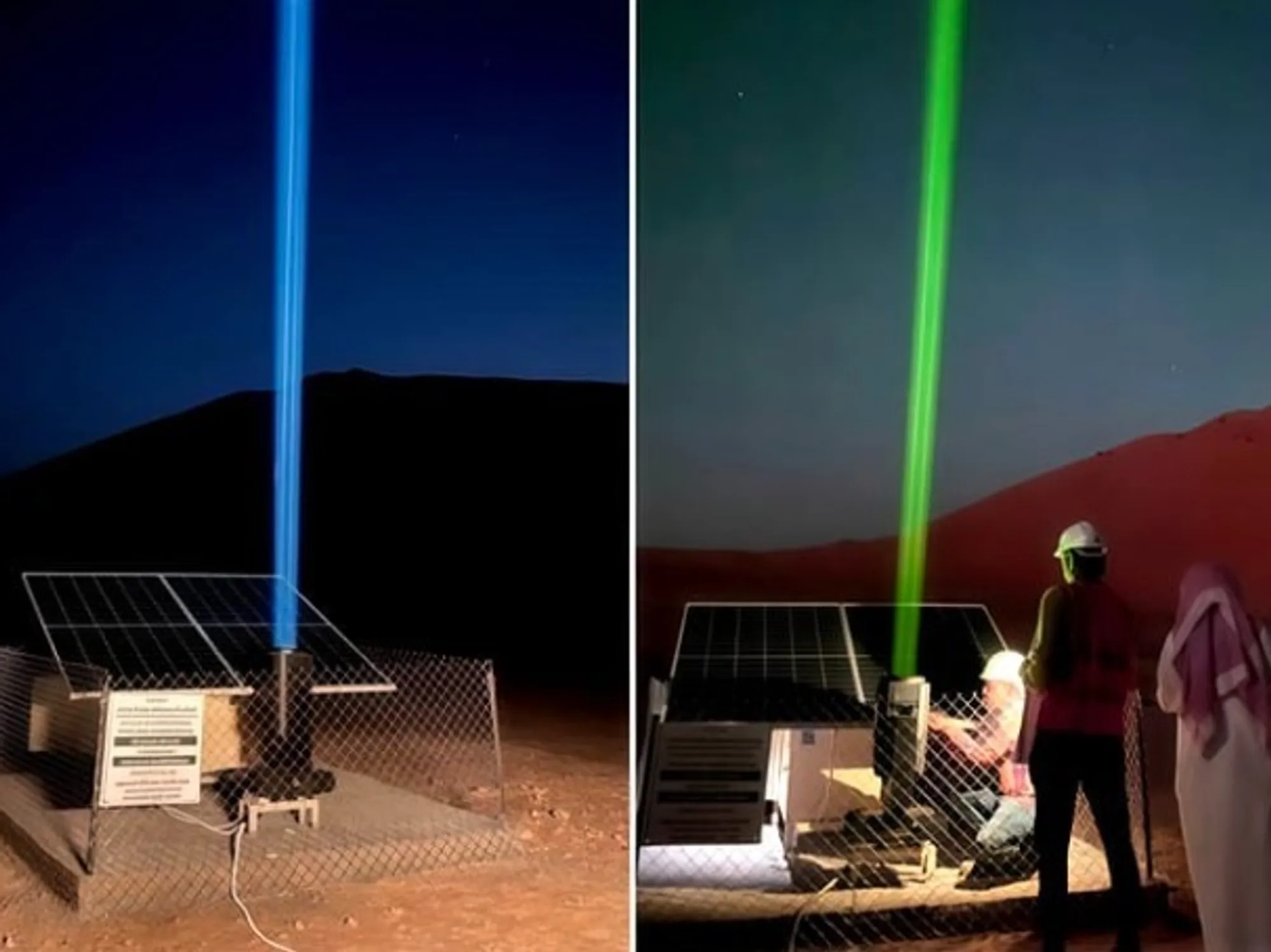
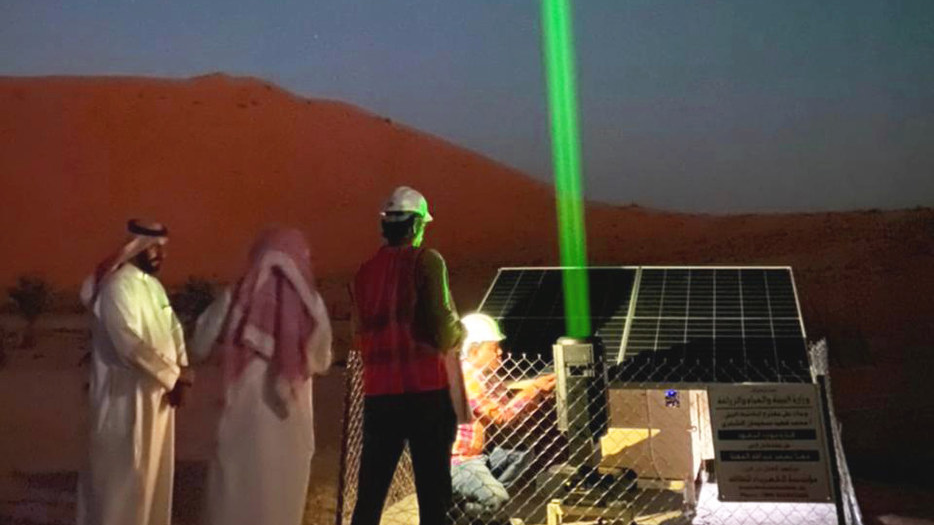
The core concept behind the laser guidance system is deceptively simple. Solar panels collect energy during daylight hours, powering laser emitters that project visible beams into the desert sky. These beams are aligned to point directly toward known water sources, such as wells or emergency water stations.
Unlike traditional signage, which can be buried by sand or damaged by weather, laser beams remain visible across long distances, even in low-light conditions. The system requires no continuous fuel supply, relying instead on the abundant sunlight that defines the region. Once installed, it operates autonomously, providing a constant directional signal without human intervention.
This simplicity is precisely what makes the system so compelling.
The Technology Behind the Light

While the concept may appear straightforward, the engineering behind it is sophisticated. The lasers are designed to remain visible without posing a hazard to aircraft or wildlife. Their intensity is carefully calibrated to ensure long-range visibility while complying with international safety standards.
Solar efficiency is another critical factor. Panels must withstand extreme heat, dust storms, and prolonged exposure to harsh sunlight. Engineers involved in the project reportedly tested multiple configurations to ensure reliability in conditions where even advanced electronics often fail.
The result is a system designed not just for innovation’s sake, but for endurance.
Who the Technology Is Designed to Help
The laser guidance system is not intended solely for tourists. Saudi Arabia’s deserts are traversed by a wide range of people, including truck drivers, rural residents, herders, and emergency responders. Off-road enthusiasts and pilgrims traveling through remote areas also face risks when navigating vast desert regions.
By providing a clear visual cue toward water, the system offers a universal language of safety. No app download is required. No network connection is needed. Anyone who can see the beam can follow it.
This inclusivity is one of the project’s most significant strengths.
Reducing Deaths and Emergency Rescues
Desert rescues are costly, dangerous, and often time-sensitive. Every hour lost searching for a stranded individual increases the risk of fatal dehydration or heat exhaustion. By helping travelers orient themselves before a situation becomes critical, the laser system has the potential to reduce the number of emergency rescues required each year.
Authorities hope that the technology will not only save lives but also reduce the strain on emergency services. In regions where response times can be delayed by terrain and distance, prevention becomes far more effective than reaction.
A Broader Vision for Sustainable Infrastructure
The project aligns closely with Saudi Arabia’s broader push toward sustainability and technological modernization. Solar-powered infrastructure has become a central pillar of the country’s long-term development plans, particularly in response to climate change and water scarcity.
By leveraging renewable energy for safety applications, the laser system demonstrates how sustainability can serve immediate human needs rather than abstract environmental goals. It reframes renewable technology as a tool for survival, not just efficiency.
This framing could influence similar projects in other arid regions around the world.
Global Interest and Potential Replication

News of the project quickly attracted international attention. Countries with large desert regions, including parts of Africa, Australia, and the American Southwest, face similar challenges related to navigation and water access. Experts began speculating whether the Saudi model could be adapted to other environments.
While each region has unique geographic and regulatory considerations, the underlying principle remains transferable. Solar-powered, low-maintenance guidance systems could offer a cost-effective solution for remote safety infrastructure worldwide.
Saudi Arabia’s experiment may become a blueprint rather than an exception.
Balancing Innovation With Environmental Concerns
As with any large-scale intervention in natural landscapes, the laser system raises environmental questions. Conservationists have asked whether constant light emissions could affect wildlife behavior, particularly nocturnal animals. Engineers involved in the project insist that the lasers are designed to minimize ecological disruption, but long-term studies will be needed to confirm these claims.
The debate reflects a broader challenge facing modern technology: how to protect human life while preserving fragile ecosystems. The success of the project may depend as much on careful monitoring as on technical performance.
Human Stories Behind the Technology
Beyond policy and engineering, the most compelling aspect of the project lies in its potential human impact. For a lost traveler, a visible beam of light pointing toward water could mean the difference between life and death. For families who have lost loved ones to desert accidents, the technology represents a form of reassurance that future tragedies may be prevented.
In regions where survival has always depended on experience and instinct, the laser beams introduce a new kind of guidance that does not replace knowledge but reinforces it.
Challenges and Limitations Remain
Despite its promise, the system is not a cure-all. Lasers can only guide toward known water sources, and their effectiveness depends on proper placement and maintenance. Dust storms, extreme weather, or mechanical failure could temporarily reduce visibility.
Officials acknowledge that the technology is meant to complement, not replace, existing safety measures. Education, preparedness, and respect for desert conditions remain essential components of survival.
What the Innovation Signals About the Future
At a symbolic level, the laser guidance system reflects a broader shift in how nations approach environmental challenges. Rather than attempting to conquer the desert, the technology works with its defining features, using sunlight as both power source and solution.
It suggests a future in which infrastructure adapts to extreme environments rather than forcing environments to adapt to infrastructure.
Conclusion: Light as a Lifeline in an Ancient Landscape
Saudi Arabia’s solar-powered laser system represents more than a technological curiosity. It is a practical response to one of humanity’s oldest challenges: finding water in a hostile landscape. By combining renewable energy, precise engineering, and a deep understanding of desert realities, the project offers a glimpse into how innovation can enhance safety without erasing tradition.
As the beams cut across the sands, they serve not only as guides toward water but as symbols of how modern solutions can emerge from ancient needs. What follows will determine whether this light becomes a global standard for survival or remains a remarkable experiment born in one of the world’s most demanding environments.