

Table of Contents
- The Moment the Chains Fell Away
- A Life Spent Behind Bars
- The Global Outcry That Changed Everything
- The Journey to Freedom
- The Science of Elephant Emotion
- Why Zoos Are Changing Forever
- The Economics of Compassion
- What Happens Next for Lammie
- The Emotional Lesson for Us All
- A Symbol of Change in a Changing World
- Final Thoughts: The Price and Power of Freedom
The Moment the Chains Fell Away
For the first time in four decades, the sound wasn’t of gates clanging shut — it was the rustle of grass beneath her feet.
Lammie, South Africa’s last remaining zoo elephant, has finally been freed after spending more than 40 years in captivity at the Johannesburg Zoo.
As the transport truck’s ramp lowered and she stepped into her new sanctuary, her world transformed — from concrete enclosures and crowds to open skies and the distant call of wild birds.
And with that single step, a new chapter began — not just for Lammie, but for how we define compassion.
A Life Spent Behind Bars
Born in the 1970s, Lammie was taken from the wild as a young elephant. Like many zoo animals of her era, she was seen as an attraction — a symbol of power, grace, and exotic beauty for visitors to marvel at.
But behind the fences and the camera flashes, she lived a lonely existence.
Her companion, Kinkel, died in 2018 — leaving Lammie completely alone for the last several years of her captivity.
Elephants are deeply emotional, social creatures. In the wild, they form tight family bonds and communicate over vast distances. But for Lammie, decades of isolation meant silence — a void where her herd’s rumbles should have been.
Animal welfare experts described her condition as emotional trauma — the invisible wounds of captivity that can linger even after the gates open.
The Global Outcry That Changed Everything
When word spread that Lammie was now the only elephant left in a South African zoo, outrage followed.
Animal rights organizations, including Elephant Reintegration Trust, The Humane Society International (HSI), and EMS Foundation, launched a coordinated campaign demanding her release.
Thousands signed petitions. Wildlife experts weighed in.
Even international conservation figures joined the call.
Their argument was simple — elephants are not built for confinement.
Their bodies are designed to roam up to 50 kilometers a day. Their minds need stimulation, social connection, and space.
And for Lammie, captivity had become a kind of living grief.
After months of pressure, the Johannesburg Zoo finally agreed — it was time to let her go.
The Journey to Freedom
It wasn’t easy moving an animal that weighs more than four tons and has spent her life in one place.
Special transport vehicles were brought in, along with a team of veterinarians, behavioral specialists, and handlers. The process took weeks of planning.
Lammie’s relocation was handled with care — tranquilizers, rest stops, hydration, and constant monitoring.
When she finally arrived at her new home — a wildlife sanctuary in the Limpopo Province — experts say she hesitated at first.
Then, she took one slow, deliberate step.
Then another.
And then, in what witnesses described as a breathtaking moment, she trumpeted — a sound that echoed across the savannah like a declaration of freedom.
The Science of Elephant Emotion

Elephants aren’t just intelligent — they’re profoundly emotional.
Studies show that they mourn their dead, remember faces for decades, and exhibit behaviors associated with empathy and joy.
Lammie’s release wasn’t just a logistical success; it was a psychological rescue.
According to Dr. Melissa Bain, an animal behaviorist involved in similar rehabilitation efforts, elephants that transition to sanctuaries often display visible signs of relief.
“You’ll see them dust bathing, vocalizing, exploring again — behaviors that captivity suppresses,” she said.
It’s like watching a soul wake up after years of sleep.
Why Zoos Are Changing Forever
Lammie’s release marks a powerful turning point.
South Africa’s zoo industry, once filled with exotic animal exhibits, is rapidly evolving under global scrutiny.
Many countries have already banned elephants in zoos altogether, citing welfare concerns and outdated practices.
The United Kingdom, France, and India have moved toward animal-free exhibits or virtual educational experiences — using technology like 3D environments and augmented reality to teach without captivity.
South Africa’s decision to free Lammie may signal a new era — one where education and empathy coexist without exploitation.
Because the truth is, we don’t need to cage animals to care about them.
The Economics of Compassion
Critics often ask: What happens to tourism when animals leave zoos?
But conservation economists argue the opposite — freeing animals doesn’t end tourism; it reinvents it.
Wildlife sanctuaries and ethical reserves generate billions annually in eco-tourism, offering visitors authentic, sustainable experiences.
Unlike traditional zoos, sanctuaries like the one now home to Lammie don’t exist for entertainment — they exist for rehabilitation, education, and coexistence.
Visitors still come. But they leave with something deeper than a photo — they leave with perspective.
What Happens Next for Lammie
Rehabilitation for a long-captive elephant isn’t instantaneous.
Experts at the sanctuary will slowly reintroduce Lammie to open space, natural foraging, and — eventually — other elephants.
Her caretakers are monitoring her 24/7, watching for signs of anxiety or disorientation.
But early reports are promising: she’s eating well, exploring, and showing curiosity about her surroundings.
It’s a process of unlearning captivity — step by careful step.
Dr. Michelle Henley, co-founder of Elephants Alive, explains:
“Freedom isn’t just about movement. It’s about rediscovering identity. Lammie will learn, slowly, that the world is safe again.”
The Emotional Lesson for Us All
There’s something profoundly human about this story.
We may never know exactly what Lammie felt when she walked out of that truck, but we know what her story makes us feel — relief, guilt, awe, hope.
Because in freeing her, we also free a part of ourselves — the part that believes it’s never too late to do the right thing.
Her release forces a question we can’t ignore:
If we can recognize suffering in an elephant, what else are we ready to change?
A Symbol of Change in a Changing World
As Lammie roams her new home, her story joins a growing movement — one where empathy meets action.
From whales freed from marine parks to bears rescued from bile farms, the world is slowly learning that kindness is a form of progress.
And in that sense, Lammie’s first steps into the sunlight weren’t just her own — they were ours too.
Final Thoughts: The Price and Power of Freedom
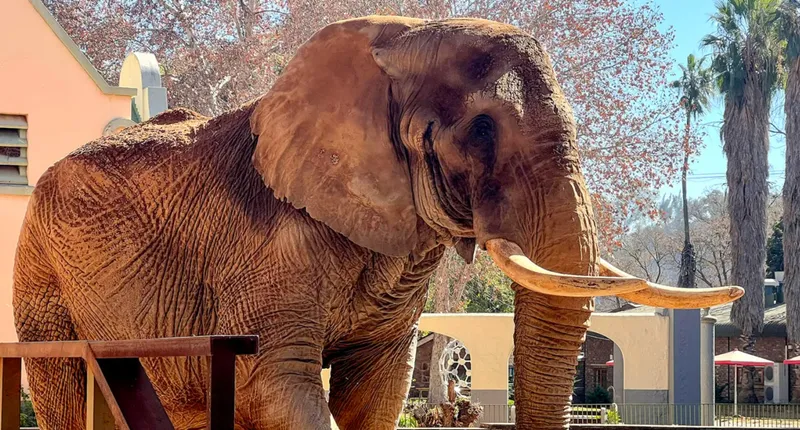
For 40 years, Lammie’s world was measured in meters.
Now, it stretches for miles.
Her release reminds us that freedom, once given, transforms everything — the animal, the people who fought for her, and the future we all share.
It’s a reminder that compassion, when multiplied by persistence, can move even the heaviest chains.
Because in the end, the story of Lammie isn’t just about an elephant walking free.
It’s about humanity learning to walk forward.