

Imagine hearing the soft cry of a bird so rare it was once declared extinct in the wild. Then imagine seeing it soar again — over land that is turning into desert.
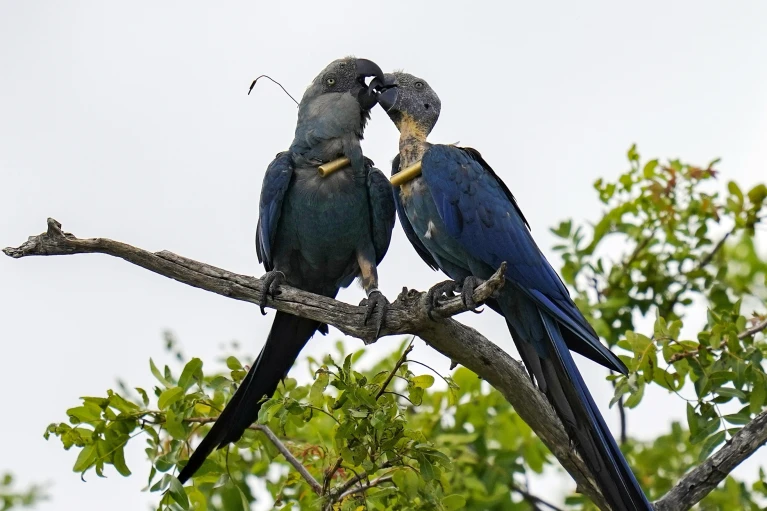
This is the story of the Spix’s Macaw, a brilliantly blue parrot native to Brazil’s Northeast, whose comeback is threatened by rising temperatures, drying soil, and human neglect.
But the battle being fought isn’t just about one species. It touches travel, climate action, home-improvement of natural habitats, conservation financing — and the future of biodiversity.
If this bird vanishes again, what message does that send about the world we’re building for ourselves and for future generations?
The Bird That Left—and Returned
The Spix’s Macaw — once native to a very small range near the São Francisco River basin in northeastern Brazil — was declared extinct in the wild in 2000.
Its habitat vanished through overgrazing, deforestation and illegal trapping.
But a dedicated conservation network refused to let it vanish entirely. Captive-breeding programs began. Robust reintroduction efforts followed.
Despite this, the bird’s resurrection isn’t secure. It’s now flying in a landscape that’s less friendly than ever.
Table of Contents
- Why This Macaw’s Home Is Disappearing
- Breeding and Reintroduction: Hope Amid the Ashes
- Climate Change Isn’t Some Distant Threat — It’s Hitting Here and Now
- How Local Communities and Private Sector Are Getting Involved
- The Critical Numbers — Why We Can’t Ignore This
- Travel, Photography and the Wild Blue That Once Vanished
- What Happens If It Fails?
- The Open Loop — Will the Blue Sky Return?
- Final Thought
Why This Macaw’s Home Is Disappearing
The bird lives in the Caatinga region — a dry, thorn-scrub forest in Brazil’s Northeast known for extreme conditions. Large parts of this region are transforming into what scientists call Brazil’s first official arid climate zone.
In northern Bahia state, researchers found that rainfall and soil moisture between 1960 and 2020 have dropped so much the land now behaves like a desert.
This matters because every habitat depends on a delicate balance of shade, water, seed‐bearing trees and stable ground. When the land dries, the trees die. When the trees die, the birds lose food and nesting sites.
When you renovate a home, you replace old materials to prevent collapse. Nature doesn’t always get that chance. For the Caatinga, desertification is the demolition of a living home—without a contractor in sight.
Breeding and Reintroduction: Hope Amid the Ashes
In 2020, a landmark step: 52 Spix’s macaws were flown back to Brazil from Germany to reintroduction facilities near Curaçá, Bahia.
They were paired with wild-sourced Blue-Winged macaws to teach them survival skills — how to forage, how to fly free, how to avoid predators.
By 2024, some wild‐born chicks had been observed—tiny miracles in a land of drought.
But for every life saved, so many others remain at risk. Half of the released birds have already died or disappeared.
When conservation is a high-stakes investment, you measure value not just in dollars but in lives. These birds represent returns in biodiversity, ecosystem health, and global hope.
Climate Change Isn’t Some Distant Threat — It’s Hitting Here and Now

You might think: “This is a nature story—nice but far away.”
But note this: the Caatinga region has changed so much it now behaves like a desert. A 300,000 km² expansion of semi-arid land since 2005—an area roughly the size of three Californias.
For humans, this means farming becomes harder, land becomes less productive, and communities struggle. For a species like the Spix’s macaw, it means losing its only home.
The story isn’t just about a bird.
It’s about real estate (habitat), infrastructure (trees, soil), climate finance (who pays for habitat repair?) and travel (ecotourism potential of rare species).
When the home falls apart, everything else becomes fragile. Like a house built on sand.
How Local Communities and Private Sector Are Getting Involved
One of the most inspiring parts of this story: collaboration.
A German nonprofit and a private company, Blue Sky Caatinga, partnered to reforest 24,000 hectares (59,000+ acres) of degraded land in the macaw’s range.
Farmers who once grazed goats on fragile soils now lease their land for habitat restoration. The project isn’t just charity—it’s business, employment, and community resilience.
In home-improvement terms, think: transforming a rundown lot into a thriving garden. Only here, the lot is thousands of acres, the garden is wild habitat, and the tenants are endangered birds.
Travel companies, conservation funds, governments—all have interest. The rare bird becomes an investment in ecosystem health and human sustainability.
The Critical Numbers — Why We Can’t Ignore This
- Roughly 360 Spix’s macaws remain in captivity worldwide, with a small number in the wild.
- Twenty were released in 2022 into the wild. Two wild-born chicks followed.
- Half of the birds released have already been lost to predation or other causes.
- The region faces desertification that threatens nearly 55 million people.
Numbers may seem abstract, but behind each one is a living creature. Each number lost means a song gone silent. A lineage ended. A possibility vanished.
In finance, you’d diversify to hedge risk. Nature gets no second portfolio—it gets one chance.
Travel, Photography and the Wild Blue That Once Vanished
When you think of Brazil and macaws you might picture the Amazon. But the Spix’s macaw lives in the Caatinga—drier, lesser known, more vulnerable.
For wildlife photographers and travel enthusiasts, this rarity is gold. To photograph a species once extinct in the wild is to own a story, a memory, a legacy.
For home-improvement lovers, you might frame this moment: imagine your backyard, not just landscaped with flowers—but with rare wild birds flying overhead. Travel changes because the natural world changes. If the bird disappears, one less reason to travel to that exact place.
The blue of the Spix’s macaw isn’t just color—it’s hope in flight.
What Happens If It Fails?
If habitat loss, climate change, and failed policy wins out — this species goes extinct again.
But going extinct now carries heavier cost than before. Because we know the blueprint to save it. And yet we wait.
Extinction isn’t just ecology. It’s loss of potential therapies, tourism dollars, cultural markers, scientific insights. It’s the end of a thread in the tapestry of life.
Imagine owning a historic home but ignoring foundational cracks because you assume it will hold. It won’t. And when the house collapses, rebuilding costs multiply and cultural heritage disappears. Nature faces that same risk.
What You Can Do — From Home Improvement to Human Improvement
You may never travel to Brazil next month. But you can act now:
- Support legal efforts and nonprofits focused on reforestation and habitat protection.
- Choose sustainable brands that avoid farming practices which accelerate desertification.
- Sign travel photo-cards, donate a few dollars, watch a documentary.
- In your own home, improve what you can: use native plants, reduce water waste, support biodiversity gardens.
Each of us has a budget—not only financial—but of time, attention, intention. Investing it in the wild shapes lives, species, ecosystems.
If we fix homes, we can also fix habitats. If we fix habits, we can fix ecosystems.
The Open Loop — Will the Blue Sky Return?
Right now, the Spix’s macaw is perched on the edge.
Its wings may spread, or it may fold forever.
Will 2025 mark a triumph — chick survival, new habitat gains, restored flights?
Or will it mark a tragic footnote in the story of a species lost?
If you were standing in the Caatinga right now, binoculars in hand, seeking that one ghost-blue blur of a macaw flying free…
Would you wait quietly or turn away?
Because up in those drying skies, the answer matters.
Final Thought
Nature doesn’t send us second drafts.
The chance to save the Spix’s macaw is now.
The land is changing. The climate is shifting.
And the horizon isn’t waiting.
A bird once lost returns for one last flight.
May we be ready to watch it soar — rather than realize we missed our chance.