
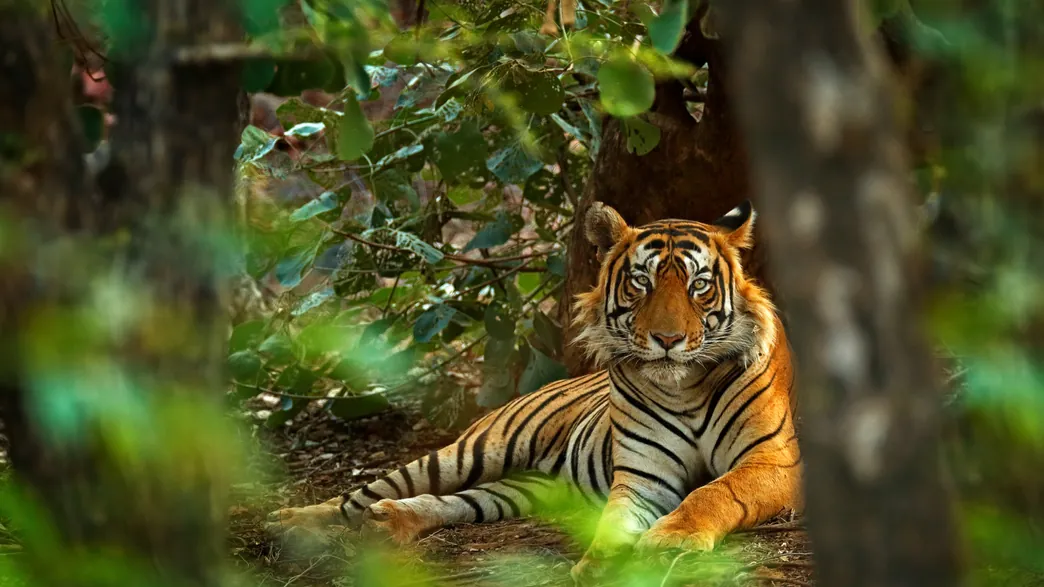
If you’ve ever seen a tiger up close — even in a photograph — one thought probably crossed your mind:
How does an animal this bright avoid being seen?
A tiger isn’t subtle.
It isn’t pale.
It isn’t dusty brown like many predators.
It’s orange — blazing orange.
Striped like fire inside a forest.
To the human eye, a tiger looks like the worst camouflage imaginable.
But to a deer, a buffalo, or a wild boar, something extraordinary happens:
A tiger becomes almost invisible.
Not because the forest hides it.
Not because the shadows protect it.
But because evolution designed an illusion so perfect that prey animals never see the danger until it’s too late.
And once you understand the science behind this camouflage, you’ll realize something incredible:
Tigers don’t look orange to the animals they hunt.
They look like shadows.
They look like grass.
They look like nothing at all.
Let’s step into the forest and uncover one of nature’s greatest tricks.
Table of Contents
- The First Clue: Animals Don’t See the World Like We Do
- The Illusion Deepens: How Stripes Turn a Tiger Into a Moving Shadow
- Why Tigers Aren’t Green — The Biology Behind the Color
- Why Tigers Look “Bright” Only to Humans — A False Visual Alarm
- The Forest Plays a Role — Tigers Are Designed for a World of Shadows
- Humans See Tigers Better Than Any Other Animal — and That’s the Real Threat
- A Species Hiding in Plain Sight — Why Saving Tigers Requires Seeing Them Differently
- The Secret Advantage: Tigers Don’t Just Blend In — They Don’t Need to Be Invisible at All
- Before You Go — A Thought That Changes Everything
The First Clue: Animals Don’t See the World Like We Do
Humans see a wide range of colors — red, green, blue, yellow, orange, violet.
Our vision is trichromatic:
we have three types of color-detecting cones that allow us to distinguish millions of hues.
But most of the tiger’s prey…
is dichromatic.
Deer, boar, antelope — animals tigers stalk in dense forests — can only see blues and greens.
They cannot distinguish orange from green.
In their world, orange simply disappears into the background.
What we see as a flaming coat, they see as a dull patch of forest.
Imagine walking through a park wearing a neon jacket…
but everyone around you is colorblind.
To them, the jacket blends into the trees.
To you, it looks ridiculous.
This difference in perception is the heart of the mystery.
But we’re only getting started.
The Illusion Deepens: How Stripes Turn a Tiger Into a Moving Shadow
Color is only one piece of camouflage.
The tiger’s black stripes play an even more powerful role.
Stripes break up its silhouette —
the most important element prey animals use to recognize danger.
A smooth shape = predator.
A broken shape = forest.
To a deer’s eyes:
- a tiger’s stripes mimic tall grasses
- the alternating color looks like filtered sunlight
- the jagged pattern dissolves at the edges
Combine orange-that-looks-green with shape-breaking stripes, and you get something unbelievable:
A 600-pound apex predator that moves like a ghost.
It’s not that tigers are fast —
it’s that prey animals rarely know they’re being hunted.
But why didn’t evolution simply make tigers green or brown if camouflage was the goal?
The answer reveals how nature balances beauty, survival, and biology all at once.
Why Tigers Aren’t Green — The Biology Behind the Color
Many people assume camouflage animals should mimic their environments.
Frogs are green.
Owls are brown.
Lizards match rocks.
So why not tigers?
Because mammal biology has a limitation:
Most mammals cannot produce green fur.
Mammalian pigmentation comes from:
- eumelanin (black/brown)
- pheomelanin (yellow/red/orange)
Green simply isn’t an option.
And even if evolution magically created green mammals, there would be a problem:
Green doesn’t hide well in many tiger habitats.
Why?
Because tigers hunt in:
- dry grasslands
- orange-toned forests
- bamboo fields
- sunset-lit undergrowth
And prey animals with dichromatic vision perceive these habitats in muted yellowish-green tones.
In other words:
Orange is the best possible camouflage color… if your prey cannot see orange.
Evolution didn’t fail.
It optimized.
And predators have been perfecting this optical illusion for millions of years.
But this leads us to another fascinating clue.
Why Tigers Look “Bright” Only to Humans — A False Visual Alarm
Let’s do a thought experiment.
Imagine looking at a tiger with:
- deer vision
- boar vision
- dichromatic mammalian vision
The tiger’s orange fur would appear:
- muddy
- brownish
- green-tinted
- forest-colored
The animal you thought was impossible to miss becomes a whisper of color.
This is why wildlife photographers often find tigers shockingly hard to spot in the wild — even when they know one is near.
It’s also why many tiger attacks catch prey (and sometimes humans) off guard.
But color and stripes are only half the story.
Something much more dramatic is happening in the tiger’s ecosystem — something that shows how deeply evolution has shaped every detail of this camouflage.
The Forest Plays a Role — Tigers Are Designed for a World of Shadows
A forest is never one color.
Light filters through leaves in broken patches.
Branches cast shifting patterns.
Grass bends in strips.
Shadows move like slow waves.
Now imagine a tiger slipping between trees.
Its stripes align with the shadows.
Its color aligns with the foliage.
Its movement aligns with the wind.
It doesn’t run.
It glides.
A tiger isn’t trying to hide —
the forest hides it automatically.
All the tiger must do… is stay low, move slowly, and wait.
But this leads to an even more astonishing revelation.
Humans See Tigers Better Than Any Other Animal — and That’s the Real Threat
Humans, with trichromatic vision, see red and orange vividly.
We evolved this way to:
- spot ripe fruits
- detect emotional signals
- identify danger
So the very color that hides tigers from their prey…
Makes them visible to us.
This creates an unexpected irony:
Tigers evolved to be invisible to deer — but highly visible to humans.
And humans have become the tiger’s greatest predator.
Deforestation, poaching, habitat expansion —
we see the tiger clearly, and too often, we destroy what we see.
This is why the camouflage that protects tigers in nature…
cannot protect them from us.
Unless something changes.
A Species Hiding in Plain Sight — Why Saving Tigers Requires Seeing Them Differently
Tigers are disappearing.
Only around 4,500 remain in the wild.
Their natural camouflage is still perfect —
but the world around them has changed.
Jungles have been replaced by farms.
Forests by development.
Hunting grounds by highways.
Camouflage protects them from prey.
It cannot protect them from bulldozers.
This is why conservation programs — funded by eco-travel, wildlife tourism, and global finance — matter more than ever.
Travelers who visit tiger reserves aren’t just seeking adventure.
They’re funding:
- anti-poaching patrols
- habitat restoration
- wildlife corridors
- research and tracking
- community education
- relocation projects
In many cases, a single eco-tourism season protects more tigers than international treaties.
Your plane ticket becomes a shield.
Your hotel stay becomes habitat protection.
Your safari becomes a fight for survival.
But let’s zoom out one more time — because there’s a final twist in this story.
The Secret Advantage: Tigers Don’t Just Blend In — They Don’t Need to Be Invisible at All
A tiger is not a cheetah.
It doesn’t sprint after prey.
It doesn’t chase across open grasslands.
A tiger hunts with:
- patience
- silence
- slow, calculated movement
Camouflage does most of the work —
but behavior finishes the job.
Tigers step:
- heel first
- toe second
- almost noiselessly
Their enormous bodies move like liquid shadows.
Even if prey could see orange clearly…
they still wouldn’t detect a tiger until the final moment.
Now ask yourself:
If you were an animal in the forest, would you notice a whisper moving in the grass — or ignore it until it was too late?
This is why tigers are such legendary predators.
Color is only one of their secrets.
But the science behind their camouflage gives us a deeper appreciation of nature’s brilliance.
Before You Go — A Thought That Changes Everything
The next time you see a tiger, whether in a photograph, a documentary, or in the wild, remember this:
You are not seeing the tiger as nature intended.
You are seeing the tiger through human eyes —
not through the eyes of the forest,
not through the eyes of its prey,
and not through the eyes of evolution.
To a deer, a tiger is a flicker.
To a boar, a tiger is a blur.
To the jungle, a tiger is a shadow.
And to us?
A reminder that the natural world still carries mysteries we almost overlooked —
hidden in plain sight, wrapped in orange and black.