
Table of Contents
- The Most Unexpected Family in the Wild
- The Myth of the Lone Wolf — and the Truth of the Pack
- When Leaders Fall, the Future of the Pack Hangs in the Balance
- Why Wolves Adopt Pups That Aren’t Their Own
- Reason 3: The New Leader Gains Status by Protecting the Pups
- A Real-Life Story: The Pack That Shocked Yellowstone Researchers
- If You Were a Wolf… What Would You Do?
- Wolf Leadership Is a Masterclass in Human Leadership
- The Science Behind Wolf Compassion
- When Packs Fail to Adopt Pups — the Consequences Are Immediate
- What Happens to Adopted Pups as They Grow?
- Why This Wolf Behavior Touches So Many People
- The Hidden Economics of Pack Survival
- A Final Reflection: What Wolves Teach Us About Family
The Most Unexpected Family in the Wild
When leadership changes in the wolf world, most people imagine chaos—growling, fighting, dominance battles, and packs splitting apart.
But what if the truth is far more surprising?
Because in the wild, where survival is ruthless and every decision determines life or death…
wolves sometimes do something humans don’t expect:
They adopt the pups of defeated leaders.
Not just tolerate them.
Not just co-exist with them.
They raise them as their own.
Science confirms it.
Wildlife researchers have witnessed it.
And the more you learn about wolf societies, the more extraordinary this behavior becomes.
But to understand why wolves do this, you must first understand how a pack really works.
The Myth of the Lone Wolf — and the Truth of the Pack
Most people imagine wolves as lone hunters.
But the lone wolf is not the rule — it’s the exception.
A wolf pack is a family:
- Parents (the breeding pair)
- Aunts and uncles
- Older siblings from previous years
- And pups of the current year
Hierarchy exists, of course.
Leadership matters.
But the pack’s foundation is something deeper and more powerful:
Cooperative survival.
Every belly depends on every set of paws.
Every howl depends on every loyal heart.
This is why what happens during leadership shifts becomes even more astonishing.
When Leaders Fall, the Future of the Pack Hangs in the Balance
A leadership change—often called a pack turnover—can happen for many reasons:
- A rival male challenges the alpha
- A new female joins the pack
- The previous leader grows old or weak
- Environmental stress forces competition
- Another pack intrudes and takes over territory
During these moments, everything the pack knows shifts.
And the pups?
They are the most vulnerable of all.
Yet this is where wolves show a side that feels almost human—
sometimes even more human than we are.
Because instead of viewing the pups of the prior leader as rivals…
the new leaders often adopt them.
This single decision changes not just the pups’ fate, but the entire future of the pack.
Why Wolves Adopt Pups That Aren’t Their Own

Scientists once assumed this behavior was rare.
But field studies from Yellowstone, Denali, and European wolf territories reveal something different:
Wolves regularly fold unrelated pups into the new structure of the pack.
And they do it for strategic reasons that benefit the entire group.
Reason 1: Pups Strengthen the Pack’s Long-Term Survival
Pups mean future hunters.
Future defenders.
Future parents.
If leadership kills them, the pack’s future disappears.
Wolves think long-term — a trait that echoes the strategic planning of CEOs, military leaders, and financial planners.
Bigger packs mean:
- Better hunting efficiency
- Better pup protection
- More stable territory control
- Stronger genetic legacy for the future
In other words—
Adopting pups is an investment.
A long-term, high-value one.
Reason 2: Wolves Are Hardwired for Social Bonding
Wolves don’t just hunt together — they raise families together.
Every member helps:
- Bringing food to the den
- Protecting pups from coyotes and bears
- Teaching pups hunting skills
- Grooming, cleaning, and comforting
This cooperative care doesn’t disappear when leadership changes.
Instead, it strengthens the pack’s cohesion.
And interestingly…
wolves value unity more than dominance.
A fractured pack is a doomed pack.
But a united pack?
Unstoppable.
That’s why wolf packs often choose nurturing over destruction.
Reason 3: The New Leader Gains Status by Protecting the Pups
In human terms, it’s like a new leader entering a company and immediately gaining respect by protecting the most vulnerable team members.
A wolf who raises pups gains:
- Trust from other pack members
- Stability within the group
- Strengthened social bonds
- Higher reproductive success later on
In nature, kindness is rarely random.
Kindness is strategy.
And wolves have mastered it.
A Real-Life Story: The Pack That Shocked Yellowstone Researchers
In Yellowstone National Park, researchers witnessed a remarkable event.
A rival male took over a small wolf pack.
The previous alpha male had disappeared.
Two pups—only 10 weeks old—were left behind.
The expectation?
The new male would kill them.
Instead?
He fed them.
He guarded them.
He even slept curled around them to keep them warm.
Months later, one of those pups became the pack’s future alpha.
Imagine that:
A pup who lost everything gained a future he never should’ve had.
And all because a wolf who owed him nothing… chose to save him.
If You Were a Wolf… What Would You Do?
Stop for a moment.
Imagine you’re the new leader of a pack.
The previous alpha is gone.
His pups are trembling, defenseless, alone.
You have two choices:
Eliminate future rivals
or
Raise them as your own
If this happened to you,
would you destroy the past
or protect the future?
The wolves’ choice reveals something powerful about leadership — not human leadership, but leadership in its rawest, purest form.
Because in nature, strength isn’t about domination.
It’s about responsibility.
Wolf Leadership Is a Masterclass in Human Leadership

This is where the story becomes bigger than wolves.
Companies. Families. Communities.
They all face leadership transitions.
And the lessons from wolf packs are surprisingly relevant:
1. Protect the vulnerable first
A great leader protects what others overlook.
2. Build a strong, unified team
A fractured team cannot survive pressure.
3. Invest in the future, even when it’s uncertain
Like pups, the smallest members often shape the greatest outcomes.
4. Create loyalty through action, not authority
True leadership isn’t declared.
It’s demonstrated.
Wolves teach us that evolution doesn’t reward aggression.
It rewards collaboration.
The Science Behind Wolf Compassion
Biologists used to avoid attributing emotions to wild animals.
But new research suggests wolf behavior is driven by:
- Cooperative instincts
- Oxytocin-based social bonding
- Long-term survival planning
- Complex emotional responses
Yes — wolves feel.
Fear, comfort, loyalty, stress, even grief.
MRI imaging and hormone studies confirm it: wolves experience emotional bonding similar to dogs and even humans.
Which explains why adopting pups isn’t just strategy.
It’s instinctive compassion wrapped in evolutionary intelligence.
When Packs Fail to Adopt Pups — the Consequences Are Immediate
Sometimes leadership changes happen too violently.
Sometimes new leaders are too stressed.
Sometimes environmental conditions are too harsh.
When pups aren’t adopted:
- The mortality rate skyrockets
- The pack loses future hunters
- Rival packs invade weakened territories
- The genetic line collapses
- Social structure crumbles
A single decision — one moment of mercy or brutality — determines whether a pack thrives… or disappears.
It’s a chilling reminder that even in nature, leadership decisions ripple for generations.
What Happens to Adopted Pups as They Grow?
Wolf biologists have tracked pups who were adopted after leadership changes.
The results are stunning:
- Many become strong hunters
- Some rise to leadership roles
- Others leave to form new packs
- All remain deeply bonded to their adoptive families
Adopted wolves rarely show aggression toward their adoptive parents.
Instead, they show gratitude behavior:
- More grooming
- More social bonding
- Higher cooperation during hunts
It’s as if they know they were given a second chance.
And they repay that chance with loyalty.
Why This Wolf Behavior Touches So Many People
This story goes viral every time it’s shared.
Why?
Because it challenges our assumptions about nature — and about ourselves.
It tells us:
- The wild is not meaningless violence
- Leadership can come from compassion
- Survival doesn’t always require cruelty
- Family is not always biological
- Strength and empathy can coexist
And maybe, just maybe…
It reminds us of what humans are capable of too.
The Hidden Economics of Pack Survival
Here’s where high-intent relevance kicks in:
Just like financial planning, home improvement, or health decisions, wolf pack decisions are built on:
- Risk assessment
- Long-term investment
- Resource management
- Strengthening structural stability
A wolf adopting pups is the wildlife equivalent of:
- Reinvesting in the next generation
- Expanding workforce capacity
- Strengthening future security
- Building a sustainable ecosystem
Survival is economics.
And wolves are master strategists.
A Final Reflection: What Wolves Teach Us About Family
In a world where survival dictates every choice…
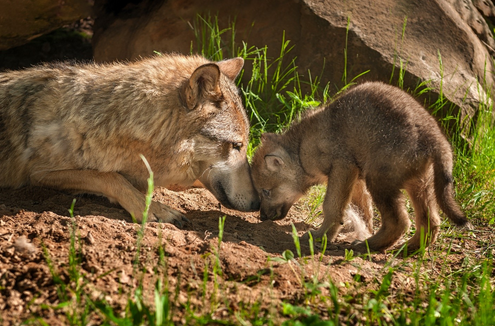
Wolves choose to raise the pups of rivals.
Not because they have to.
But because it keeps the family strong.
Because unity beats rivalry.
Because compassion strengthens survival.
Because the pack is only as strong as its future.
So the next time you hear a wolf howl…
Remember:
You’re not hearing the voice of a ruthless predator.
You’re hearing the heartbeat of a family—
one that grows, adapts, and even adopts.
A family that knows a truth we often forget:
Leadership isn’t about power.
It’s about protection.