
If you’ve ever walked through a city at night and caught the glimmer of two cautious eyes under a streetlamp, you already know: stray cats are everywhere, yet nowhere belongs to them.
They dart between parked cars, sleep behind dumpsters, and hide beneath benches — surviving on instinct, luck, and whatever kindness the city offers them.
But what if the city itself became kinder?
What if public spaces — the parks we stroll through, the plazas we gather in, the buildings we move past — were designed with all living beings in mind?
The idea sounds simple.
Revolutionary, even.
But as urban planners quietly begin redesigning modern cities, something extraordinary is happening:
Stray cats are becoming part of the urban plan — not a problem to remove, but a population to protect.
And once you see how this shift is transforming communities, you may never look at a city the same way again.
Table of Contents
- The Hidden Residents of Every City: Why Stray Cats Matter More Than We Realize
- The Turning Point: When Cities Realized They Were Built for Humans, Not Life
- The Idea That Changed Everything: Public Spaces Should Protect the Most Vulnerable
- Designing Cities With Cats in Mind: Small Features, Big Impact
- Why Compassionate Urban Design Heals Communities Too
- The Financial Benefits: Compassion Isn’t Just Kind — It’s Cost-Effective
- The Ethical Evolution of Cities: Designing Not Just for Humans, but for Life
- Stray Cats Aren’t Strays — They Are Part of Our Urban Story
- Before You Leave — Ask Yourself This
The Hidden Residents of Every City: Why Stray Cats Matter More Than We Realize
Stray cats have lived alongside humans for thousands of years.
They’ve survived wars, famines, pandemics, and urban sprawl.
They’ve adapted to cities faster than most wildlife species.
Yet despite their resilience, their lives are often short, dangerous, and unstable.
Stray cats face:
- extreme weather
- disease
- hunger
- traffic
- human conflict
- shrinking habitat
And here’s the part most people miss:
Stray cats are not “pests.” They are part of the ecosystem.
They control rodent populations.
They stabilize micro-habitats.
They offer emotional comfort to many locals.
They quietly shape urban biodiversity.
So when cities redesign public spaces with stray cats in mind, they’re not just helping animals.
They’re strengthening communities, ecosystems, and even local economies.
But how did this movement begin — and why now?
The Turning Point: When Cities Realized They Were Built for Humans, Not Life
Modern cities are marvels of engineering.
Skyscrapers. Highways. Tech hubs.
Finance districts. Tourist zones.
Smart homes. Smart parks. Smart everything.
But for decades, one thing was missing:
Compassion.
Cities optimized for efficiency.
Not empathy.
Not coexistence.
Yet as urban designers began studying environmental psychology, community well-being, and ecological resilience, a powerful truth emerged:
Healthy cities treat the animals that live in them with dignity.
This was the spark.
And the movement that followed — known as compassionate urban design — is reshaping everything we know about city planning.
At the center of this redesign?
Stray cats.
Because where cities fail their animals, they fail their people too.
The Idea That Changed Everything: Public Spaces Should Protect the Most Vulnerable
Urban planners began asking bold questions:
- What if sidewalks had shaded micro-shelters for cats during heatwaves?
- What if parks included feeding stations monitored by volunteers?
- What if city benches doubled as safe hideaways for small animals?
- What if building edges were designed with warm zones for strays in winter?
- What if humans and animals could share public space without conflict?
This wasn’t about prioritizing cats over people.
It was about designing cities that function like ecosystems — interconnected, harmonious, and resilient.
And now, global cities from Istanbul to Seoul to São Paulo are experimenting with these ideas.
But the real magic lies in how small design choices create massive change.
Designing Cities With Cats in Mind: Small Features, Big Impact
Here’s where compassionate design gets practical — and fascinating.
1. Micro-Shelters Built Into Existing Structures
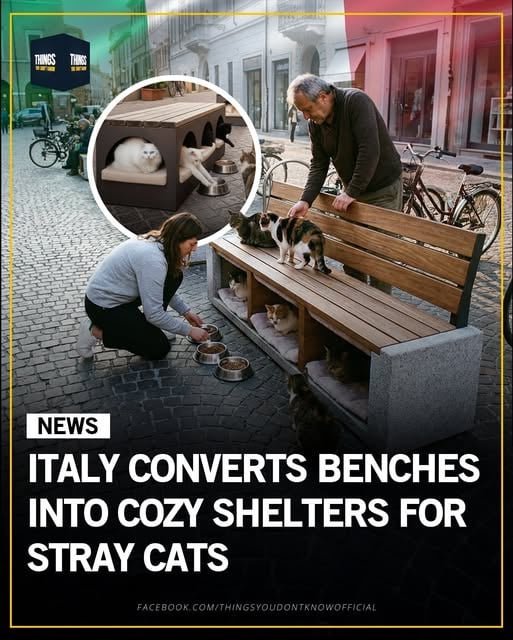
Imagine a park bench with a small, hidden compartment that stays dry during storms.
To you, it’s just a bench.
To a stray cat, it’s survival.
These shelters:
- cost almost nothing to install
- blend into urban aesthetics
- reduce cat mortality
- reduce noise complaints
- prevent cats from sleeping in dangerous areas
It’s home improvement on a city scale — but with empathy.
2. Temperature-Controlled Rest Zones
Some cities use excess heat from underground pipes or solar panels to warm discreet cat shelters at night.
A simple redirection of energy becomes the difference between life and death in winter.
3. Community Feeding Stations
Not random bowls on sidewalks, but designed structures with:
- weather protection
- controlled access
- community maintenance
- water filtration
- scheduled feeding times
These stations reduce waste, discourage pests, and keep cats healthier.
And healthier cats mean fewer problems.
4. Cat Walkways Integrated Into Architecture
Bridges, ledges, and elevated paths help cats move without crossing traffic — reducing road accidents significantly.
5. Green Zones for Wildlife Coexistence
Parks with tall grasses, bush pockets, and natural shade allow cats to hide safely without disturbing public use.
These are win-win designs:
- better for cats
- better for people
- better for biodiversity
But the most surprising transformation isn’t environmental — it’s emotional.
Why Compassionate Urban Design Heals Communities Too
When cities care for animals, something unexpected happens:
Residents feel more connected to each other.
A feeding station becomes a gathering point.
A micro-shelter becomes a neighborhood project.
A stray cat becomes everyone’s shared responsibility.
Suddenly, strangers talk.
Neighbors cooperate.
Children learn empathy.
Volunteers emerge.
Communities strengthen.
In a world where loneliness and disconnection run high, a cat can become the bridge.
A small life bringing big humanity back into public spaces.
But there’s another layer — one cities never expected.
The Financial Benefits: Compassion Isn’t Just Kind — It’s Cost-Effective
At first glance, protecting stray cats seems like charity.
In reality, it’s smart urban economics.
Cities that redesign public spaces for animal welfare see improvements in:
- tourism
- real estate appeal
- public health
- sanitation costs
- rodent control
- environmental resilience
- community engagement
Why?
Because clean, humane cities attract travelers.
People choose compassionate neighborhoods.
Parks with integrated wildlife features increase property value.
Even financial analysts now recognize urban compassion as a high-ROI city planning strategy.
And governments are taking notice.
But the most powerful lesson still lies ahead.
The Ethical Evolution of Cities: Designing Not Just for Humans, but for Life
Urban designers predict that future cities will be measured not by:
- how tall their buildings are,
- how advanced their technology is,
- or how efficient their transportation becomes,
but by something more meaningful:
**How well they protect the vulnerable.
Human or not.**
A compassionate city is sustainable.
A compassionate city is inclusive.
A compassionate city is genuinely modern.
Redesigning public spaces for stray cats isn’t just an architectural decision.
It’s a philosophical one.
It’s a declaration:
“This city is alive, and every life here matters.”
But before we end, there’s one more angle worth exploring — one that changes the way we see these animals completely.
Stray Cats Aren’t Strays — They Are Part of Our Urban Story
Cities often forget this:
Stray cats didn’t choose to be strays.
Humans built cities.
Humans changed ecosystems.
Humans created the environments cats now struggle to survive in.
So when cities redesign public spaces with compassion, they’re not “helping strays.”
They’re restoring balance.
They’re acknowledging responsibility.
They’re rewriting the relationship between people and the environment.
And that is why this movement is not a trend — it’s the future.
Before You Leave — Ask Yourself This
Next time you see a cat resting under a bench, crossing a sidewalk, or peeking from behind a flowerpot, ask yourself:
If this city were designed with this cat in mind, what would it look like?
Would it be safer?
Kinder?
Cleaner?
More human?
More alive?
Because in the end, the question isn’t:
“How do we design cities for animals?”
It’s:
“How do we design cities that remember we share the world with them?”
And maybe — just maybe — the first step toward a better future begins with a small shelter, a shaded corner, or a quiet place for a stray cat to rest.