

Table of Contents
- When a Casual Update Sparked a Major Privacy Conversation
- From Casual Chat to Privacy Panic
- What Exactly Is Vanish Mode in Messenger
- Why Screenshots of Disappearing Messages Matter
- A New Normal in Digital Etiquette
- Zuckerberg’s Demonstration With Priscilla Chan
- The Broader Context of Messenger’s Privacy Features
- How Users Reacted to the Screenshot Warning
- What This Means for Digital Privacy and Social Messaging
- Looking Ahead What Might Change Next
- Conclusion A Turning Point in How We Think About Digital Messages
When a Casual Update Sparked a Major Privacy Conversation
When news emerged that Meta CEO Mark Zuckerberg had taken to his own Facebook profile to warn users about new Messenger behaviors the tech world and millions of everyday users took notice. What may have seemed like a simple feature update soon ignited a larger conversation about digital privacy etiquette and how we all interact in the age of disappearing messages and instant communication. In a short post, Zuckerberg revealed that Facebook Messenger will now notify users when someone takes a screenshot of a chat that was sent under vanish mode, a privacy‑focused setting where messages are supposed to disappear after a short period.
This change, while technical, has profound implications for how people use Messenger to communicate — especially when discussing sensitive topics or private conversations they assumed would vanish without a trace. The reaction across social platforms was swift and emotional. Many users posted screenshots of the post itself while others lamented that a feature meant to protect privacy might actually make users more anxious about how their messages are shared and stored. What follows is an in‑depth exploration of what this update really means, how it works, why it matters for internet users everywhere, and what the future of digital privacy may look like in a world shaped by constant messaging updates.
From Casual Chat to Privacy Panic
At first glance, the update Zuckerberg announced might seem like a small technical tweak. Meta has rolled out countless updates across Facebook Messenger in recent years, including end‑to‑end encryption, new emoji reactions, updated GIF keyboards, and enhancements to group chat features. But this particular change hit a nerve because it directly touches on something deeply personal: trust between communicators.
In Zuckerberg’s update, he stated clearly that if someone takes a screenshot of a disappearing message — Messenger’s version of a temporary chat — the sender will be notified. Unlike regular chats where messages persist until manually deleted, disappear mode is intentionally temporary. Users activate it when they want messages, pictures, or voice notes to disappear after being viewed or after a short set time.
Until now, many users assumed that anything sent in vanish mode could be screenshotted without the sender ever knowing. This update changed that assumption overnight.
What Exactly Is Vanish Mode in Messenger
To understand why this matters, it’s important to know how vanish mode is designed to work. Messenger’s disappearing message functionality is meant to mirror features introduced years earlier by apps like Snapchat. In vanish mode, messages are only visible while both users are active in the chat window and disappear automatically once the chat screen is closed or after a set time period.
The goal of vanish mode is to give users more control over their digital footprint — especially when sending sensitive information or casual messages they do not want stored indefinitely. It builds on the idea that some conversations simply should not leave a lasting digital trace.
Prior to this update, users could take screenshots of these ephemeral chats without alerting the sender. In practice that meant a message could disappear from the chat history but still be saved by the recipient without the sender ever knowing.
Zuckerberg’s announcement changed that dynamic, prompting global debate.
Why Screenshots of Disappearing Messages Matter
On the surface, notifying someone when their private message has been screenshotted may seem like a reasonable privacy feature. But in practice it raises new questions about communication norms, consent, and online trust.
For many users, vanish mode was a way to send quick, ephemeral content with the same sense of freedom as a live conversation. If someone could now be alerted when a screenshot was taken, the psychology of how people use that feature changes dramatically. Users may now hesitate to send sensitive content for fear of how it could be captured or shared outside the conversation.
Privacy advocates have pointed out that while the feature may protect senders’ awareness of screenshots, it also assumes a level of digital etiquette that cannot always be enforced. In other words, even if the sender knows a screenshot was taken, it does not prevent that screenshot from being stored, shared, or misused outside the app.
What Zuckerberg’s update does is push users to think more carefully about what they send and how they expect it to be treated.
A New Normal in Digital Etiquette
With this Messenger update, we may be witnessing a subtle but important shift in digital etiquette. In a world where friends, colleagues, and even strangers are connected across platforms, the line between private and public communication has already blurred. This feature signals that social platforms are beginning to draw firmer lines around what should remain private and what cannot be kept invisible.
For example, in the world of Snapchat, where notification of screenshots has been long established, users have already adapted their behavior. What once was casual image sharing became more careful and intentional. Zuckerberg’s announcement signals an effort to bring a similar culture to Facebook Messenger, a platform with billions of users worldwide.
But unlike Snapchat, Messenger is often used for text, documents, work communication, and group chats with family or colleagues. The broader context of use means that the implications of this screenshot warning reach far beyond teenage social messaging.
Zuckerberg’s Demonstration With Priscilla Chan
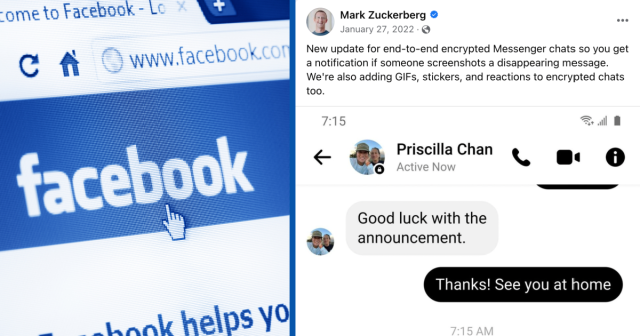
To bring his point to life Zuckerberg didn’t just post a text update. He shared an example exchange between himself and his long‑time partner Priscilla Chan. In the playful demonstration, Zuckerberg teased a supercomputer project while Chan took a screenshot in vanish mode, prompting the app to generate a notification showing that a screenshot had been taken.
The intent was to show real‑world functionality. But what users saw was a reminder that even casual conversations between friends could have digital footprints that are harder to erase than they assumed.
The demonstration was light‑hearted in tone, yet beneath it lies a heavier truth about how technology shapes modern communication habits.
The Broader Context of Messenger’s Privacy Features
Messenger’s disappearing message screenshot warning is not the first privacy update the platform has rolled out in recent years. Meta has steadily expanded end‑to‑end encryption across its messaging apps, signaling a commitment to stronger user privacy.
End‑to‑end encryption means that only the sender and recipient can read the contents of a message. Not even the platform itself can access the message text. Combining end‑to‑end encryption with screenshot alerts appears to be part of a broader strategy to give users more control over their conversations.
But digital privacy is never simple. Even encrypted messages can be screenshotted, recorded with an external camera, or stored with third‑party tools. The existence of a notification does not prevent misuse. It only alerts senders to what has already occurred.
With this update, Zuckerberg appears to be acknowledging that privacy features must extend beyond encryption and into user behavior — giving senders not only the ability to protect their messages but also the tools to know when a boundary has been crossed.
How Users Reacted to the Screenshot Warning
The response to Zuckerberg’s announcement was strikingly diverse. Some users applauded the move as a positive step toward transparency and accountability in digital communication. They argued that senders deserve to know when screenshots are taken of texts they expected to vanish.
Others expressed frustration, saying the feature may create anxiety or dissuade users from communicating freely. Critics pointed out that if a recipient is determined to capture and share a message then notification changes nothing — it simply highlights the event without preventing it.
Privacy advocates weighed in alongside everyday Messenger users. Some said that such features should be accompanied by stronger safeguards against misuse, while others called for expanded education about digital consent and responsible screenshot behavior.
Regardless of stance, the update began trending on social platforms in hours, with users debating the implications far beyond the Messenger app itself.
What This Means for Digital Privacy and Social Messaging

Looking beyond Messenger, this update signals a broader shift in how tech companies are thinking about privacy. The last decade has seen privacy conversations evolve from simple message deletion options to complex negotiations about consent data retention algorithmic tracking and digital wellbeing.
Zuckerberg’s announcement, for all its simplicity, plays into this evolving landscape. It nudges users to think actively about the consequences of how they interact online. Screenshots, once a mundane part of smartphone life, have become a symbol of how digital content can outlive its intended context.
In a world where screenshots can crop up in courtrooms, news feeds, and legal disputes many times long after a conversation is over, the idea that senders can be warned is a small but meaningful shift in user awareness.
Looking Ahead What Might Change Next
Messenger’s screenshot warning may be only the beginning. As social platforms compete for users and trust, more features are likely to emerge that balance privacy with transparency. We may see expanded controls over screenshot permissions, timers that more aggressively enforce disappearance, or even image recognition safeguards that detect attempts to capture content through alternate means.
Tech companies know that privacy is not just a feature to be toggled on or off — it is part of the emotional contract between users and platforms. And when a contract is broken, trust erodes. Zuckerberg’s update is a reminder that trust — digital trust — has become an essential commodity in social technology.
Users, developers, and digital citizens alike will continue to grapple with what it means to communicate privately in a world where screens can capture anything at any time.
Conclusion A Turning Point in How We Think About Digital Messages
Mark Zuckerberg’s warning about Messenger screenshots was more than a small technical announcement. It touched a universal truth about how we communicate in the digital age: nothing is as temporary as we once assumed. The notification feature may not stop screenshots altogether but it introduces a new kind of awareness that could change user behavior and expectations.
In an era where communication technologies evolve rapidly, this update serves as a reminder that privacy features must keep pace with how we live our lives online. As disappearing messages gain popularity, so too will conversations about what should stay private, what should be captured, and who gets to decide the difference.
Ultimately this update forces a broader reflection about trust, consent, and accountability online. And in the world of social apps where billions of people interact every day, that reflection might be more important than any feature update itself.