
Table of Contents
- A Moment No One Expected
- The Unusual Friendship Between Two Very Different Creatures
- What Happened Before the Camera Clicked
- The Shot That Went Viral
- Understanding the Science Behind the Sweetness
- A Reminder of What We’re Losing
- A Photographer’s Reflection
- The World Responds with Hope
- What This Means for Conservation
- Thinking About a Safari? Here’s What to Know
- A Final Question for You
A Moment No One Expected
If you were walking through the African savannah and saw a bird cuddling a rhino, would you believe your eyes—or think the heat was getting to you?
That was exactly the feeling photographer Daniel K., an experienced wildlife traveler, had when he spotted something extraordinary:
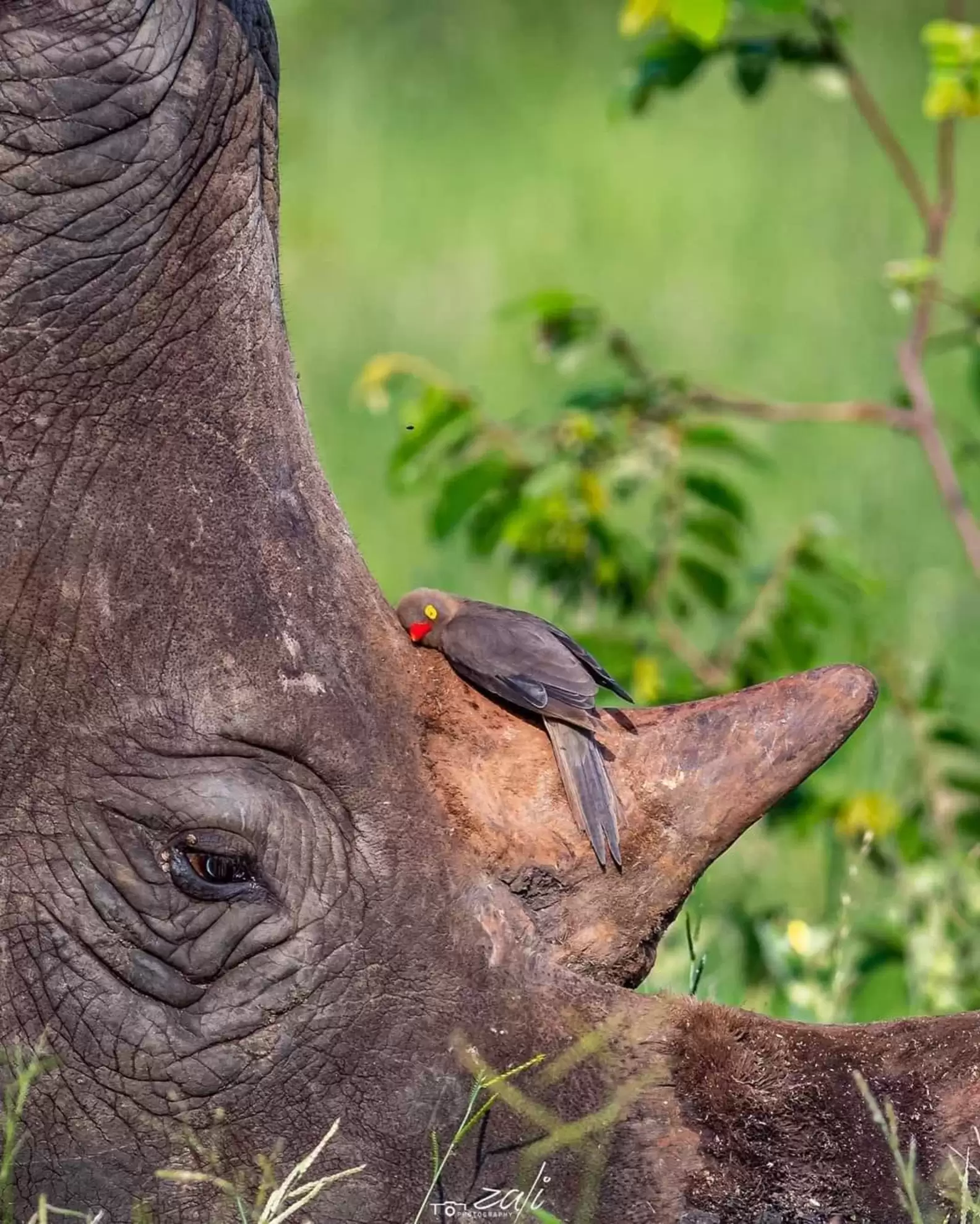
An oxpecker perched on the face of a massive rhino… gently cuddling him.
For a few seconds, everything else disappeared—the rustling grass, the distant thunder, even the sound of Daniel’s own breath.
This wasn’t just a bird doing its job.
It looked like… affection.
Soft, unexpected, cross-species affection.
And once Daniel lifted his camera, the moment that followed would eventually make the world stop scrolling.
The Unusual Friendship Between Two Very Different Creatures

Oxpeckers and rhinos have lived side-by-side for centuries.
Technically, the relationship is “mutualistic”—a fancy biology term meaning both get something out of it.
The oxpecker eats ticks, parasites, and dead skin from the rhino’s thick hide.
The rhino gets cleaned.
Simple. Practical.
But what Daniel captured wasn’t just biology.
It was something different—something emotional.
The oxpecker wasn’t pecking.
It wasn’t feeding.
It wasn’t cleaning.
It was leaning in.
Feathers puffed.
Eyes half-closed.
Almost as if it were… hugging.
And the rhino?
This massive, armored tank of a creature—gentle as a mountain—stood perfectly still, eyes soft, as if savoring the company.
Daniel whispered to himself:
“This is not something you see every day.”
And he was right.
Most people will go their entire lives without ever witnessing anything like this in the wild.
What Happened Before the Camera Clicked

Daniel had been on a conservation photography assignment, documenting endangered species to support ecological tourism—a rapidly growing sector valued at over $200 billion worldwide.
On that particular morning:
- The light was golden.
- The air smelled of fresh rain.
- Animals were slowly beginning to move.
Daniel spotted the rhinos first—two adults grazing peacefully near a watering hole.
But as he moved closer, he saw a small flutter of brown and red.
The oxpecker landed directly on the rhino’s snout.
“I expected the usual cleaning behavior,” Daniel later explained.
“But then the bird did something strange—it tucked itself into the curve of the rhino’s face. I froze.”
At first, Daniel thought the rhino would shake the bird off.
Instead, the giant creature leaned gently into the bird’s tiny body.
A gesture so tender it almost didn’t seem real.
The photographer instinctively reached for his camera.
And then?
Nature delivered something magical.
The Shot That Went Viral

When Daniel finally shared the photos online, viewers reacted instantly.
The images didn’t show aggression, danger, or the intensity people usually associate with African wildlife.
They showed warmth.
Connection.
Stillness.
In a world where most people only see rhinos through heartbreaking headlines—poaching, habitat loss, declining populations—the pictures felt like a breath of hope.
Thousands commented:
- “This melted my heart.”
- “I didn’t know rhinos could look so gentle.”
- “This shows how deeply connected animals really are.”
Some even said the photos made them reconsider booking a safari trip—not for thrill, but for appreciation.
Understanding the Science Behind the Sweetness
A cuddle between bird and rhino seems cute, but there’s interesting science behind it.
Oxpeckers Are More Than Freeloaders
Researchers believe oxpeckers form strong bonds with specific rhinos.
Not just any rhino—their rhino.
They recognize individuals.
They return to the same partners.
They even warn rhinos of danger by hissing loudly when humans approach.
Some conservationists call oxpeckers:
“The rhino’s personal alarm system.”
So, was it affection?
Comfort?
A moment of trust built over years?
Maybe all of the above.
A Reminder of What We’re Losing
Today, fewer than 27,000 rhinos remain worldwide, and some species are nearly gone forever.
Poaching.
Land loss.
Illegal trade.
Every year, we get closer to a world where stories like this can never happen again—not because we lack photographers, but because we lack rhinos.
This is why wildlife tourism, conservation funding, and protected preserves matter more than ever.
When people travel responsibly, money flows into:
- Habitat restoration
- Anti-poaching patrols
- Community-based conservation jobs
- Veterinary care
- Ranger training
In fact, studies show that every tourist who visits an African wildlife reserve generates enough money to protect 3–4 animals from poaching.
Every traveler makes a difference.
A Photographer’s Reflection
When asked why this moment struck him so deeply, Daniel said:
“It reminded me that nature is not just about survival. It’s about connection.”
He recalled watching the oxpecker rest against the rhino’s cheek for nearly two minutes—an eternity in the wild.
“At that moment,” he said, “no one was thinking about danger, food, or survival. It felt like two beings simply enjoying each other’s presence.”
For a man who has photographed lions, elephants, and cheetahs in action, this small quiet moment became one of his most meaningful captures.
The World Responds with Hope
After the images were published, conservation groups reached out to Daniel asking to use the photos in campaigns promoting:
- Rhino conservation
- Biodiversity education
- Ethical safari travel
- Wildlife fundraiser events
Teachers used the images in environmental science classes.
Travel companies featured them in blogs promoting eco-friendly safaris.
Parents showed them to kids as proof that animals feel connection too.
This is how one moment—one click—can become a global message.
A message that says:
“There is still magic in the wild.”
What This Means for Conservation
Stories like this remind people that wildlife is not just something to observe—it’s something to protect.
When a rhino and a bird share a moment of gentle trust, it shakes us in a way statistics never can.
Numbers don’t cuddle.
Graphs don’t blink slowly or close their eyes with contentment.
But real animals do.
That’s why emotional storytelling is one of the most powerful drivers of conservation funding.
It makes people care.
It makes people share.
It makes people act.
Thinking About a Safari? Here’s What to Know
Because articles like these often inspire people to travel, here are essential tips for responsible wildlife travel:
1. Choose parks that support conservation.
Places like Kruger, Serengeti, and Maasai Mara reinvest tourism money into wildlife protection.
2. Make sure your safari is ethical.
No touching, no baiting, no forced interactions.
3. Get travel insurance that covers wildlife regions.
Unexpected weather, terrain challenges, or emergency evacuations are more common in remote parks.
4. Hire guides from local communities.
Local knowledge protects animals, visitors, and ecosystems.
5. Don’t chase the “perfect shot.”
Good photographers wait for the moment.
They don’t force it.
Even Daniel said:
“If I had stepped two inches closer, that moment might have never happened.”
A Final Question for You
If you saw a moment like this—a tiny bird cuddling a giant rhino—would you reach for your camera, or would you just watch?
Would you try to capture the moment, or protect it?
There’s no wrong answer.
There’s only one truth:
Moments like these are rare.
Precious.
Fragile.
And they remind us of something important—
That even in the wild, friendship exists where you least expect it.