

Table of Contents
- The Sleeping Habit That Surprises Millions of Travelers
- A Traveler’s First Night on a Futon
- The Science Behind Why Soft Beds Can Hurt You
- Japanese Homes Are Designed Around Movement, Not Furniture
- Sleeping Close to the Floor Improves Circulation and Alignment
- The Cultural Wisdom Behind the Japanese Futon Tradition
- The Psychological Barrier: Soft Beds Feel Luxurious, So We Assume They’re Better
- What People Experience When They Switch to a Japanese Futon
- The Hidden Benefit: A Simpler, More Intentional Lifestyle
- Not All Thin Futons Are Created Equal
- Should You Switch to a Japanese Futon?
- A Final Thought
The Sleeping Habit That Surprises Millions of Travelers
If you’ve ever visited Japan, you probably had the same reaction many travelers do the first time they walk into a traditional Japanese inn.
A thin futon.
On the floor.
No frame.
No bulky mattress.
And then the biggest surprise of all:
It’s incredibly comfortable.
Even more surprising?
Millions of Japanese people who sleep on these thin futons report less back pain, better posture, and deeper sleep than people with thick, plush Western mattresses that promise “cloud-like softness.”
Why does this simple sleeping setup work so well?
The answer reveals something bigger than just sleep—it reveals a lifestyle philosophy built on alignment, simplicity, and the science of supporting the human spine.
Let’s start with the moment this tradition began to fascinate the world.
A Traveler’s First Night on a Futon

Imagine you’ve been walking around Kyoto all day. Your legs ache. Your back feels tight from carrying your backpack. You finally reach your ryokan (traditional Japanese inn). Inside your room sits:
- Soft tatami mats
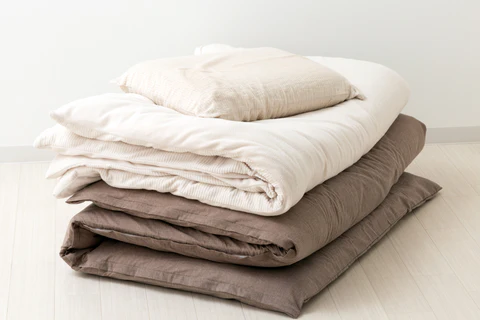
- A folded futon stored neatly in a closet
- A perfectly minimal space
When the host prepares your bedding, you notice how thin it is—just a few inches.
You wonder:
“How am I supposed to sleep on this?”
But then morning comes.
And you wake up shocked.
Your back feels better than it has in months.
You’re not stiff.
You didn’t toss and turn.
You got up easily without sinking into anything.
And you think, like so many visitors do:
“Why don’t we sleep like this at home?”
The answer lies in how your body interacts with firmness, alignment, and gravity.
The Science Behind Why Soft Beds Can Hurt You
Let’s consider something most mattress companies don’t want you to think about:
Your spine loves neutrality.
Soft mattresses feel great for the first 10 minutes, but when you sink too deeply:
- Your hips drop
- Your spine curves
- Your lower back strains
- Your muscles stay engaged all night
And what happens when your muscles work overnight?
You wake up with stiffness.
You wake up with pain.
You wake up tired.
This is where the Japanese futon flips the script.
Instead of molding around you, it gently supports you.
Your spine stays aligned.
Your weight distributes naturally.
Your body shifts less.
Medical experts actually recommend firmer surfaces for people with chronic back pain—something Japan figured out centuries before sleep science caught up.
But futons offer even more than science. They offer a cultural advantage.
Japanese Homes Are Designed Around Movement, Not Furniture
In Japan, space is precious. Homes are smaller than in many Western countries. But instead of feeling cramped, they feel intentional.
Why?
Because rooms transform.
A bedroom becomes a living room.
A living room becomes a dining area.
A dining area becomes space for guests.
And the key to this flexibility is the futon.
A Western bed takes up permanent space—often three, four, even five feet of height when you include the mattress, box spring, and frame.
But a Japanese futon?
- Folds up in seconds
- Fits in a closet
- Clears the entire floor for daytime use
This design isn’t just functional.
It supports the philosophy of ma — the Japanese concept of meaningful empty space.
And believe it or not, this space contributes to better sleep, too.
How?
Because a less cluttered environment promotes mental calmness and reduces sleep anxiety—something psychologists frequently link to improved rest.
But the benefits don’t stop there.
Sleeping Close to the Floor Improves Circulation and Alignment
When you sleep on the floor—or close to it, as with a futon—something interesting happens physiologically.
- Your core stabilizes.
Getting on and off the floor uses muscles modern furniture has made us forget. - Your posture aligns.
A firm futon prevents your pelvis from tilting forward or backward. - Your circulation improves.
Firmer surfaces discourage numbness and pressure points. - Your breathing deepens.
A straight spine makes more space for your diaphragm.
These small changes add up.
Many people who switch to a Japanese futon report:
- Less lower-back pain
- Fewer morning aches
- Deeper sleep cycles
- Better mobility
- Improved hip flexibility
And here’s the unexpected twist:
Even people who’ve struggled with back problems for years often report improvements within weeks.
But if thin futons were just about practicality or posture, the story would end here.
What makes the Japanese sleep system extraordinary is how it blends culture, health, and design into a single experience.
Let’s explore why the futon tradition survived—and thrived—into the modern era.
The Cultural Wisdom Behind the Japanese Futon Tradition
Japanese culture has long valued harmony between the body and environment.
Meals are intentional.
Bathing is ritualistic.
Living spaces are simplified.
And sleep is treated with respect.
The futon fits perfectly into this worldview.
1. Minimalism Before Minimalism Was Trendy
While Western culture sometimes equates comfort with abundance, Japan equates comfort with clarity.
A room with only what you need is a room your mind can rest in.
2. Natural Materials Matter
Traditional futons are made with:
- Cotton
- Wool
- Natural fibers
These materials breathe, regulate heat, and wick moisture—a huge advantage in Japan’s humid summers.
3. Cleaning Is Easy
In Japan, people air out futons in the sun to kill bacteria and restore fluffiness. You’ll often see futons hanging from apartment balconies on bright days.
This reduces:
- Dust mites
- Moisture buildup
- Allergens
Better hygiene = better sleep health.
4. The Futon Encourages Daily Reflection
When you set up and put away your bedding every day, you’re reminded that rest is a ritual, not just a habit.
But if this tradition is so effective, why don’t more people outside Japan adopt it?
That answer has everything to do with comfort zones—literally.
The Psychological Barrier: Soft Beds Feel Luxurious, So We Assume They’re Better

In many cultures, “comfort” means:
✔ A giant king-sized mattress
✔ Layers of pillow-top cushioning
✔ A bed that swallows your body
But luxury doesn’t always equal health.
A thick mattress can mask problems:
- Poor posture
- Weak core muscles
- Misalignment
- Back strain
We assume softness equals quality because that’s what marketing teaches us.
But the Japanese futon challenges that assumption.
It asks us to rethink comfort.
To rethink posture.
To rethink what our bodies actually need—not what advertisements tell us.
So here’s the real question:
If sleeping on a thinner, firmer surface could eliminate back pain, reduce inflammation, and help you wake feeling young again… would you try it?
Let’s look at what happens when people make the switch.
What People Experience When They Switch to a Japanese Futon
Thousands of people around the world have transitioned from Western mattresses to Japanese futons. Their feedback is surprisingly consistent:
✔ Week 1–2
Some initial soreness as muscles adjust.
The body begins realigning.
✔ Week 3–4
Reduced lower-back stiffness.
Fewer waking periods at night.
✔ Month 2
Improved spinal curvature.
Deeper, more restorative sleep.
✔ Month 3
Back pain significantly reduced or completely gone.
Better hip and shoulder mobility.
Those who stick with the futon often say the same thing:
“I’ll never go back.”
And yet the biggest benefit has nothing to do with the body.
The Hidden Benefit: A Simpler, More Intentional Lifestyle
Switching to a Japanese futon often inspires deeper life changes:
- Decluttering the bedroom
- Downsizing furniture
- Cleaning more often
- Creating more open space
- Feeling lighter mentally
Many say their room looks like a serene Japanese guesthouse—minimal, cozy, peaceful.
You sleep where the floor is clear.
You wake where light enters.
You step into a space that feels open, not crowded.
It’s not just better sleep—it’s a better life.
But before you buy a futon, there’s one important detail you need to know.
Not All Thin Futons Are Created Equal
If you want the true Japanese experience, consider the following:
1. A proper shikibuton
This is the mattress layer—firm but supportive.
2. A tatami mat or mattress topper
This adds breathability and air circulation.
3. Natural materials
Cotton and wool regulate temperature far better than synthetic foam.
4. Regular sun exposure
Air out your futon once or twice a month.
Getting these details right ensures your futon lasts for years and feels just as good as the ones in Japan.
Should You Switch to a Japanese Futon?
Ask yourself:
- Do you wake up with back pain?
- Do you sink deeply into your mattress?
- Do you toss and turn at night?
- Do you want a simpler bedroom?
- Do you want better posture?
- Do you want deeper, more restorative sleep?
If you answered yes to any of these, the Japanese futon might be worth exploring.
After all, millions of people in Japan sleep this way—not because it’s trendy, but because it works.
A Final Thought
Imagine waking up tomorrow without back pain.
Imagine feeling grounded—literally and emotionally.
Imagine sleeping in a room designed for peace, not clutter.
The Japanese futon is more than a mattress.
It’s a philosophy.
A lifestyle.
A return to alignment—with your body and your space.
And maybe… it’s the sleep upgrade you’ve been searching for.