

When news broke that an Ohio father had booked six separate flights just to be near his daughter on Christmas, the internet didn’t react with a single emotion. People rarely do. Some called it the sweetest modern-day dad move imaginable—an act so extra it wrapped itself in sincerity. Others stared at the headline like it was a riddle from the algorithm: six flights, for Christmas, just to “hang out” with your kid… in the sky? And yet the reason landed with almost everyone, even the skeptics: his daughter was a flight attendant scheduled to work Christmas Eve and Christmas Day, and he didn’t want her spending the holiday alone between boarding calls and rushed crew meals.
The story didn’t come from a press conference or a carefully edited brand campaign. It came from chance—one passenger sitting next to the father on a flight, realizing the man wasn’t traveling for business or a getaway, but for something oddly specific and quietly emotional. That passenger, Mike Levy, later posted about the encounter and shared photos, and the post caught fire. In a culture trained to scroll past most “heartwarming” content, this one stuck—maybe because it felt old-fashioned in the best way, like a handwritten letter showing up in a world of auto-replies.
Table of Contents
- The moment a stranger realized this wasn’t a normal Christmas trip
- Who Pierce Vaughan is—and why this Christmas mattered more than most
- The six-flight marathon—and the “Christmas miracle” detail people couldn’t stop repeating
- Why the internet instantly turned it into a debate instead of just a “aww”
- The overlooked supporting cast: gate agents, crew members, and the invisible teamwork behind the “cute” story
- What this story really reveals about modern loneliness—and why it hit so hard
- The “is this too much?” question—and why it’s the wrong way to frame it
- Conclusion: a Christmas story that keeps circling back for a reason
The moment a stranger realized this wasn’t a normal Christmas trip
Levy met the father, Hal Vaughan, on a Christmas Eve flight—Fort Myers to Detroit, according to the reporting—and what started as small talk turned into a full-blown plot twist. Hal explained that his daughter, Pierce Vaughan, was working as a Delta flight attendant through the holidays. Instead of accepting that reality like most families do—sending a quick “miss you” text and promising a makeup dinner later—Hal decided he would physically stay close to her. Not “meet her after work.” Not “catch one flight.” He bought tickets to fly the same route segments she worked, effectively turning her work schedule into his holiday itinerary.
This wasn’t a luxury vacation disguised as parenting. It sounded exhausting: multiple airports, tight connections, gate changes, the constant anxiety of whether a seat would be available, whether weather would disrupt everything, whether a delay would domino into missing the next flight she’d be on. And that’s part of why the story hit so hard. Love, in its most believable form, often looks inconvenient. It looks like showing up when it would’ve been easier not to.
Who Pierce Vaughan is—and why this Christmas mattered more than most
Pierce Vaughan, Hal’s daughter, was relatively new to the job at the time the story went viral, with local reporting noting she’d only been with Delta for about a year. That matters because the first holiday season in a demanding job can feel like a rite of passage—and not always a fun one. Flight attendants are the visible face of air travel: smiling through delays, navigating anxious passengers, staying calm when the cabin mood changes, and doing it all while the rest of the country is posting matching pajamas photos. Working Christmas isn’t rare in aviation, but that doesn’t make it emotionally easy, especially when it’s your first time doing it away from your usual family routines.
So Hal’s decision wasn’t just about seeing his daughter. It was about refusing to let “company scheduling” decide whether she experienced Christmas as a lonely layover or as a shared memory. His plan was simple in concept and chaotic in execution: if she had to be in the air, he would be there too—somewhere on the same plane, hearing the same announcements, breathing the same recycled cabin air, turning ordinary minutes into a kind of moving family room.
The six-flight marathon—and the “Christmas miracle” detail people couldn’t stop repeating
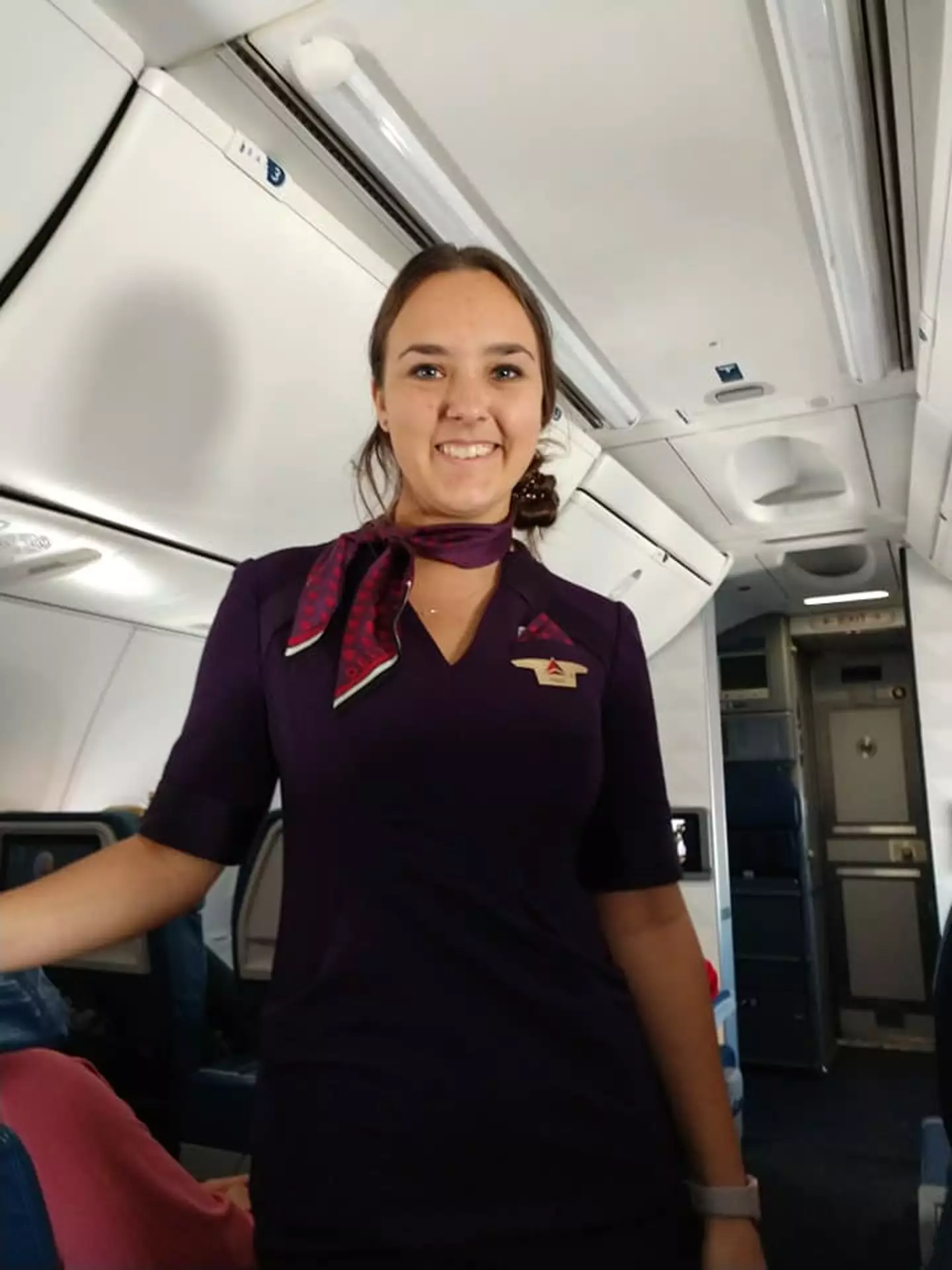
According to the coverage, Hal purchased a total of six flights to follow Pierce’s work schedule across Christmas Eve and Christmas Day. That number became the hook everyone repeated, because “six” sounds both specific and borderline ridiculous—like a challenge you dare someone to attempt. But the story didn’t go viral because six flights is a flex; it went viral because he actually pulled it off. Pierce later posted that he made every flight and even ended up in first class on at least one segment—she described it as a “Christmas miracle,” a phrase that basically guarantees internet immortality.
And here’s where the narrative gets even more cinematic: Hal wasn’t just some random traveler with unlimited free time. This was reported as his first trip using his benefits—suggesting the family had access to travel perks through her job, and that this whole thing was also a father stepping into his daughter’s new world, learning the logistics, meeting the system, and experiencing what her work life actually feels like. In a weird way, he didn’t just follow her route—he followed her reality.
Why the internet instantly turned it into a debate instead of just a “aww”
The most predictable thing about a viral wholesome story is how fast it stops being purely wholesome. The second a clip, photo, or headline hits the mainstream feed, it becomes a mirror for whatever people already feel about life: money, privilege, parenting, climate guilt, airline chaos, and the pressure to be “that” kind of parent.
On one side, the reaction was basically: this is what love looks like when it’s active, not passive—when it’s not just words but effort. People saw a father making a bold choice that signaled, “Your work matters, and you matter, even when your job steals the holidays.” That resonated with anyone who has worked retail, healthcare, hospitality, transportation—any job where Christmas isn’t a day off but a shift on the schedule.
On the other side, the questions came fast: is this romantic or is this indulgent? Is it deeply loving or slightly performative? Would the story have gone viral if it were a mom doing it? Would it have been celebrated if the family didn’t have travel benefits, if it cost a small fortune, if it added unnecessary flights during peak travel season? The moral tension wasn’t that the act was “bad.” The tension was that it was big—and big gestures invite big opinions.
The overlooked supporting cast: gate agents, crew members, and the invisible teamwork behind the “cute” story

One reason stories like this feel almost too perfect is because we forget how many people have to quietly cooperate for them to happen. Pierce herself thanked gate agents and the crew for their patience and help, implying that multiple employees across multiple airports treated the situation with a little extra humanity. And that detail matters because holiday travel can bring out the worst in systems and in people. Airports get stressed, staff get stretched thin, and passengers get impatient. Yet this story suggests that, in the middle of all that, a handful of workers made space for something kind.
Delta also commented publicly, describing appreciation for employees working holidays and expressing how much they loved seeing a dad get to spend Christmas with his daughter even while traveling at cruising altitude. Corporate statements are usually bland, but this one was basically the company acknowledging a rare thing: a viral moment that made airline work look human instead of miserable.
What this story really reveals about modern loneliness—and why it hit so hard
Strip away the viral packaging and the story gets quietly heavy: Pierce could have spent Christmas surrounded by people and still felt alone. That’s the modern kind of loneliness—being physically near others but emotionally separated from the people who make a day feel like a day. A flight attendant works in a cabin full of passengers who are going somewhere meaningful to them, while she is there because it’s her job. That contrast can sting.
Hal’s decision didn’t “fix” the reality of working holidays. It didn’t change the schedule. It didn’t rewrite the labor economics of aviation. But it did something smaller and arguably more powerful: it told one person, “You don’t have to carry this alone.” That’s why the story didn’t just trend—it lodged itself into people’s brains as a standard, a myth, a dare, a dream.
And yes, there’s a controversial angle here too: viral parenting stories can create an impossible bar. Not everyone can buy six flights. Not everyone has the flexibility. Not everyone has the health, the money, the time, or the emotional capacity. Sometimes “love” looks like a long FaceTime call between shifts, or a meal dropped off, or a sincere “I’m proud of you” text that actually lands. But the internet likes extremes because extremes are easier to share.
The “is this too much?” question—and why it’s the wrong way to frame it
People love to ask whether a gesture is “too much,” as if there’s a universal maximum for love before it becomes cringe. But the more interesting question is: what problem was he solving? Hal wasn’t trying to impress strangers. He was trying to change his daughter’s emotional experience of a hard holiday. That’s a real problem, and he solved it in a way that fit his family’s circumstances.
Still, it’s fair to acknowledge the friction points. Multiple flights mean more time in an already crowded system during peak travel. It can also raise questions about unnecessary emissions if the travel was purely symbolic. Those concerns aren’t “hate”—they’re part of how people process modern life, where every beautiful story sits inside a complicated world.
But maybe that’s the final reason this went viral: it’s a simple act that forces a complicated conversation. It makes people ask what we owe to each other, what we owe to our planet, what we owe to workers who keep society moving while everyone else celebrates.
Conclusion: a Christmas story that keeps circling back for a reason

Years after the original post, this story continues to resurface because it’s not really about air travel—it’s about what happens when someone refuses to let a system define how lonely you’re allowed to feel. Hal Vaughan didn’t change the fact that Pierce had to work Christmas. He changed what “working Christmas” meant. He turned it from an isolation sentence into a shared memory. He made airports feel briefly like living rooms, turned gate announcements into background music, and proved that love doesn’t always arrive wrapped in paper. Sometimes it arrives as a boarding pass—again and again—until the holiday is no longer something that happens without you.