
Table of Contents
- The Brilliantly Simple Idea: Filter the Carbon Before It Reaches the Sky
- How the Device Allegedly Works: Breaking Down the Science
- A Future Where Cars Clean the Air Instead of Polluting It
- But Could This Actually Work? What Experts Are Saying
- Investors and Environmental Groups Are Paying Attention
- The Human Story: Why Teenagers Are the Best Innovators
- Could This Change the Way We Think About Emissions Forever?
- The Road Ahead: Testing, Scaling, and Real-World Validation
- Whether This Device Succeeds or Evolves, the Impact Is Real
- Final Thought: If You Could Clean the Planet With Every Drive… Would You?
The Brilliantly Simple Idea: Filter the Carbon Before It Reaches the Sky
The teens’ invention is based on a concept surprisingly few inventors have explored:
What if you could attach a device to your exhaust pipe that captures carbon dioxide — and releases clean oxygen instead?
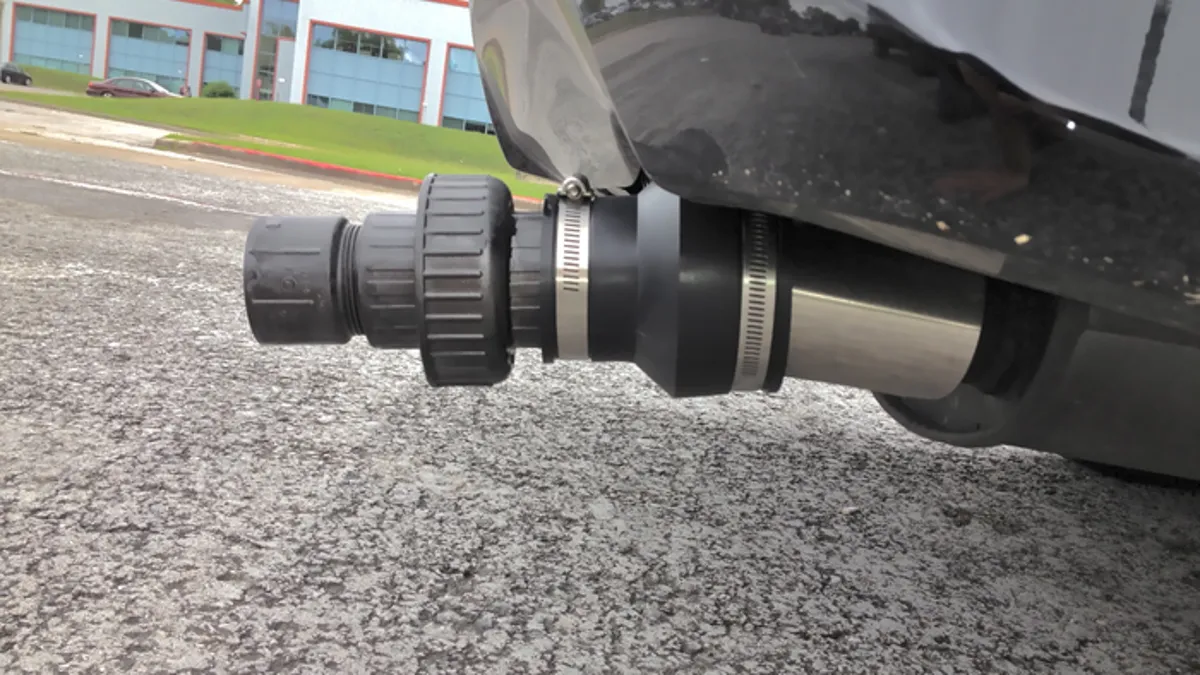
Their prototype, inspired by research on algae-based filtration and chemical adsorption materials, uses a CO₂-filtering cylinder that attaches directly to the car’s tailpipe.
Inside the filter are specialized materials — including algae cultures in certain versions — that:
- Absorb carbon dioxide
- Undergo a chemical reaction or photosynthetic process
- Produce oxygen as a byproduct
The creators say the device can be detached, cleaned, and reused — and the captured carbon can be repurposed for various industries.
For a concept born outside of a corporate lab, the idea is elegantly disruptive.
How the Device Allegedly Works: Breaking Down the Science
The filter is based on a three-stage process:
1. Intake and Capture
When the car releases exhaust, carbon dioxide enters a sealed chamber inside the filter.
Here, porous materials or microalgae systems trap CO₂ molecules.
This is similar to the way industrial carbon-capture systems operate — but miniaturized.
2. Conversion
Depending on the version of the prototype, the device uses:
- Photosynthetic organisms (like algae)
OR - Chemical catalysts that cause CO₂ to break down during reaction
Both pathways aim to convert captured carbon into:
- Oxygen
- And other reusable carbon compounds
3. Oxygen Release
After processing, oxygen vents from the filter, while the remaining carbon stays inside the chamber until cleaned or recycled.
If perfected at scale, the system could function like a tiny forest strapped to the back of every vehicle.
A Future Where Cars Clean the Air Instead of Polluting It
If this invention reaches commercial viability, the implications are massive.
Picture major cities where:
- Vehicles reduce smog instead of producing it
- Highway traffic becomes a source of cleaner air
- Urban pollution levels drop dramatically
- CO₂ captured from cars is recycled into concrete, fuel, plastics, or soil enhancers
It’s the kind of circular economy environmentalists dream about.
But here’s the twist:
This breakthrough didn’t come from a veteran research lab.
It came from teenagers experimenting with scientific principles and thinking beyond boundaries.
Their boldness is the part that’s capturing global attention.
But Could This Actually Work? What Experts Are Saying
Engineers and environmental scientists have praised the creativity — but they also highlight real challenges:
1. Cars produce more CO₂ than a small filter can capture.
A single gallon of gasoline creates nearly 20 pounds of CO₂.
To capture all of that, a filter would need very high efficiency.
2. Filters require frequent cleaning or replacement.
Captured carbon must be removed and reused.
3. Heat and pressure from exhaust could damage biological systems.
Algae may struggle in high-temperature environments unless protected.
4. Energy balance must be considered.
If the filter increases engine strain, it could paradoxically raise fuel consumption.
Yet despite these obstacles, many experts emphasize:
Breakthroughs in sustainability often begin with ambitious prototypes like this — not finished products.
Just as early solar panels were inefficient and expensive, or early electric cars had tiny ranges, disruptive ideas improve over time.
The point isn’t that the filter is perfect.
The point is that teenagers are pushing boundaries once left only to corporate R&D departments.
Investors and Environmental Groups Are Paying Attention
Green-tech investors love innovations that:
- Are low-cost
- Can be scaled
- Require minimal consumer behavior change
- Integrate into existing infrastructure
This filter checks all those boxes.
Environmental groups (and even automakers quietly watching the trend) are also intrigued:
What if retrofitting existing vehicles could significantly cut emissions — without replacing entire fleets?
It’s cheaper.
Faster.
More realistic for developing countries.
And aligned with national climate-target deadlines.
If the prototype evolves successfully, it could become the most accessible carbon-capture device ever designed.
The Human Story: Why Teenagers Are the Best Innovators
Every major environmental breakthrough shares a common root:
Vision from someone who refuses to accept “that’s impossible.”
Young innovators are:
- Less jaded
- Less constrained by tradition
- More imaginative
- More open to hybrid scientific ideas
- More willing to fail and try again
They grew up hearing about climate change not as a distant threat — but as a daily reality.
Their urgency is real.
Their creativity is untamed.
And inventions like this highlight a powerful truth:
**The next generation isn’t waiting for someone else to save the planet.
They’re building the tools themselves.**
Could This Change the Way We Think About Emissions Forever?
Ask yourself this:
If cars could capture CO₂ instead of releasing it…
if highways became clean-air generators…
if technology made sustainability effortless…
Wouldn’t the world look different?
Wouldn’t people feel empowered instead of overwhelmed by climate change?
Wouldn’t countries reach net-zero faster?
That’s the promise behind this invention — not certainty, but possibility.
Possibility is where every revolution begins.
The Road Ahead: Testing, Scaling, and Real-World Validation
The teenage inventors acknowledge the prototype is still early. The next stages include:
- Independent lab testing
- Thermal-resistance studies
- Long-term durability trials
- Cost analysis
- Government certification
- Potential integration with automaker designs
But the spark has already been lit.
The idea is out there.
The world is curious.
And sometimes, curiosity is the missing ingredient for transformation.
Whether This Device Succeeds or Evolves, the Impact Is Real
Even if the prototype doesn’t reach mass production exactly as designed, it has already:
- Inspired thousands of young scientists
- Challenged industry norms
- Proved innovation doesn’t require a PhD
- Opened doors to hybrid bio-mechanical emissions tech
- Pushed carbon-capture conversations into the automotive mainstream
Some inventions succeed as products.
Others succeed as catalysts.
This one might be both.
Final Thought: If You Could Clean the Planet With Every Drive… Would You?
Climate change often feels overwhelming — a global crisis too large for individuals to influence.
But imagine a future where cleaning the air is as simple as turning on the ignition.
A future shaped not by corporations or governments alone, but by young minds refusing to accept the status quo.
A future where the exhaust pipe becomes a symbol not of pollution — but of innovation.
We’re not there yet.
But thanks to a handful of determined teenagers,
we’re closer than we were yesterday.