
Table of Contents
- The Legislation That Sparked Immediate Debate
- Why Nancy Mace Says The Bill Is Necessary
- Understanding Current Federal Law
- Why The Proposal Is Generating Strong Support
- Critics Raise Constitutional Concerns
- The Military Justice Component
- The Shadow Of High Profile Abuse Cases
- How The Debate Reflects Broader Criminal Justice Questions
- What Happens Next In Congress
- What This Means For The Future
The Legislation That Sparked Immediate Debate
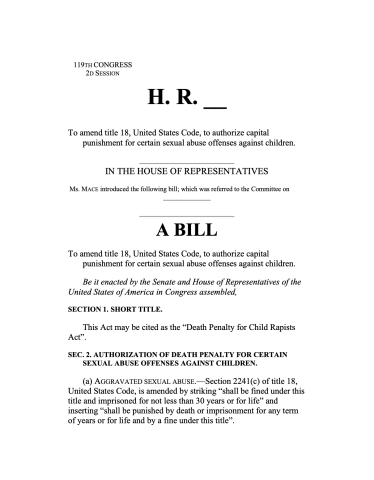
Representative Nancy Mace introduced the measure under the title “Death Penalty for Child Rapists Act.”
The proposal seeks to expand federal death penalty eligibility to include several categories of child sexual abuse offenses currently prosecuted under federal law.
According to information released alongside the legislation, the bill would apply to aggravated sexual abuse of a child, sexual abuse involving minors, and certain forms of abusive sexual contact involving children.
The proposal would also extend to specific offenses prosecuted under the Uniform Code of Military Justice, meaning some cases involving military personnel could potentially qualify for capital punishment if the legislation becomes law.
The announcement immediately drew national attention because federal death penalty cases remain relatively rare and are generally reserved for the most serious crimes, such as terrorism, espionage, or murder.
Expanding eligibility to include child sexual abuse offenses would represent a significant change in federal criminal law.
Why Nancy Mace Says The Bill Is Necessary
Mace framed the legislation as part of a broader effort to strengthen protections for children and increase accountability for individuals who commit sexual crimes against minors.
In public statements supporting the proposal, she argued that predators who target children commit some of society’s most devastating offenses and should face the strongest punishment available.
Her argument reflects a growing sentiment among many voters who believe existing penalties do not adequately reflect the severity of crimes involving children.
Supporters often point to the lifelong emotional, psychological, and physical trauma experienced by victims. They argue that the justice system should impose consequences that reflect the lasting harm caused by these offenses.
For many advocates of tougher sentencing laws, the proposal represents a symbolic statement as much as a legal one.
It sends a message that crimes against children occupy a unique category within the criminal justice system and deserve extraordinary punishment.
That message has resonated strongly among some victims’ rights organizations and advocacy groups focused on child protection.
Understanding Current Federal Law
Under existing federal law, capital punishment is generally limited to specific categories of crimes.
Historically, the Supreme Court has imposed significant constitutional limits on when the death penalty can be used.
One of the most important precedents came in 2008 when the Supreme Court ruled in Kennedy v. Louisiana that imposing the death penalty for child rape where the victim did not die violated the Eighth Amendment’s prohibition against cruel and unusual punishment.
That ruling significantly shaped the legal landscape surrounding capital punishment for non-homicide offenses.
As a result, many legal experts immediately questioned how Mace’s proposal would interact with existing constitutional precedent.
Even if Congress passed the legislation, courts would likely face challenges regarding whether the law could survive judicial review.
That constitutional question has become one of the central issues in discussions surrounding the bill.
Why The Proposal Is Generating Strong Support

Supporters argue that crimes involving children deserve exceptional treatment under the law.
Many believe the severity of the trauma inflicted on child victims justifies the strongest possible penalties.
Advocates point out that sexual abuse often causes lifelong emotional scars, mental health challenges, and difficulties forming healthy relationships later in life.
Some supporters also argue that technological changes have increased opportunities for exploitation, making stronger deterrents necessary.
They believe federal lawmakers should respond aggressively to threats against children, particularly as investigators continue uncovering complex trafficking networks operating across state and international borders.
For these supporters, the debate extends beyond legal technicalities.
They view the proposal as a moral statement about society’s responsibility to protect vulnerable children.
The emotional nature of these crimes often generates powerful public reactions, making the issue politically significant as well.
Critics Raise Constitutional Concerns
Despite strong support in some circles, the proposal faces substantial criticism from legal scholars and criminal justice experts.
Many point directly to existing Supreme Court precedent.
Critics argue that expanding the death penalty to non-homicide child sex crimes could conflict with constitutional rulings already established by the nation’s highest court.
Some legal experts believe the legislation would face immediate challenges if enacted.
Others argue that Congress may be intentionally creating a legal pathway designed to encourage future reconsideration of existing Supreme Court decisions.
Beyond constitutional concerns, opponents question whether expanding capital punishment would produce the intended results.
Research on deterrence remains highly debated, and many studies have failed to establish a clear connection between harsher penalties and reduced crime rates.
These critics argue that improving prevention, investigation, victim support services, and prosecution rates may have a greater impact than increasing punishments.
The Military Justice Component

One aspect of the proposal receiving particular attention involves military law.
The legislation specifically includes offenses prosecuted under the Uniform Code of Military Justice.
This means service members convicted of qualifying child sexual abuse offenses could potentially face capital punishment under military courts.
Supporters argue that military personnel should be held to the highest standards of conduct.
Given the trust placed in members of the armed forces, they believe severe violations involving children warrant equally severe consequences.
Military justice experts note that introducing capital punishment into these cases could significantly alter how certain prosecutions are handled.
Additional legal review and procedural requirements typically accompany death penalty cases, making them more complex and resource intensive.
As a result, the military component of the bill is likely to generate substantial discussion if lawmakers begin formally debating the proposal.
The Shadow Of High Profile Abuse Cases
The legislation arrives during a period when public attention remains focused on several high-profile sexual abuse scandals.
Cases involving trafficking networks, institutional failures, and influential individuals accused of exploiting minors have fueled widespread frustration among many Americans.
Mace referenced broader efforts to increase transparency and accountability surrounding sexual abuse investigations.
Many supporters see the legislation as part of a larger movement demanding stronger consequences for offenders and greater protection for victims.
These high-profile cases have shaped public opinion significantly.
They have also contributed to a growing perception among some voters that the justice system has not always adequately addressed crimes involving vulnerable children.
That environment helps explain why proposals involving tougher penalties often attract strong emotional support.
How The Debate Reflects Broader Criminal Justice Questions
Beyond the specifics of this proposal, the legislation highlights larger debates occurring within American criminal justice policy.
For decades, lawmakers have wrestled with competing goals of punishment, deterrence, rehabilitation, and public safety.
The death penalty remains one of the most divisive issues within that conversation.
Supporters view capital punishment as an appropriate response to society’s most horrific crimes.
Opponents argue that the risk of wrongful convictions, unequal application, and constitutional concerns outweigh potential benefits.
Mace’s proposal places these broader questions back into the national spotlight.
It forces lawmakers, legal experts, and voters to reconsider where society draws the line when determining appropriate punishment for particularly severe offenses.
Regardless of one’s position, the proposal has already succeeded in reigniting debate about the purpose and limits of criminal justice.
What Happens Next In Congress
Introducing a bill represents only the first step in a lengthy legislative process.
The proposal must move through committee review, hearings, amendments, and votes before it can potentially become law.
During that process, lawmakers will likely hear testimony from constitutional scholars, victims’ advocates, prosecutors, defense attorneys, and criminal justice experts.
The proposal’s chances of passage remain uncertain.
Even if the bill receives strong support in certain political circles, constitutional concerns could complicate its path forward.
Additionally, lawmakers may seek revisions or alternative approaches that strengthen penalties without triggering immediate legal challenges.
The coming months will determine whether the proposal gains momentum or remains primarily a symbolic statement.
Either way, the debate surrounding it is unlikely to disappear anytime soon.
What This Means For The Future
The introduction of the Death Penalty for Child Rapists Act reflects a broader national conversation about accountability, justice, and the protection of children.
For supporters, the proposal represents a bold effort to ensure that the most severe crimes against minors receive the harshest possible consequences. For critics, it raises fundamental questions about constitutional rights, legal precedent, and the effectiveness of capital punishment.
Regardless of where the legislation ultimately ends up, its introduction highlights the powerful emotions surrounding crimes against children and society’s ongoing struggle to determine how best to respond to them.
As lawmakers continue debating the proposal, Americans will likely confront difficult questions about punishment, deterrence, victims’ rights, and the limits of government power.
The outcome may shape not only future criminal justice policy but also the broader national conversation about how a society chooses to protect its most vulnerable members.
One thing is already clear. The proposal has ignited a debate that reaches far beyond Congress, touching on some of the deepest questions about justice, morality, and public safety in modern America.