

Table of Contents
- A Hook for the First 3 Seconds
- What Scientists Call “Earthing” — And Why It’s Getting So Much Attention
- Your Body Is Electrically Alive
- The Earth Has a Pulse — And Your Body Responds to It
- Why Walking Barefoot Feels Instantly Calming
- Inflammation: The Silent Threat Earthing May Help Ease
- Why Beaches Are the World’s Best Natural “Charging Stations”
- Can You Ground at Home? Yes — But With One Important Catch
- What Happens After 30 Days of Grounding?
- The Earth Is One Giant Electromagnetic Shield
- Why Modern Life Disconnects Us From Our Natural Energy Source
- Your Body Knows When It Touches the Earth
- How to Start Grounding: Simple, No-Cost Methods
- A Question to Leave You With
- Final Thoughts
A Hook for the First 3 Seconds
Most of us rarely walk outdoors without shoes, but what if the simple act of touching the Earth with your bare feet could reset your body’s energy, lower inflammation, improve sleep, and dramatically calm your nervous system?
It sounds almost too simple to be real.
Yet growing research says this ancient practice—now called earthing or grounding—might be one of the most powerful natural health tools we’ve forgotten.
And the best part?
It’s free, accessible, and literally right beneath your feet.
But what actually happens inside your body when you walk barefoot on grass, soil, sand, or stone?
That’s where the story gets interesting.
What Scientists Call “Earthing” — And Why It’s Getting So Much Attention

Earthing is the practice of placing your body in direct contact with the ground—usually by walking barefoot in nature.
Your skin touches the Earth’s surface, connecting you with the planet’s natural supply of electrons, which carry a subtle but measurable electrical charge.
Researchers say these electrons may act as antioxidants inside the body, neutralizing harmful free radicals and calming inflammation.
The Earth isn’t just a giant rock we live on.
It’s a huge battery of electromagnetic potential.
For most of human history, we were plugged straight into it.
Now?
We spend 95% of life indoors, on man-made floors, wearing rubber or plastic soles—the perfect insulators.
We’ve accidentally disconnected our bodies from the charge nature once supplied to us daily.
But what happens when we reconnect?
Scientists have been measuring it.
Your Body Is Electrically Alive
Think about this:
Your brain sends signals through electricity.
Your heartbeat is controlled by electrical impulses.
Your nervous system fires based on electrical gradients.
Your whole body runs not just on chemistry—but on electrical balance.
So the idea that the Earth’s massive electrical field might influence your biology isn’t mystical.
It’s physiology.
In studies, grounding has been found to:
- improve heart rate variability
- reduce cortisol (stress hormone)
- increase circulation
- normalize sleep cycles
- speed up wound healing
- reduce chronic pain
- improve mood and calm anxiety
- reduce inflammation markers in the blood
These aren’t small effects.
One study even found that grounding immediately changed blood viscosity, making it flow more smoothly—important for heart health.
Another found that grounded participants experienced significantly better sleep quality in just one night.
But how can something as simple as touching dirt, grass, or sand do all of that?
The Earth Has a Pulse — And Your Body Responds to It

Scientists call it the Schumann Resonance—a natural electromagnetic frequency around 7.83 Hz that vibrates subtly through the planet.
It’s the same frequency range as the human brain during deep relaxation and meditation.
Some researchers believe we evolved in harmony with this natural “Earth pulse.”
This means that touching the Earth may help regulate our internal rhythms—something modern life constantly disrupts.
Think about it:
- We stare at blue-lit screens
- We carry smartphones everywhere
- We sleep with WiFi routers running
- We rarely go outside
- We almost never touch nature with bare skin
Your ancestors lived barefoot, outdoors, connected to soil, weather, plants, and ground.
Your system still expects that environment.
When you reconnect with it—even for 10 minutes—the body seems to remember something ancient.
Why Walking Barefoot Feels Instantly Calming
If you’ve ever taken your shoes off in a garden or on the beach and felt your whole chest soften and your breath slow down…
That wasn’t in your imagination.
Researchers measuring brain waves found that grounding can shift the body into a parasympathetic (rest-and-digest) state.
This is the opposite of stress mode.
In other words:
Going barefoot tells your nervous system that you are safe.
And when that happens, everything improves—your digestion, your hormones, your immunity, your sleep.
But there’s another layer that scientists didn’t expect.
Inflammation: The Silent Threat Earthing May Help Ease
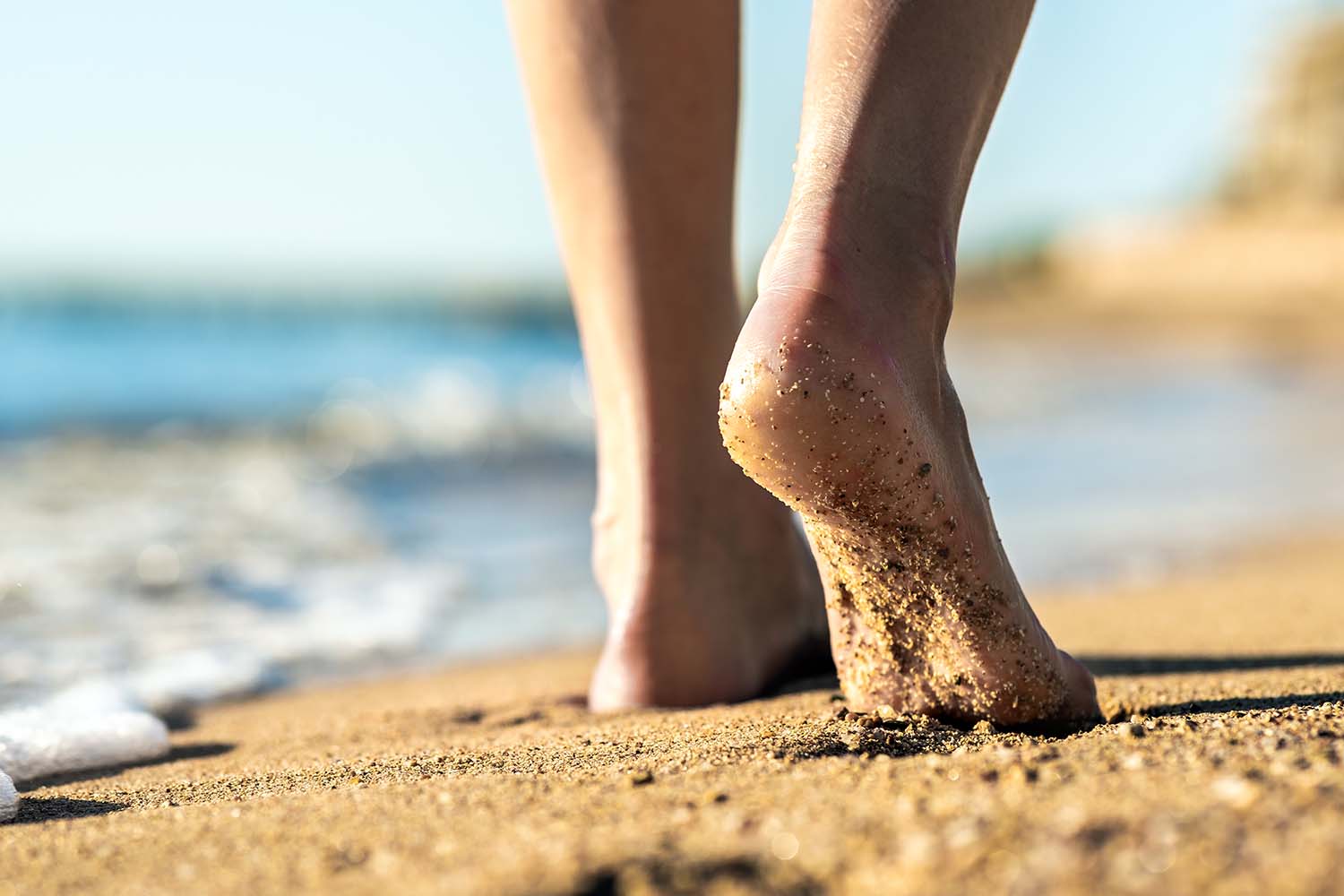
Chronic inflammation is behind many modern health conditions:
- heart disease
- autoimmune disorders
- arthritis
- allergies
- depression
- chronic fatigue
- skin flare-ups
Several studies on earthing found consistent reductions in inflammation markers, including C-reactive protein.
Why?
Researchers think electrons from the Earth may act like a biological fire extinguisher—neutralizing the oxidative stress that drives inflammation.
Some long-term grounding studies showed:
- reduced swelling
- faster recovery from injuries
- decreased muscle soreness
- better immune response
Athletes in particular have been experimenting with grounding to speed up muscle repair.
Imagine recovering faster from workouts just by… touching the ground.
Why Beaches Are the World’s Best Natural “Charging Stations”
There’s a reason people report feeling relaxed, calm, and mentally clear near the ocean.
Beaches are perfect grounding environments because:
- sand conducts electricity well
- saltwater increases conductivity
- waves create abundant negative ions
- sunlight boosts serotonin
- barefoot walking is natural
Walking barefoot on wet sand might be the most potent grounding method available.
If you’ve ever wondered why vacations near the ocean make you sleep better and feel lighter—this may be part of the answer.
Can You Ground at Home? Yes — But With One Important Catch
Grass, soil, stone, and concrete (unfinished) all conduct the Earth’s charge.
But:
❌ Rubber
❌ Plastic
❌ Wood
❌ Vinyl
❌ Asphalt
…all block it.
If you want grounding to work at home:
- Stand barefoot on grass
- Sit with your feet on soil
- Walk on natural stone or brick
- Garden with bare hands
- Lay down on the ground for a few minutes
You don’t need hours.
Studies show benefits begin within 10–20 minutes.
But consistency creates the biggest changes.
Just like exercise, grounding builds effects over time.
What Happens After 30 Days of Grounding?
People who practice grounding daily report:
After a few minutes:
- calmer breathing
- less mental noise
- improved mood
After a week:
- deeper sleep
- reduced anxiety
- fewer headaches
After a month:
- less inflammation
- fewer mood swings
- better recovery from workouts
- improved digestion
- reduced chronic pain
Even skeptics often admit something shifts.
But grounding doesn’t replace medical care.
It complements it.
Still—if something so simple and accessible can improve your wellbeing, why not try it?
But there is one more fascinating layer.
The Earth Is One Giant Electromagnetic Shield
(And You’re Part of It)
Earth’s surface absorbs lightning strikes—millions per day—creating a global electron reservoir.
This charge disperses across the planet.
When you touch the ground, you’re tapping into this vast electrical network.
Some scientists believe humans evolved with constant exposure to these electrons, and separating ourselves from them may have consequences we don’t fully understand yet.
It raises a question:
If your phone needs to be grounded to function properly, why wouldn’t your body?
Why Modern Life Disconnects Us From Our Natural Energy Source
Think about an average day:
You wake up on an elevated bed.
You walk on insulated floors.
You drive in a rubber-tired car.
You work in a building far above the ground.
You touch screens more than soil.
Your feet rarely contact earth.
Your ancestors were grounded thousands of times more than you are.
So grounding isn’t “new age.”
It’s actually ancient biology.
Modern lifestyles just forgot what the human body remembers.
Your Body Knows When It Touches the Earth
Some people describe grounding as:
- feeling “plugged in”
- feeling lighter
- feeling emotionally clearer
- feeling more stable
- feeling more present
But the most common reaction is:
“I didn’t know I needed this until I felt it.”
If you try grounding for a week, you’ll understand why.
How to Start Grounding: Simple, No-Cost Methods
Here are the most effective ways to reconnect with Earth’s energy:
✔ Walk barefoot on grass for 10 minutes
Preferably in the morning.
✔ Sit with your bare feet on soil
Meditation optional.
✔ Stand on concrete (but not sealed or painted)
Outdoor concrete conducts electricity.
✔ Lie on the ground
Picnic blankets that are thin still allow grounding.
✔ Touch trees or garden with bare hands
Your skin-to-earth contact counts.
✔ Dip your feet in natural water
Rivers, lakes, and oceans all ground you instantly.
Start small, be consistent, and watch how your body responds.
A Question to Leave You With
If something as simple as touching the Earth can improve your stress levels, sleep, mood, and inflammation…
Why did we ever stop doing it?
And more importantly—
What would your life feel like if you started again today?
Final Thoughts
Grounding won’t solve every problem, but it offers something rare in modern life:
A way to heal that doesn’t require devices, pills, subscriptions, or screens.
Just you.
Your bare feet.
And the Earth.
A connection humans knew for thousands of years—
now rediscovered by science.
Because sometimes the most powerful medicine is the one waiting quietly beneath your feet.