

Table of Contents
- A History-Making Moment Before Her Life Has Even Begun
- Born Into a Game That Didn’t Expect Her
- The Hidden World Behind a Chess Prodigy
- From Local Tournaments to National Ranking: The Climb Begins
- A Seat at a Table Once Closed
- The Game That Crowned a Champion
- The Barriers She Broke Through
- Why Chess Needs Voices Like Hers
- But Her Success Didn’t End at the Chessboard
- A Question to Ask Yourself Today
- Her Future: The Most Exciting Part of the Story
- What Her Victory Means for America — And the World
- Conclusion: A New Queen on the Board
A History-Making Moment Before Her Life Has Even Begun
At 19, most teenagers are thinking about their next semester, their first job, or how to afford rent.
But this 19-year-old wasn’t thinking small. She was rewriting history.
In a world where chess champions are often men in their 30s, seasoned by decades of competition, she broke through every barrier placed in front of her—age, gender, race—and claimed the title:
The highest-rated African American female chess player in history.
It’s a title no one can ever take from her.
But what’s even more incredible is the journey behind it.
Because history is rarely made in a single match.
It’s created by years of sacrifice, discipline, and the quiet fire of a young girl who believed she belonged at the top of a game that wasn’t built for her.
Born Into a Game That Didn’t Expect Her

She didn’t grow up in a world overflowing with chessboards, private tutors, or elite academies.
Like many great stories, hers began with something simple:
A library.
A free after-school program.
A dusty wooden chess set with three mismatched pieces.
And a mentor who saw something she didn’t see yet.
At age 7, she sat across from her first opponent—a boy twice her size who had been playing since kindergarten.
She lost in seven moves.
Most kids would have quit.
She asked for a rematch.
That was the first clue:
She didn’t love the game because she won.
She loved it because she wanted to understand it.
Understanding always came before victory.
The Hidden World Behind a Chess Prodigy
People see the trophies.
They don’t see the 4 a.m. study sessions, the dozens of notebooks filled with openings, the games replayed until midnight.
Chess isn’t only a sport—it’s cognitive warfare.
For years, she trained like an athlete:
- studying Grandmaster openings
- memorizing tactical patterns
- analyzing her losses like a scientist
- meditating to control her emotions
- building a strategic mind one puzzle at a time
Chess masters call it “pattern recognition.”
But she called it survival.
Because every tournament she entered, someone underestimated her.
Because every time she sat down at the table, someone whispered,
“Who is she?”
and
“She can’t win this.”
But anyone who’s ever been underestimated knows this:
Being doubted is rocket fuel.
From Local Tournaments to National Ranking: The Climb Begins

Her rise wasn’t sudden.
Good stories never are.
From age 12 to 16, she placed herself inside every tournament she could travel to—sleeping in cheap hotels, studying games on car rides, eating quick meals between rounds.
Her rating climbed steadily, each milestone a quiet victory.
But the first major turning point came at 16, when she defeated a National Master in a tense 62-move endgame—a moment that sent shockwaves through the regional chess scene.
People finally noticed her.
But they still didn’t expect her to break history.
They didn’t see what was coming.
A Seat at a Table Once Closed
Chess is often dominated by:
- older players
- wealthier players
- male players
And very rarely by African American women.
That’s what makes her journey so extraordinary.
She didn’t just enter a world that had few people who looked like her.
She climbed to the top of it.
By age 17, she earned her Woman Candidate Master title.
By 18, she had defeated multiple titled players.
By 19, her rating soared past every African American woman who had ever competed in the sport.
That wasn’t luck.
That was legacy in motion.
The Game That Crowned a Champion
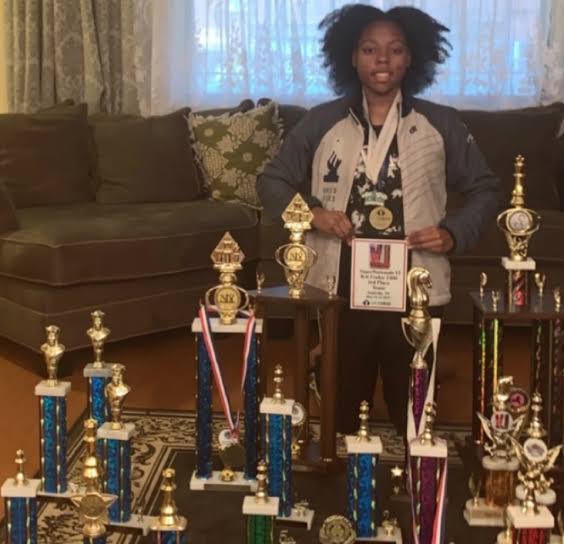
Her record-breaking moment happened at a national-level tournament packed with some of the strongest young players in the country.
In round four, she faced a highly rated opponent who opened with the Sicilian Defense—a notoriously sharp, tactical battleground.
She chose a calm, positional approach instead, slowly tightening the board like a net.
Every move carried intention.
Every decision shaped the game’s future.
By move 34, she had built a passed pawn.
By move 45, her opponent was in time trouble.
By move 51, she forced resignation.
That single victory pushed her rating beyond all African American female predecessors.
She didn’t celebrate loudly.
She simply closed her scorebook, folded her hands, and breathed.
She had been ready for this moment for years.
The Barriers She Broke Through
Her achievement is about more than numbers.
It is about walking into spaces where people don’t expect you.
It is about shattering ceilings others pretend don’t exist.
It is about proving that brilliance has no gender, no skin tone, no zip code.
Her success challenged stereotypes within the chess community:
✔ Black girls can excel in cognitive sports.
✔ Teen girls can compete at the highest levels.
✔ Talent grows when opportunity meets determination.
✔ Diversity strengthens the strategic landscape of chess itself.
She didn’t just change ratings.
She changed expectations.
Why Chess Needs Voices Like Hers
Chess is undergoing a transformation.
Streaming platforms, online tournaments, viral matches, and academic studies have made the game more accessible and exciting than ever before.
But representation matters.
When young Black girls walk into a classroom or a public park and see a chessboard, they deserve to know:
“You belong here, too.”
Her story opens doors for:
- scholarships
- STEM pathways
- cognitive development programs
- after-school chess clubs
- mental health interventions through strategic play
- leadership opportunities for young girls
One girl’s path becomes a blueprint for thousands.
But Her Success Didn’t End at the Chessboard
Behind the scenes, she is also an advocate for:
- educational equity
- free chess programs for underserved youth
- mental resilience training
- financial literacy for students pursuing competition sports
- mentorship for young women entering male-dominated fields
Chess became her platform, but her mission is bigger:
To show every kid who’s ever been overlooked that brilliance is not determined by circumstances—it is determined by choice, discipline, and support.
A Question to Ask Yourself Today
If you were in her position—walking into a room where no one looked like you, no one believed in you, and no one expected you to win—
Would you shrink back, or would you take your seat at the board and play anyway?
That’s the courage this 19-year-old embodies.
And it’s a courage we all need in our own battles.
Her Future: The Most Exciting Part of the Story
She’s only 19.
She hasn’t peaked.
She hasn’t reached her limit.
She hasn’t even entered her prime.
Chess legends often reach their highest ratings in their late 20s or early 30s.
That means her journey is just starting.
Will she become a Grandmaster?
A national champion?
A world contender?
The possibilities stretch beyond the board.
And if her past is any indication, she will not be stopped.
What Her Victory Means for America — And the World
Her achievement sends a message that extends far beyond games and tournaments:
That brilliance grows in unexpected places.
That talent blooms when given opportunity.
That leadership can come from any background.
That young women—especially women of color—are rewriting the future of intellectual sports.
And that the next generation of thinkers, innovators, strategists, and leaders might be sitting in classrooms today, waiting for someone to hand them their first chess piece.
Conclusion: A New Queen on the Board
Chess has always been a metaphor for life.
Strategy. Sacrifice. Vision. Patience. Persistence.
This 19-year-old girl didn’t just play the game.
She changed it.
By becoming the highest-rated African American female chess player in history, she placed herself in a lineage of pioneers—women who broke barriers not just for themselves, but for everyone who comes after them.
Her name will be remembered.
Her ranking is historic.
And her impact?
It is just beginning.