
Table of Contents
- The Library Was Built Around Millions of Pages of Evidence
- Random Pages Reveal Disturbing Details
- The Exhibit Focuses Heavily on Survivors
- Trump’s Relationship With Epstein Remains a Central Focus
- Constructing the Archive Was a Massive Operation
- Epstein Became a Symbol of Elite Impunity
- The Installation Raises Questions About Transparency
- The Exhibit Blends History, Politics, and Art
- Fear and Political Pressure Still Surround the Case
- The Epstein Story Continues to Haunt America
The Library Was Built Around Millions of Pages of Evidence
The scale of the installation immediately shocks visitors.
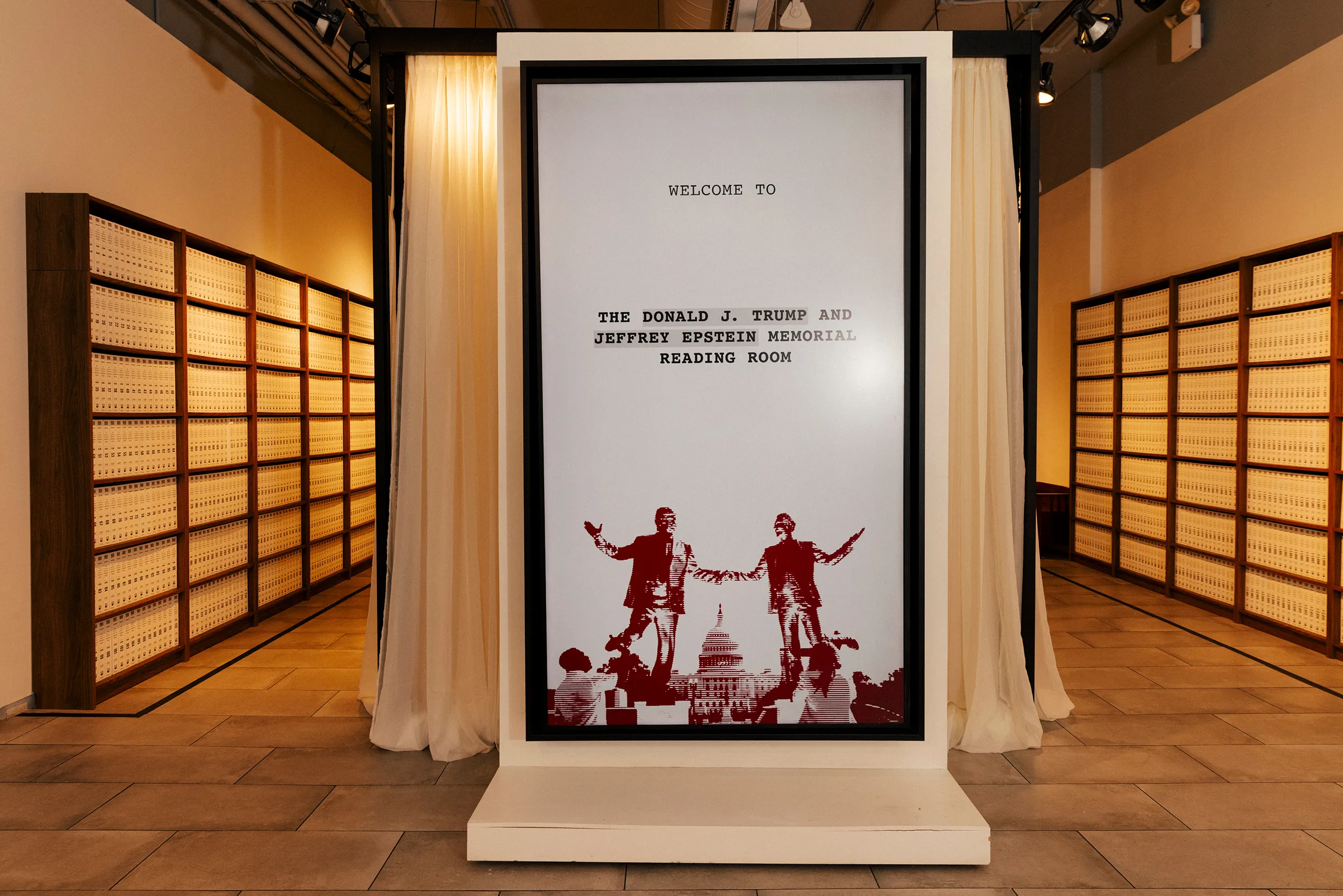
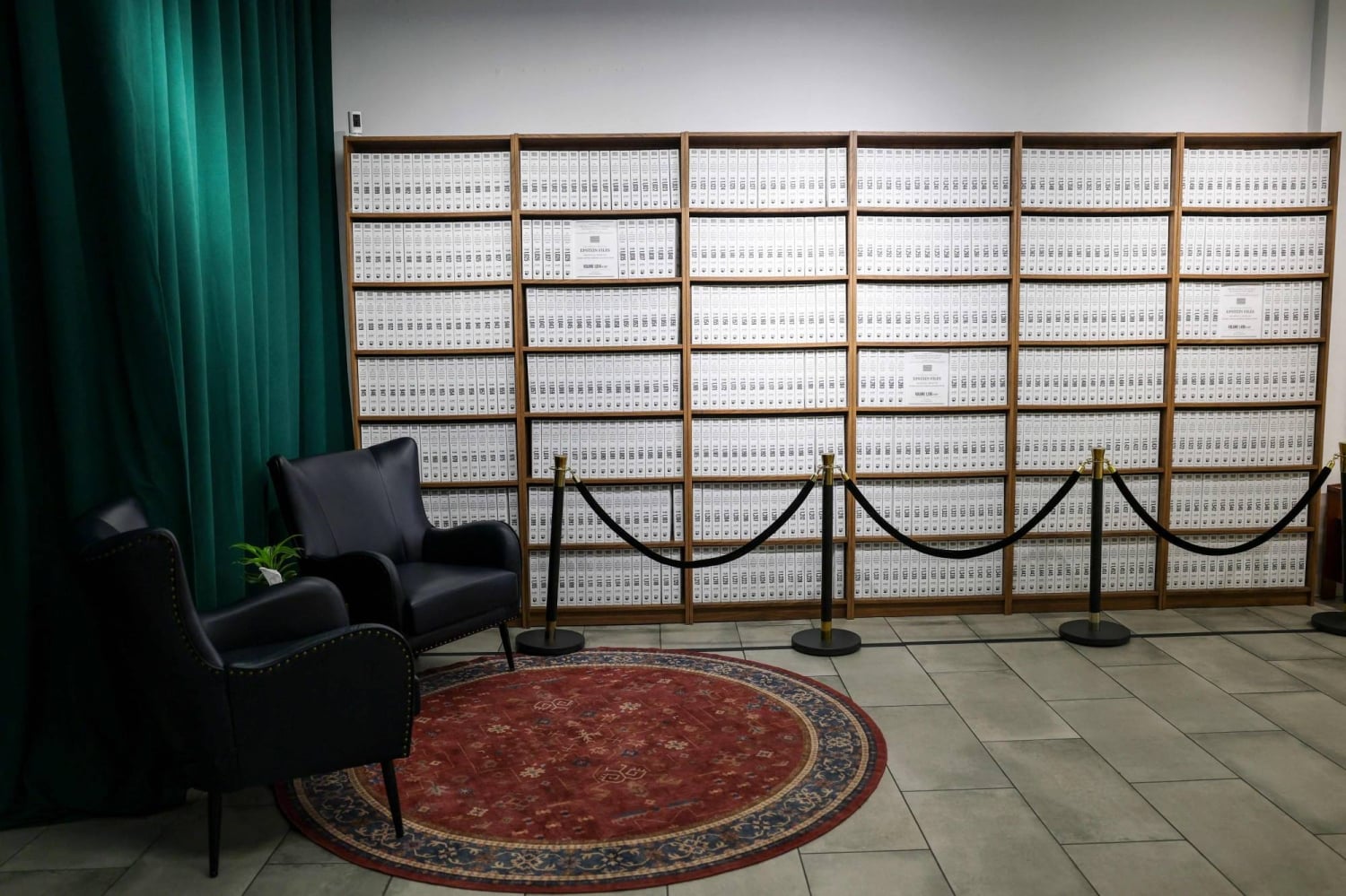
According to organizers, the reading room contains every page of Epstein related records released by the Department of Justice earlier this year. The files were transformed into thousands of physical books lining shelves throughout the gallery.
The sheer size of the archive is central to the exhibit’s message.
Rather than presenting only selected highlights, organizers wanted visitors to physically experience the overwhelming volume of material connected to Epstein’s network and alleged crimes. The rows of books create a visual representation of how enormous the investigation became over time.
Visitors entering the gallery reportedly encounter shelves stretching throughout the space, along with timelines, survivor tributes, and exhibits explaining key moments connected to Epstein’s life and criminal allegations.
The result feels less like a traditional art exhibition and more like an unsettling historical archive documenting one of the most infamous criminal scandals in modern American history.
Random Pages Reveal Disturbing Details

One of the most unsettling aspects of the archive is how casually disturbing material appears throughout the files.
A journalist visiting the reading room reportedly opened one volume at random and found an email exchange involving Epstein and a woman whose identity had been redacted. In the messages, Epstein allegedly requested a “naughty selfie” before later asking whether she knew young women who might travel and work for him.
Standing alone, the email might seem strange but ambiguous. Yet viewed within the larger context of the allegations against Epstein, it takes on a much darker meaning.
Federal authorities estimated that Epstein may have abused or trafficked more than 1,200 victims over many years. Many of those victims were reportedly minors or vulnerable young women manipulated through money, coercion, and power imbalances.
The random nature of the discovery inside the reading room reinforces a central point organizers appear eager to make: disturbing material exists throughout the archive, not only in isolated documents.
The Exhibit Focuses Heavily on Survivors
Despite the political attention surrounding Epstein’s powerful connections, organizers insist the exhibit is ultimately centered around survivors.
Candles displayed throughout the gallery reportedly symbolize the more than 1,200 alleged victims connected to the case. Parts of the exhibit were designed specifically to emphasize the human impact behind the millions of pages of records.
Organizers said they wanted visitors to understand that the scandal was not merely a celebrity conspiracy story or political controversy. It involved real people whose lives were profoundly damaged.
This focus shaped some of the exhibit’s restrictions as well.
Although the reading room is open to the public by appointment, only journalists and members of law enforcement are reportedly allowed to directly read through the files themselves. Organizers said this decision was made because some records released by the Department of Justice allegedly failed to properly redact survivor identities.
They argued unrestricted access could expose victims to harassment or further trauma.
The balancing act between transparency and survivor protection became one of the exhibit’s most difficult ethical challenges.
Trump’s Relationship With Epstein Remains a Central Focus

A major portion of the installation reportedly examines the relationship between Epstein and President Donald Trump.
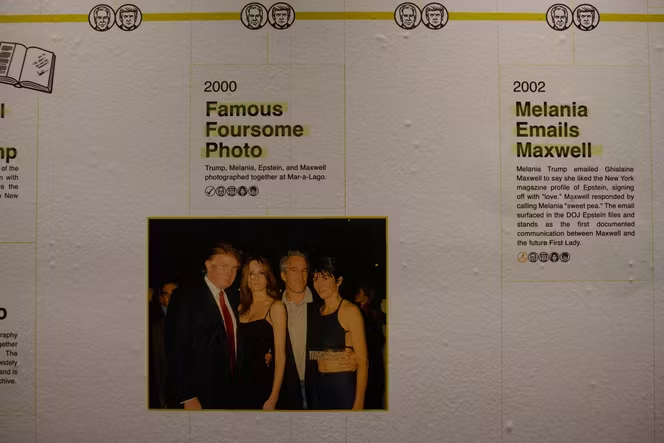
The exhibit includes a timeline tracing interactions between the two men over many years, including alleged meetings in Palm Beach, Epstein’s reported attendance at Trump’s 1993 wedding to Marla Maples, and the eventual end of Epstein’s membership at Mar a Lago.
The timeline reportedly highlights allegations that Trump later distanced himself from Epstein after witnessing inappropriate behavior involving a teenage girl at the club.
The White House strongly pushed back against implications connected to the exhibit. A spokesperson reportedly stated that Trump had been fully exonerated regarding Epstein related wrongdoing and argued that he had done more for Epstein’s victims than anyone else.
Still, the connection between Trump and Epstein remains politically explosive because Epstein socialized with numerous wealthy and influential figures across politics, business, and entertainment.
The reading room appears designed partly to visualize how deeply Epstein embedded himself within elite circles.
Constructing the Archive Was a Massive Operation
Building the installation reportedly required enormous logistical effort.
According to organizers, lawyers and fact checkers spent weeks reviewing documents to ensure the information displayed could be verified and presented accurately.
The physical challenge alone was enormous. Millions of pages had to be printed, organized, and assembled into thousands of volumes. Organizers also needed to find a venue willing to host such a politically sensitive exhibit.
That reportedly proved difficult.
The project’s main organizer, David Garrett, claimed many people feared retaliation or controversy associated with hosting an exhibit tied to Epstein, Trump, and government records.
The atmosphere surrounding the project reflects how emotionally charged the Epstein story remains years after his death.
Even now, discussions surrounding the case often trigger conspiracy theories, political accusations, and intense online battles.
Epstein Became a Symbol of Elite Impunity
Part of what makes the Epstein scandal so enduring is that many people view it as larger than one criminal case.
To critics, Epstein became a symbol of how wealth, power, and influence can shield people from accountability for years. Questions continue to surround how he maintained relationships with powerful individuals while repeatedly facing allegations involving sexual abuse and trafficking.
The fact that Epstein died in prison in 2019 before standing trial intensified public suspicion and conspiracy theories surrounding the case.
For some Americans, the scandal represents a broader collapse of trust in institutions. They see it as evidence that elites operate under different rules than ordinary citizens.
The reading room appears to deliberately lean into that symbolism by presenting the files almost like historical evidence from a systemic failure rather than simply a criminal archive.
Walking through thousands of volumes reportedly creates a physical sense of scale difficult to capture through digital headlines alone.
The Installation Raises Questions About Transparency
The exhibit also reflects a growing public demand for transparency surrounding Epstein related records.
For years, journalists, activists, and online communities have pushed for additional document releases connected to Epstein’s network, clients, and associates. The release of new Department of Justice files earlier this year intensified public curiosity even further.
Supporters of transparency argue that public access is necessary to ensure accountability and prevent powerful individuals from escaping scrutiny.
Critics, however, warn that releasing large quantities of sensitive information carries risks, especially when victims’ identities may not be fully protected.
This tension sits at the heart of the reading room itself.
The installation attempts to make the records visible without fully exposing vulnerable individuals connected to the case. That balance remains controversial, especially given the internet’s tendency to spread accusations, speculation, and harassment rapidly.
The Exhibit Blends History, Politics, and Art
Although it functions partly as an archive, the reading room also operates as a form of political and cultural statement.
The physical arrangement of documents, survivor memorials, timelines, and symbolic displays transforms the material into something closer to an immersive experience than a traditional library.
Some visitors reportedly describe the space as emotionally overwhelming.
The exhibit forces people to confront not just disturbing allegations, but also the bureaucratic scale of the case itself. Thousands of books containing evidence, emails, records, and investigative material create a sense of industrialized secrecy and institutional failure.
The experience becomes both informational and psychological.
Rather than consuming Epstein related stories through social media clips or viral headlines, visitors are confronted with the raw weight of millions of pages documenting years of allegations and investigations.
Fear and Political Pressure Still Surround the Case
The organizers also suggested that fear continues to surround discussions of Epstein and political accountability.
According to reports connected to the exhibit, Garrett referenced the recent indictment of former FBI Director James Comey while discussing concerns people had about participating in the project.
He suggested many individuals feared retaliation or controversy associated with hosting or supporting an installation connected to powerful political figures.
Whether or not those fears are justified, the comments reveal how politically sensitive the Epstein story remains.
The case intersects with ongoing debates about corruption, elite protection, media influence, conspiracy theories, and institutional trust. Few modern scandals have generated such a lasting mix of outrage and obsession across the political spectrum.
The Epstein Story Continues to Haunt America

Years after Epstein’s death, the scandal continues to shape public conversation in unusual ways.
For some people, the story represents unresolved trauma and injustice for victims. For others, it symbolizes hidden corruption within powerful social networks. Online communities continue dissecting records, relationships, timelines, and theories in search of answers they believe remain hidden.
The opening of the reading room demonstrates that public fascination has not faded.
Instead, the scandal appears to be evolving into something closer to a permanent cultural symbol tied to wealth, secrecy, and abuse of power in America.
What makes the exhibit so striking is not simply the number of documents inside the room. It is what those documents represent collectively.
Millions of pages sitting silently on shelves become evidence of how massive the Epstein investigation truly became and how many questions still linger around it.
For supporters of the exhibit, that visibility matters because they believe public memory fades too easily. Turning the files into a physical archive forces people to confront the scale directly rather than allowing the scandal to disappear into digital history.
Whether viewed as journalism, activism, memorial, or political statement, the reading room ultimately reflects a deeper national obsession with accountability and power.
And in a country increasingly distrustful of institutions, the Epstein files remain one of the clearest reminders of how strongly people still fear that some truths remain buried behind wealth, influence, and closed doors.