

Table of Contents
- When Europe Heard a Familiar but Unsettling Echo From Washington
- Why Greenland Continues to Carry Outsized Symbolic Weight
- Europe’s Immediate and Coordinated Response
- Why Tariff Threats Raised the Stakes
- How Trade Became a Pressure Point in Transatlantic Relations
- A Rare Moment of European Unity
- Why Sovereignty Became the Central Theme
- The Role of Denmark and the Nordic States
- How the EU Framed the Dispute Strategically
- Why This Episode Resonated Beyond Europe
- Transatlantic Relations in a New Phase
- Why This Was Not Simply About Trump
- What This Means for Greenland Itself
- The Economic Undercurrent Beneath the Rhetoric
- Why Europe Chose Calm Over Confrontation
- What This Means for Future Trade Negotiations
- The Arctic as an Emerging Diplomatic Flashpoint
- Why This Moment Matters in the Long Run
- A Shift in How Europe Defines Strength
- What Comes Next for Transatlantic Dialogue
- A Moment That Clarified Europe’s Voice
- Why This Episode Will Be Remembered
- A Closing Signal of Collective Resolve
When Europe Heard a Familiar but Unsettling Echo From Washington
When Donald Trump once again raised the idea of Greenland while coupling it with renewed threats of trade tariffs, European leaders reacted with an unusual degree of coordination. The response was swift, public, and notably unified. For a continent often divided by internal disagreements, the moment stood out—not because the rhetoric was new, but because the reaction was.
Trump’s comments, which revisited long-standing suggestions about Greenland’s strategic value while warning of potential economic consequences for Europe, reopened wounds that many believed had begun to heal. What followed was not merely diplomatic pushback, but a collective reaffirmation of sovereignty, alliance boundaries, and Europe’s determination to present a common front. This is an exploration of why the response mattered, how Europe found unity in tension, and what it reveals about the evolving state of transatlantic relations.
Why Greenland Continues to Carry Outsized Symbolic Weight

Greenland is vast, sparsely populated, and strategically located, making it a recurring subject of geopolitical fascination. Though an autonomous territory within the Kingdom of Denmark, Greenland occupies a central position in Arctic security, climate research, and emerging global trade routes.
When Trump previously suggested that the United States could acquire Greenland, the idea was dismissed as implausible but revealing. Revisiting the topic, even rhetorically, rekindled concerns about how sovereignty is discussed in an era of renewed great-power competition. For Europe, Greenland is not merely territory—it is a test case for respect of international norms.
Europe’s Immediate and Coordinated Response
European leaders moved quickly to dismiss any implication that Greenland’s status was negotiable. Officials emphasized that sovereignty is not a bargaining chip and that discussions about territory must be grounded in international law and mutual consent.
What made the response notable was its consistency. From Nordic leaders to EU officials, the message was aligned. Greenland was not for sale, not open to negotiation, and not a topic for transactional diplomacy. In an EU often characterized by divergent voices, the unity was striking.
Why Tariff Threats Raised the Stakes
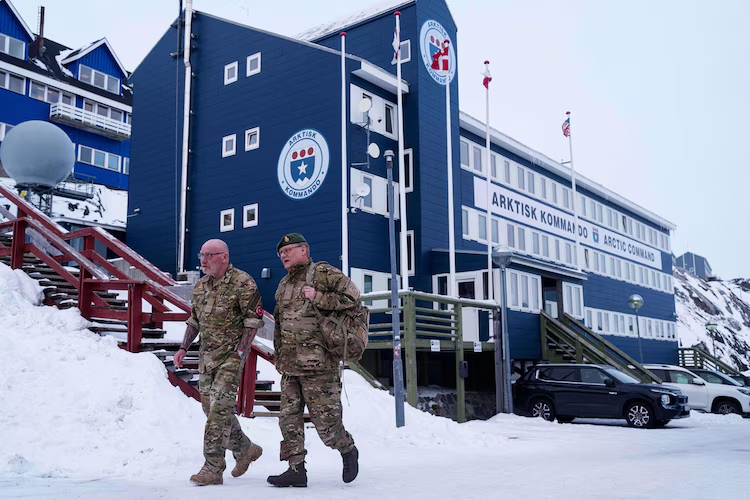
Trump’s remarks did not stop at Greenland. They were accompanied by renewed warnings of tariffs on European goods, a familiar tactic from his previous term. For Europe, this revived memories of trade disputes that strained economic relations and disrupted supply chains.
Tariffs are not merely economic tools; they are political signals. By pairing territorial rhetoric with trade threats, the message appeared confrontational, prompting Europe to treat the situation as more than rhetorical noise.
How Trade Became a Pressure Point in Transatlantic Relations
Trade has long been a source of friction between the United States and Europe. While the two economies are deeply interconnected, disputes over tariffs, subsidies, and market access have periodically escalated into broader diplomatic tensions.
European leaders view trade threats as destabilizing, particularly at a time when global economic uncertainty remains high. The prospect of renewed tariff battles strengthened Europe’s resolve to respond collectively rather than bilaterally.
A Rare Moment of European Unity

Internal divisions often complicate Europe’s foreign policy responses. Differences in economic priorities, security perspectives, and domestic politics can fracture consensus. Yet in this case, Europe spoke with one voice.
This unity was not accidental. It reflected a shared understanding that responding individually would weaken Europe’s position, while collective response reinforced credibility. The episode became a reminder that external pressure can sometimes accelerate internal cohesion.
Why Sovereignty Became the Central Theme
At the heart of Europe’s response was sovereignty—not only Greenland’s, but Europe’s own political agency. The firm rejection of any suggestion of territorial negotiation reaffirmed a principle that resonates deeply across the continent, shaped by centuries of conflict and reconstruction.
European officials framed the issue not as opposition to the United States, but as defense of norms. This distinction allowed Europe to push back without severing diplomatic ties, emphasizing principle over provocation.
The Role of Denmark and the Nordic States

Denmark, as Greenland’s sovereign partner, played a central role in articulating Europe’s stance. Danish officials emphasized Greenland’s autonomy and the importance of respecting its people’s right to self-determination.
Nordic countries, traditionally cautious in rhetoric, aligned closely with this position. Their response underscored regional solidarity and highlighted the Arctic’s growing importance in global diplomacy.
How the EU Framed the Dispute Strategically
Rather than escalating the rhetoric, EU officials focused on stability, law, and cooperation. Statements emphasized dialogue while drawing clear boundaries. This approach reflected a strategic choice: resist provocation without amplifying it.
By framing the issue within established diplomatic language, the EU sought to demonstrate maturity and reliability—qualities it increasingly emphasizes in global affairs.
Why This Episode Resonated Beyond Europe
The exchange drew attention globally, not because of immediate consequences, but because of what it signaled. Allies, rivals, and observers watched closely to see whether Europe would fracture or consolidate under pressure.
The unified response sent a message that Europe is increasingly willing to assert itself collectively, particularly when core principles are challenged.
Transatlantic Relations in a New Phase
The episode highlights a shift in transatlantic relations. While cooperation remains essential, Europe is no longer content to rely solely on assumptions of alignment. Strategic autonomy, once an abstract concept, is becoming a guiding principle.
Europe’s reaction reflected growing confidence in its ability to articulate interests independently while maintaining partnerships.
Why This Was Not Simply About Trump
Although Trump’s remarks were the catalyst, the response was about more than one political figure. It reflected broader European concerns about unpredictability in global leadership and the need for institutional resilience.
By responding to the substance rather than the personality, Europe framed the issue as systemic rather than personal.
What This Means for Greenland Itself

For Greenland, the episode reaffirmed international recognition of its autonomy and dignity. European leaders emphasized that Greenland’s future must be decided by its people, not external actors.
This support strengthens Greenland’s position in navigating increased global interest in the Arctic.
The Economic Undercurrent Beneath the Rhetoric
Trade threats carry tangible consequences. European industries remain sensitive to tariff escalation, particularly in manufacturing, agriculture, and technology.
By responding early and collectively, Europe aimed to deter escalation before economic damage could materialize.
Why Europe Chose Calm Over Confrontation
Despite firm language, Europe avoided inflammatory rhetoric. This restraint was deliberate. Escalation could have triggered retaliatory cycles that neither side desired.
Calm firmness allowed Europe to assert boundaries while preserving diplomatic space.A Test of Europe’s Diplomatic Maturity
This episode functioned as a stress test for European diplomacy. The ability to coordinate, communicate clearly, and resist fragmentation demonstrated institutional maturity.
For many observers, it marked progress from reactive diplomacy toward proactive positioning.
What This Means for Future Trade Negotiations
The unified response may influence future trade discussions. It signals that Europe prefers collective negotiation and will resist pressure tactics that target individual states.
This approach could reshape how transatlantic trade disputes are managed moving forward.
The Arctic as an Emerging Diplomatic Flashpoint
Greenland’s mention highlights the Arctic’s growing geopolitical importance. Climate change, resource access, and security concerns are drawing increased attention to the region.
Europe’s response suggests readiness to defend Arctic governance norms as interest intensifies.
Why This Moment Matters in the Long Run
While the immediate consequences were limited, the symbolic impact was significant. Europe demonstrated that unity is possible when principles are clearly defined.
This precedent may shape responses to future challenges, whether economic, territorial, or strategic.
A Shift in How Europe Defines Strength
Strength, in this context, was not expressed through retaliation, but through coherence. Europe’s response redefined strength as the ability to remain calm, coordinated, and principled under pressure.
This definition aligns with the EU’s broader self-image as a stabilizing force.
What Comes Next for Transatlantic Dialogue
Dialogue will continue, but with clearer expectations. Europe’s message suggests willingness to cooperate, but not at the expense of sovereignty or stability.
Future engagement will likely involve firmer boundaries alongside continued diplomacy.
A Moment That Clarified Europe’s Voice
In responding to Trump’s Greenland remarks and tariff threats, Europe clarified something important—not only to Washington, but to itself. It demonstrated that unity is not merely aspirational, but achievable when stakes are high.
The moment may fade from headlines, but its implications linger.
Why This Episode Will Be Remembered
This was not the most dramatic confrontation in transatlantic history, nor the most consequential. Yet it revealed a shift in tone and confidence that may define future interactions.
Europe did not shout. It did not fracture. It simply spoke together.
A Closing Signal of Collective Resolve
As the dust settled, one thing became clear: Europe’s response was less about resisting a threat and more about asserting identity. In doing so, it reinforced the idea that sovereignty, unity, and dialogue are not mutually exclusive.
In a world increasingly defined by uncertainty, Europe’s collective stance offered a rare moment of clarity—and a reminder that unity, once found, can be its own form of power.