
Table of Contents
- They Survived War — Then the Storm Was Waiting
- Storm Byron: A Winter Test Gaza Was Never Built to Endure
- A Humanitarian Crisis Meets a Public Health Explosion
- Why the Floods Were Worse than Expected
- Children on the Frontlines of a Silent Threat
- Shelter Shortages: A Risk Factor No One Could Afford
- Disease Risk Is Rising — And It’s Not Just Waterborne Illness
- Why Gaza’s Winter Floods Are a Global Alarm Bell
- How the World Is Responding — And Why It Matters
- A Crisis Beyond Headlines — What Comes Next?
They Survived War — Then the Storm Was Waiting
On a rainy December night, mud swallowed tents that had already seen too much.
Displaced families in Gaza, exhausted from two years of conflict and displacement, once again faced a threat they never expected: floodwaters rising inside their fragile homes — not from bombs this time, but from a winter storm blending nature’s wrath with man‑made catastrophe.
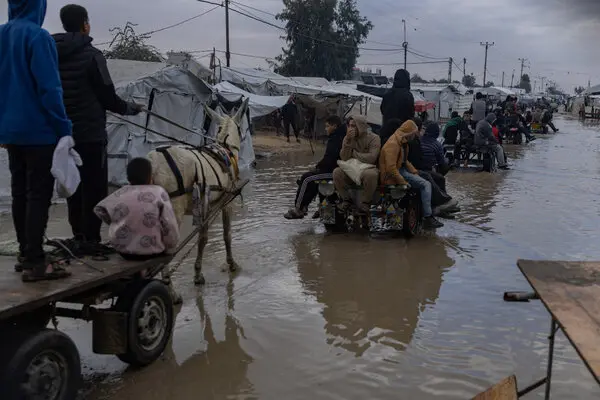
Across the Gaza Strip, tents became bathtubs, streets turned to rivers of sludge, and children huddled against the cold as water seeped into every corner of their lives.
If you survived war, how do you survive a storm?
That question has become a grim reality for nearly 1.5 million displaced Gazans this winter — and the consequences go far beyond soaked belongings. It’s now a full‑blown health crisis with disease spreading where civil infrastructure has collapsed.
This is a story about survival, vulnerability, and how nature exploits the weakest fault lines in a broken system.
Storm Byron: A Winter Test Gaza Was Never Built to Endure
Storm Byron arrived like thunder in a land already in pain — a region where:
- homes are ruins,
- water systems are damaged,
- and sanitation barely exists.
The result?
Torrential rain flooded hundreds of makeshift displacement camps, submerging tents and forcing families into mud and cold.
In Khan Younis, medics reported an infant dying of exposure, a haunting symbol of how vulnerable life here has become.
Imagine rain so relentless that it doesn’t just wet the ground — it ruins what little shelter you have left. Imagine waking up drenched, with nowhere to move without trudging through water and filth.
That’s the daily nightmare here.
A Humanitarian Crisis Meets a Public Health Explosion
Floodwaters don’t just soak tents.
They mix with sewage, poison water sources, and create perfect breeding grounds for disease.
According to global health experts monitoring the region, flooding in Gaza raises the risk of multiple waterborne illnesses — from gastrointestinal infections to skin diseases — because much of the water and sanitation infrastructure was destroyed long before this storm hit.
With sewage systems crippled and untreated waste swirling through the streets, the risk of outbreaks is no longer hypothetical — it’s already happening.
Ask yourself: What happens to a population when disease spreads faster than aid trucks can arrive?
This is the question aid organizations are racing to answer.
Why the Floods Were Worse than Expected
It wasn’t just rain.
It was rain falling on terrain that had lost its ability to absorb water.
Years of bombardment destroyed roads, drainage systems, and wastewater treatment plants. Most sewage pumping stations have been destroyed, and groundwater is contaminated with toxins and waste, making every flood a toxic threat.
In normal circumstances, cities divert water through drains and treatment facilities.
In Gaza?
There are almost no functioning systems left.
Street runoff mingles with sewage. Broken pipes leak into drinking water. Flooded camps rage with stagnant pools teeming with bacteria — the perfect storm for disease outbreaks.
No infrastructure. No filtration. No safety net.
Just water where it should never be — and health risks multiplying in its wake.
Children on the Frontlines of a Silent Threat
The most vulnerable are suffering first.
A baby — barely eight months old — died after exposure to the cold and rain in a flooded tent.
Behind that single headline is a deeper story:
Children in Gaza are now at risk not just from conflict, but from disease, cold stress, pollution, and contaminated water.
Medical staff working with local partners report a surge in:
- respiratory infections triggered by damp, cold conditions,
- skin infections from filthy water,
- diarrheal diseases due to contaminated drinking sources.
For children whose immune systems are already weakened by malnutrition, the storm is not just an environmental disaster — it’s a health catastrophe.
These diseases don’t just make people sick.
They can be deadly — especially when health facilities lack resources. Nearly half of Gaza’s clinics are operating with limited capacity or have shut their doors entirely because of flooding and infrastructure damage.
Shelter Shortages: A Risk Factor No One Could Afford
Aid agencies warn that hundreds of thousands of Gazans are living in conditions that simply can’t withstand winter storms.
Even before the rains, winter was a threat:
- lack of waterproof tents,
- inadequate clothing,
- no thermal blankets,
- and damaged homes all increased exposure risks.
When 795,000 people are living in low‑lying areas with poor drainage and blocked access to shelter supplies, heavy rain becomes more than rain — it becomes a life‑and‑death issue.
Aid convoys, delayed or blocked at entry points, were unable to deliver enough supplies in time. And because infrastructure is destroyed, even trucks that do arrive struggle to reach people most in need.
It’s like trying to fill a leaky bucket during a flood — the more you try to help, the faster the crisis spreads.
Disease Risk Is Rising — And It’s Not Just Waterborne Illness
Flooding also creates conditions that accelerate other health risks.
When sewage mixes with floodwater, bacteria and toxins spread rapidly.
When potable water is scarce, people drink what’s available — which may be contaminated.
And when displaced populations are crowded together in cold, muddy tents, respiratory infections take hold quickly.
According to health agencies tracking disease trends, outbreaks — especially of respiratory diseases and intestinal infections — are already rising in shelter camps.
This is not a future risk.
This is a present reality.
Why Gaza’s Winter Floods Are a Global Alarm Bell
When a region’s infrastructure collapses and disease begins spreading rapidly, it doesn’t just affect local residents — it strains regional health systems and humanitarian networks.
And it doesn’t exist in isolation.
Around the world, extreme weather events are increasing in frequency and severity due to climate change. In Asia, record floods recently killed hundreds and devastated communities, showing that intensified rainstorms are becoming a global pattern, not a one‑off tragedy.
Climate change, conflict, and poor infrastructure are converging into what experts call compound crises — situations where multiple disasters overlap, making response harder and consequences worse.
Gaza’s flooding is one such crisis — where war weakened the earth, and nature delivered the blow.
How the World Is Responding — And Why It Matters
International organizations — from the UN International Organization for Migration to NGOs on the ground — are sounding the alarm.
They say:
✔ More tents and shelter materials are urgently needed
✔ Water‑pumping equipment must reach flooded areas
✔ Medical resources must be scaled up immediately
But the window to act is closing fast.
Families are running out of dry space.
Food supplies are dwindling.
And disease thrives where people are packed together in unsanitary, cold conditions.
The million‑dollar question — literally and figuratively — is this:
Will global aid arrive fast enough to prevent a larger health catastrophe?
The answer may determine not just survival in Gaza — but how humanitarian crises are managed worldwide when extreme weather hits vulnerable populations.
A Crisis Beyond Headlines — What Comes Next?
So where does Gaza go from here?
Floodwaters will eventually recede.
But the health crisis they leave behind may last months or years if:
- drinking water remains unsafe,
- sewage systems are not repaired,
- disease outbreaks continue unchecked,
- and shelter needs go unmet.
And climate scientists warn that severe weather events like this won’t be the last — especially where infrastructure is fragile.
In a world where climate risk intersects with conflict zones, Gaza’s floods are a wake‑up call for how we plan for disasters that combine war, poverty, and extreme weather.
Ask yourself:
What does it mean for global health — when the world’s most vulnerable people are left without protection from the storm?
The answer may reshape how humanitarian aid, public health systems, and climate resilience strategies are designed in every corner of the globe.