

Imagine standing on a beach, staring at endless blue waves, while holding an empty glass in your hand. You’re thirsty. Dying of thirst, even. And yet, you can’t drink a single drop of the ocean in front of you.
For decades, this has been the cruel irony of our planet: we’re surrounded by water, but most of it is undrinkable.
Now, a team of British scientists says they may have cracked the code—with a filter so advanced, it could turn seawater into clean drinking water almost instantly.
If true, this discovery could reshape everything from global health and travel to finance and home living.
But what makes this filter different? And is it really the miracle solution humanity has been waiting for?
Table of Contents
- The Water Crisis You Don’t See Every Day
- Why Seawater is So Hard to Drink
- Enter Graphene: The Wonder Material
- Why This Filter Changes Everything
- What If Every Home Had Its Own Ocean Tap?
- The Money Behind the Miracle
- The Travel Angle: No More Fear of Tap Water
- The Health Impact: Saving Millions of Lives
- What Could Go Wrong?
- From Seawater to the Sky: What’s Next for Graphene?
- Imagine This Future
- Final Thoughts
The Water Crisis You Don’t See Every Day
When you open a tap, water flows. It feels normal. Automatic.
But for 2.2 billion people worldwide, clean water isn’t guaranteed. Families walk miles to reach a well. Children get sick from contaminated sources. Cities ration supplies during droughts.
Even wealthy nations aren’t safe. Cape Town nearly ran dry in 2018. California faces constant drought battles. And climate change is only making it worse.
If this technology works, the story of water could flip overnight.
Why Seawater is So Hard to Drink

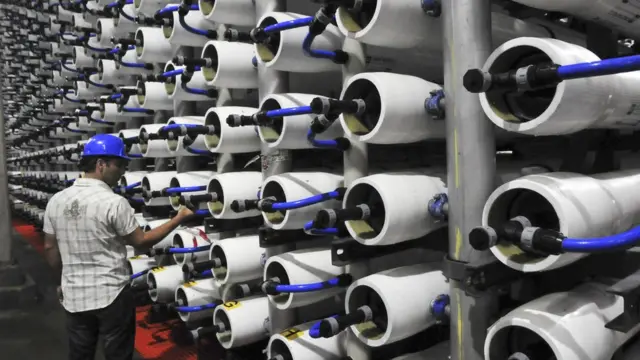
You’d think desalination—the process of removing salt from seawater—would be an obvious solution. After all, 97% of Earth’s water is in the oceans.
But traditional desalination plants are:
- Massive and expensive, costing billions to build.
- Energy-hungry, guzzling electricity to force water through membranes.
- Environmentally messy, discharging super-salty brine back into the ocean.
That’s why most countries can’t afford desalination at scale.
Which brings us back to the British breakthrough…
Enter Graphene: The Wonder Material
Graphene isn’t just any filter. It’s a sheet of carbon atoms arranged in a honeycomb structure, only one atom thick—the thinnest material known to science.
Here’s why that matters:
- Strength: It’s 200 times stronger than steel.
- Lightweight: Practically featherlight.
- Conductive: Carries electricity better than copper.
- Precise: Can filter molecules at the atomic level.
When scientists engineered a graphene oxide membrane, they discovered something incredible: it could block salt and contaminants while letting water molecules slip through almost effortlessly.
This means instant desalination with far less energy.
Why This Filter Changes Everything

Think about the ripple effects:
- Health: Millions of people could avoid deadly waterborne diseases.
- Finance: Countries could save billions currently spent on water infrastructure.
- Travel: Backpackers, sailors, and disaster zones could carry portable water filters instead of heavy bottles.
- Home improvement: Households in drought-prone regions could install compact desalination systems right in their kitchens.
This isn’t just about drinking water. It’s about reshaping economies, lifestyles, and even geopolitics.
What If Every Home Had Its Own Ocean Tap?
Picture this. Instead of relying on distant reservoirs or unpredictable rainfall, your home has a compact filter that takes seawater—or even polluted river water—and turns it into crystal-clear drinking water.
No more rationing. No more worrying about contamination.
That’s the vision British researchers are pushing toward. And it could disrupt industries the same way solar panels did for energy.
The Money Behind the Miracle

Here’s where things get interesting.
Water is big business. From bottled water companies to municipal suppliers, entire industries profit from scarcity.
If graphene filters scale, they could:
- Slash bottled water sales, a $300 billion industry.
- Reduce infrastructure costs for governments.
- Open massive investment opportunities in graphene production and nanotechnology.
Investors are already circling. Graphene isn’t just useful for water—it’s being tested for batteries, electronics, and even medical implants. The global graphene market is expected to exceed $2 billion by 2030.
So the real question is: who controls the patents? Whoever does may hold the keys to the world’s next essential resource—water.
The Travel Angle: No More Fear of Tap Water
Travelers know the rule: “Don’t drink the tap water” in many countries. It’s why bottled water piles up in hotels from Bali to Mexico City.
Now imagine tossing a sleek graphene filter into your backpack. Whether you’re hiking in Peru or camping in Africa, you’d always have safe water.
For tourism-heavy nations, this could be game-changing. Clean water means healthier travelers, less waste, and more sustainable tourism.
Would you feel safer traveling if you never had to worry about unsafe tap water again?
The Health Impact: Saving Millions of Lives
According to the World Health Organization, over 500,000 people die each year from contaminated water. Most of them are children.
That number could drop dramatically with affordable, portable graphene filters.
Doctors Without Borders, refugee camps, and disaster response teams could carry compact systems into emergencies. After hurricanes, earthquakes, or wars, survivors often suffer more from dirty water than from the event itself.
This isn’t just science—it’s survival.
What Could Go Wrong?
It’s easy to get swept up in the excitement. But let’s pause.
Challenges remain:
- Cost: Large-scale graphene production is still expensive.
- Durability: Will filters clog or wear down too quickly?
- Access: Will the technology reach the poorest regions—or just wealthy nations first?
And here’s the uncomfortable truth: sometimes, life-saving innovations are slowed down not by science, but by politics and profit.
From Seawater to the Sky: What’s Next for Graphene?
Graphene’s potential doesn’t stop at water.
Scientists are exploring:
- Graphene-based solar panels that could make renewable energy even cheaper.
- Flexible electronics for next-gen smartphones.
- Medical uses, from cancer detection to artificial retinas.
In other words, desalination might just be the beginning of graphene’s global takeover.
Imagine This Future
You’re sitting at home in 2035. Drought warnings flash on the news. Supermarkets ration bottled water. But you’re calm.
Because in your kitchen, a sleek graphene unit hums quietly, pulling fresh water from the ocean pipeline at the edge of your city.
Outside, your neighbor fills a glass from his filter. Across the world, a village once ravaged by drought drinks safely from a graphene-powered well.
The technology is invisible, but the impact is everywhere.
Would you trust a material only one atom thick to keep your family alive?
Final Thoughts
For centuries, humans have dreamed of turning the sea into a source of life instead of death. Now, British scientists say we’re closer than ever.
Graphene filters aren’t science fiction anymore. They’re real. And if scaled, they could solve one of humanity’s oldest problems.
The ocean has always been a symbol of abundance we couldn’t touch. Now, with a filter thin enough to be invisible, we may finally drink from it.