

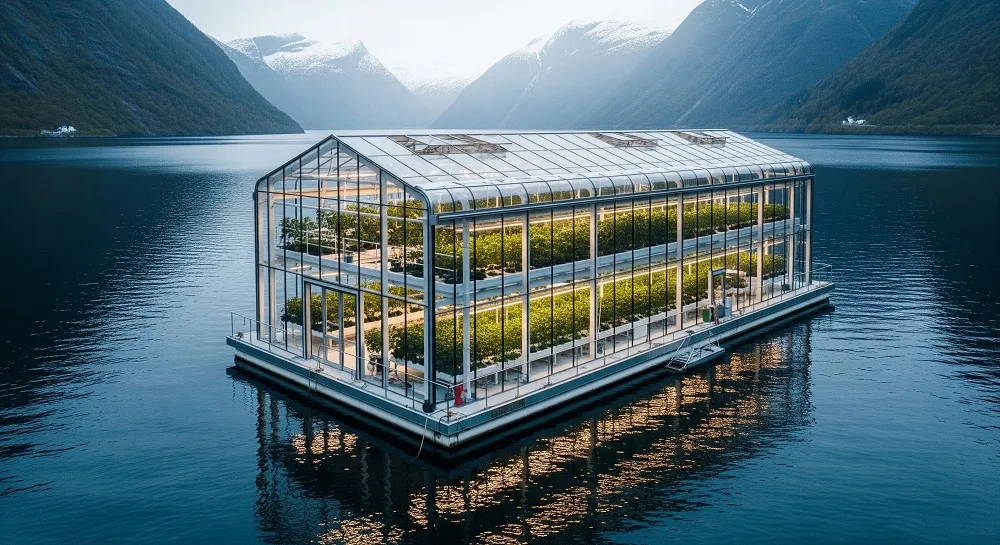
Imagine sailing through Norway’s breathtaking fjords. The air is crisp, the mountains dramatic, and then you see it—something that looks like a glass bubble floating serenely on the water. Inside? Rows of thriving green plants, bathed in sunlight, shielded from the cold winds.
It’s not science fiction. It’s a floating greenhouse. And it might just be the future of farming.
Table of Contents
- Why a Floating Greenhouse?
- The Concept: A Green Bubble at Sea
- How Floating Farming Works
- Norway’s Experiment: A Bold First Step
- The Money Question: Can It Compete?
- Could You Live Off a Floating Farm?
- What About Climate Change?
- From Norway to the World
- Would You Book a Trip to See One?
- The Home Connection: Could Your House Benefit?
- The Challenges Ahead
- Why This Matters to You
- The Big Picture
Why a Floating Greenhouse?
At first glance, it feels unnecessary. After all, isn’t there enough farmland on land?
The truth is sobering. Global farmland is shrinking while the population keeps rising. Cities are sprawling, soil is degrading, and climate change is making traditional agriculture more unpredictable than ever.
Floating greenhouses flip the equation. Instead of fighting land shortages, they expand farming onto water. In a country like Norway, where the coastline stretches for more than 62,000 miles, the opportunity is enormous.
And if floating farms work in the cold, stormy waters of Scandinavia, they could work anywhere.
The Concept: A Green Bubble at Sea

The prototype that sparked global attention looks like a giant geodesic dome bobbing gently on the water. Its translucent panels trap sunlight, creating a warm, controlled environment perfect for growing vegetables, fruits, and even exotic crops.
The structure rests on floating pontoons, anchored to prevent drifting. Inside, advanced hydroponic systems feed plants with nutrient-rich water, eliminating the need for traditional soil.
Think of it as a self-contained eco-lab, where farming becomes resilient to storms, pests, and extreme weather.
But the big question is: can this futuristic design scale to feed real communities?
How Floating Farming Works
At its core, the system blends three technologies:
- Hydroponics and Aquaponics – Plants grow in water, not dirt. Some systems even integrate fish farming, where fish waste fertilizes crops.
- Solar and Renewable Power – Panels built into the greenhouse provide electricity for lighting, heating, and pumps.
- Water Recycling – Rainwater and seawater can be filtered, making the greenhouse largely self-sufficient.
In other words, it’s a closed-loop farm designed to thrive almost anywhere—even in places where traditional farming is impossible.
Norway’s Experiment: A Bold First Step

Why Norway?
The country already leads in offshore engineering thanks to its oil rigs and wind farms. Now, innovators are applying that same know-how to food security.
The floating greenhouse gained attention not just for its futuristic look, but because it demonstrated that food could be grown sustainably in a nation where winters are long, dark, and cold.
It’s a proof of concept that challenges how we think about farming. If you can grow fresh tomatoes in a glass bubble on a fjord, why not scale it up?
The Money Question: Can It Compete?
Here’s the elephant in the room: floating greenhouses are expensive.
Building structures that can withstand waves, ice, and storms costs far more than traditional farmland. But remember—solar panels, electric cars, and offshore wind were all “too expensive” once.
Investors are already circling. Green finance funds see floating farming as a future trillion-dollar market. Imagine cities like Singapore, Dubai, or Hong Kong importing food not from distant countries, but from floating farms anchored just offshore.
If food prices keep rising and land scarcity worsens, these glass domes could look less like luxuries and more like necessities.
Could You Live Off a Floating Farm?

Picture this: your vegetables aren’t shipped across oceans, but grown a few miles offshore, harvested in the morning, and on your plate by evening.
Would you pay more for lettuce that traveled five miles instead of 5,000? Many consumers already do. That’s why supermarkets highlight “local produce” labels—freshness sells.
Now, imagine communities where floating farms provide not just food, but jobs, renewable energy, and even eco-tourism. Suddenly, farming isn’t just rural—it’s a part of modern coastal life.
What About Climate Change?
This is where floating greenhouses shine.
Rising seas threaten to drown farmland in countries like Bangladesh, the Maldives, and Pacific island nations. But what if farmland could float? Instead of losing land to water, communities could adapt and farm on the water.
It’s not just farming—it’s climate resilience.
In fact, the United Nations has already highlighted floating agriculture as one of the most promising ways for coastal communities to survive.
From Norway to the World
The floating greenhouse is more than a quirky Nordic experiment. It’s part of a global movement:
- In the Netherlands, architects are designing entire floating neighborhoods with farms attached.
- In Singapore, vertical floating farms are being tested to reduce dependence on imports.
- In the Maldives, developers are exploring floating resorts with built-in hydroponic food systems.
Norway’s glass dome might be the spark, but the fire is spreading worldwide.
Would You Book a Trip to See One?
Here’s a twist you might not expect: floating farms could double as tourist attractions.
Eco-travelers already flock to organic farms, vineyards, and farm-to-table resorts. Imagine booking a tour of a futuristic floating greenhouse, tasting fresh strawberries grown in the middle of a fjord, then staying the night at an attached eco-lodge.
Would you go? Many travelers say yes—and that creates another revenue stream that could make these projects profitable.
The Home Connection: Could Your House Benefit?
You might not live near a fjord, but the technology inside floating greenhouses could trickle down into everyday life.
Hydroponics and vertical farming kits are already hitting the home improvement market. Homeowners can install compact systems to grow lettuce, herbs, and even strawberries in kitchens or garages.
It’s a reminder that innovation isn’t limited to billion-dollar projects. The same systems that power futuristic farms can help families save money, eat healthier, and reduce reliance on grocery chains.
Would you consider growing 20% of your food at home if it saved you hundreds per year?
The Challenges Ahead
Of course, it’s not all smooth sailing. Floating farms face real obstacles:
- Cost – Can they scale without huge subsidies?
- Durability – How do they survive storms, ice, and saltwater corrosion?
- Ecosystems – Could they disrupt marine life if scaled massively?
- Policy – Who owns the ocean space where these farms sit?
Each of these questions will decide whether floating farming becomes the future—or remains a curiosity.
Why This Matters to You

This isn’t just about Norway. It’s about food prices, job creation, and global security.
The next time you see your grocery bill climb, remember: food supply chains are fragile. Droughts, shipping delays, and wars all disrupt the flow of crops. Floating farms offer a way to shorten that chain, bringing food production closer to where people actually live.
That means fewer shortages. Lower transport emissions. And fresher food on your plate.
The Big Picture
Floating greenhouses aren’t just about farming. They’re about rethinking how humans live with water.
For centuries, we’ve fought to keep the sea away from our cities and crops. Now, innovators are asking: what if we embraced it instead?
Norway’s glass bubble is more than a farm—it’s a vision. A vision of cities with floating food hubs, coastlines dotted with sustainable domes, and homes powered by the same renewable systems inside those bubbles.
The question is: will we build this future fast enough?