
Table of Contents
A Long Requested Fix to a Very Old Problem
For millions of users, the biggest significance of this feature is emotional as much as practical. Google’s own blog framed the change as a way to help an account “grow with you,” and that captures the heart of the issue. People change names, careers, relationships, and public identities. Some created a Gmail address as teenagers and then carried it into adulthood. Others made a professional compromise, opened a second account, or simply kept living with an address they disliked because the cost of abandoning years of mail, files, photos, contacts, subscriptions, and sign-ins felt too high. By letting users change the Gmail username without forcing them to rebuild their digital lives from scratch, Google has finally acknowledged that identity online is not static.
The feature also matters because Google did not solve the problem with a crude migration. It did not tell users to export their data, open a new account, and move on. Instead, it preserved continuity. According to Google’s Help Center, when a user changes from one @gmail.com address to another, the previous address becomes an alternate email address. Messages sent to both the old and new addresses still arrive in the same inbox. The data in the account stays intact, including photos, messages, and mail previously sent to the old address. Users can also sign in with either the old or new email on Google services. That continuity is what turns this from a cosmetic feature into something genuinely powerful.
What the Feature Actually Does
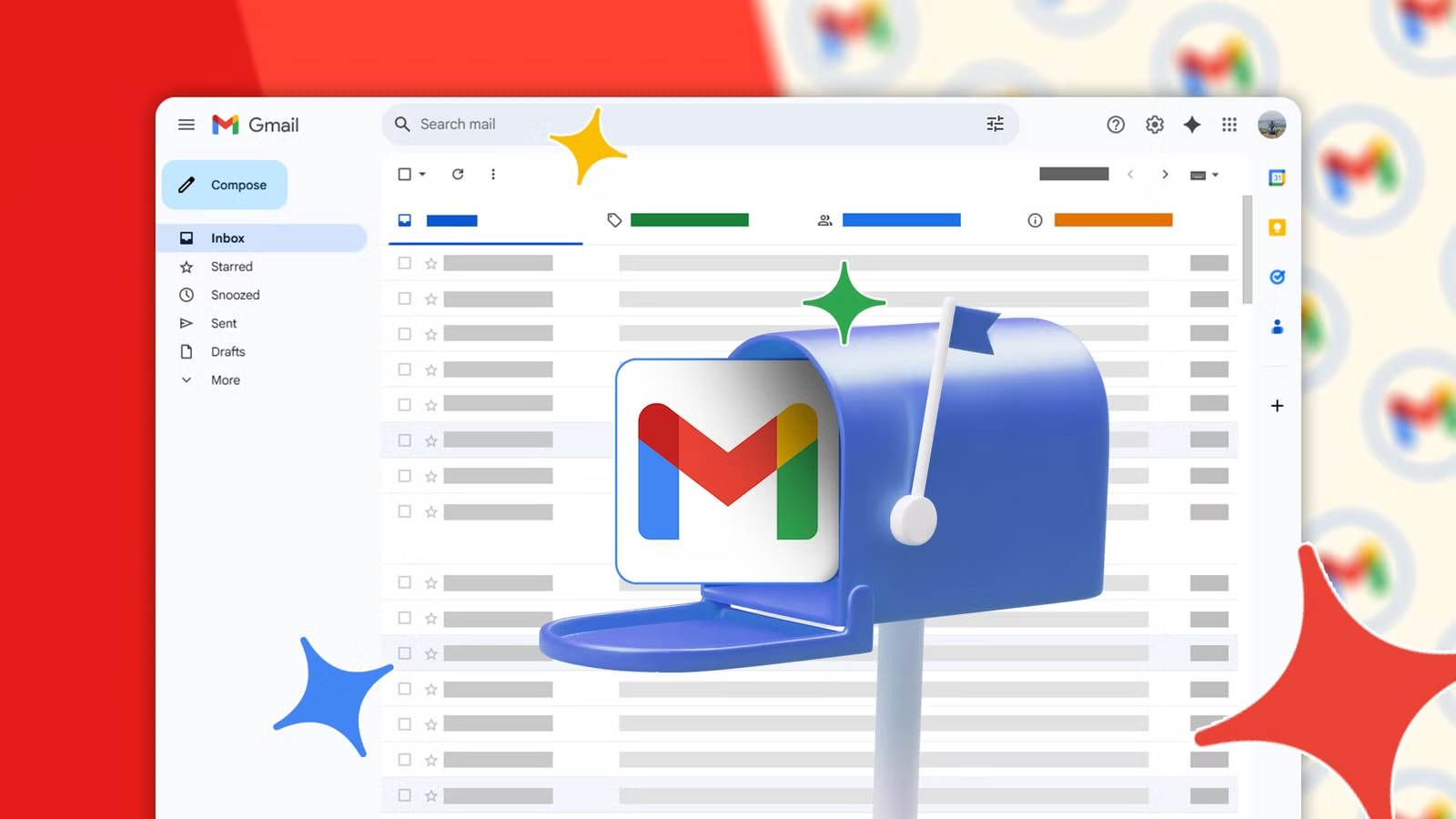
Google’s documentation is unusually clear about what happens after the switch. The old Gmail address does not vanish. It becomes an alternate email attached to the same account. Email sent to both addresses continues to arrive. Users can still sign in to services like Gmail, Maps, YouTube, Google Play, and Drive with either the old or the new address. They can also choose to send mail from either address, which means the old identity can remain available for communication even after the new one becomes primary.
That design choice solves several problems at once. It prevents the nightmare scenario where someone changes their address and instantly loses access to old contacts, old subscriptions, and old sign-in habits. It also preserves a measure of backward compatibility for people whose earlier Gmail address is already known by friends, schools, employers, or websites. In practical terms, Google has turned the old address into a permanent alias rather than a discarded credential. That is a much more user-friendly outcome than a hard switch, and it explains why the feature will likely be welcomed by people who have spent years stuck between keeping an outdated address and starting over entirely.
Google also built in the ability to reverse course. The Help Center says users can switch back to their previous Google Account email at any time. But there is an important limitation: after creating a new Gmail-based Google Account email, users cannot create another new one for the next 12 months. So the flexibility is real, but it is not unlimited. Google appears to want the feature used thoughtfully rather than casually.
The Limits Show This Was Not Built Casually
The restrictions Google attached to the feature are some of the most revealing details in the rollout. According to the Help Center, users can create a new Google Account email ending in @gmail.com only once every 12 months and only three times total. Google also says a single account can have up to three new Gmail addresses over its lifetime, for a total of four including the original. That cap immediately tells you this is not meant to be a disposable identity tool. It is a controlled, carefully bounded feature attached to a long-lived account.
There are other boundaries too. Users cannot delete the new Gmail address after creating it. The old one remains as an alternate email and cannot be claimed by anyone else. Even if the account is deleted, no one else can use that old Google Account email. Google also makes clear that users cannot use their old Gmail address to create a brand-new account later. That means Gmail username history becomes permanently attached to the original account rather than released back into circulation. From a security and anti-abuse perspective, that makes sense. It reduces impersonation risk, blocks account recycling confusion, and keeps old address identity tied to the person who already used it.
These rules also show that Google is handling email identity as something closer to account history than mere display text. A Gmail username is not being treated like a profile nickname you can swap every weekend. It is being treated like a durable layer of identity that can evolve, but only under strict controls. That design is probably one reason Google waited so long to release the feature in the first place.
The Technical Lift Was Probably as Big as It Sounds
Google has not published a full engineering deep dive on how it built this feature. But even from the official documentation, the technical complexity is easy to infer. This is not just an email rename. The changed Google Account email shows up in sign-in systems, sharing surfaces, Calendar invites, Google Drive permissions, send-from aliases, app settings, and account menus. Google also warns that some app settings may reset during the change, in a way similar to signing in on a new device. That suggests the change touches more than a single label in one database. It touches the relationship between the visible email address and the deeper account systems that many Google products rely on.
The official help page also warns users to review possible issues before changing their address. Chromebook users may need to take special steps. People who use Sign in with Google on non-Google sites are told to review how the change may affect those connections. Chrome Remote Desktop is flagged as another possible complication. Google also recommends backing up data as a precaution before making the switch. None of those warnings would exist if this were a trivial profile edit. They strongly suggest the feature had to be designed across multiple identity-dependent systems, each with its own assumptions about what a “primary email” means. That is why the apparent simplicity of “change your Gmail address” hides what was almost certainly a very large internal effort.
What Stays the Same and What Does Not
One of the smartest parts of Google’s documentation is its honesty about what does not change retroactively. The company says that while the new address will appear when users access Google products after the switch, old instances are not updated after the fact. Calendar events created before the change may still show the old email. That means Google is preserving account continuity without pretending it can or should rewrite every historical artifact produced by the account.
This distinction matters because it sets expectations correctly. Users should think of the feature as changing their account’s present and future identity layer, not as rewriting all history. That is likely the only realistic way to implement it safely at scale. Anything more aggressive could risk damaging records, permissions, invitations, or long-established references across third-party and internal systems. Google chose continuity over total retroactive cleanup, and for a platform this large, that was almost certainly the right tradeoff.
It also means there will be a transition period in how people experience the new identity. Friends may still have the old address in past threads. Shared documents and prior invites may show it. Some non-Google websites that stored the original address may continue displaying that address until users manually update their profile there. The feature solves a huge problem, but not by pretending years of accumulated digital history can be erased with one click.
Why This Matters for Identity, Not Just Convenience
The most meaningful part of this rollout may be the reason Google says it built it. The official blog described the feature as a way for an account to grow with its user. That framing matters because it recognizes that a Gmail address is not just contact information. It is often a public expression of who someone is, and for many users it becomes tightly bound to work, family, personal safety, self-presentation, and belonging. The ability to update it without losing access to one’s accumulated digital life is not just convenient. For some people, it is a form of overdue control over identity.
This is especially important for people whose names or life circumstances have changed. It also matters for users who outgrew an address that felt unserious, revealing, outdated, or simply misaligned with how they want to be known. Until now, Google’s practical answer was often to add aliases, create new accounts, or live with the mismatch. This feature does something more respectful. It allows continuity without forcing someone to remain trapped inside a label they no longer want.
The Rollout Is Real, but Not Universal Yet
Google says the feature is available now to all Google Account users in the U.S., but its Help Center also notes that the ability to change a Google Account email is gradually rolling out and may not yet appear for every user. The company tells people to check availability by opening the Google Account email settings and looking for the “Change Google Account email” option. If that option does not appear, the feature is not available for that account yet. So while the launch is real, it is still arriving in stages.
Google’s public blog post does not provide a firm date for the international rollout, but the U.S. launch alone is significant enough to mark a major shift in how Gmail works. For more than two decades, the service was defined by the permanence of the initial address. That permanence is now gone, even if only in a controlled and carefully limited form. And once a change like this exists for one market, it becomes much easier to imagine it becoming a permanent global standard.
In the end, the story here is bigger than one new setting in Gmail. Google has changed a long-standing rule about identity inside one of the world’s most important digital ecosystems. Users can now update the most visible part of their Google identity without losing their inbox, their files, their sign-in access, or their account history. The old address stays with them, the new one becomes primary, and the account remains intact. That sounds obvious only because Google has finally made it sound ordinary. For twenty years, it was not. And that is exactly why this rollout matters.