
Table of Contents
- This Animal Climbed Cliffs Steeper Than Most Hikers Dare — Without Gear
- Born to Climb: The Mountain Goat’s Rugged Habitat
- Footwear Nature Made: The Hooves That Grip the Vertical
- Balance and Body Geometry: The Goat’s Silent Advantage
- Two Phases of a Vertical Climb: How Goats Physically Do It
- Sure‑Footed on the Steepest Slopes: Lessons for Humans
- Surviving Predators by Staying Above Danger
- Evolution Built This — Not Chance
- Beyond the High Cliffs: What Goats Can Teach About Resilience
- From Nature to Your Next Adventure
This Animal Climbed Cliffs Steeper Than Most Hikers Dare — Without Gear
If you’ve ever stood at the base of a sheer mountain wall and thought, “No way would I climb that,” consider this: there’s an animal that does exactly that routinely, without ropes, crampons, or training.
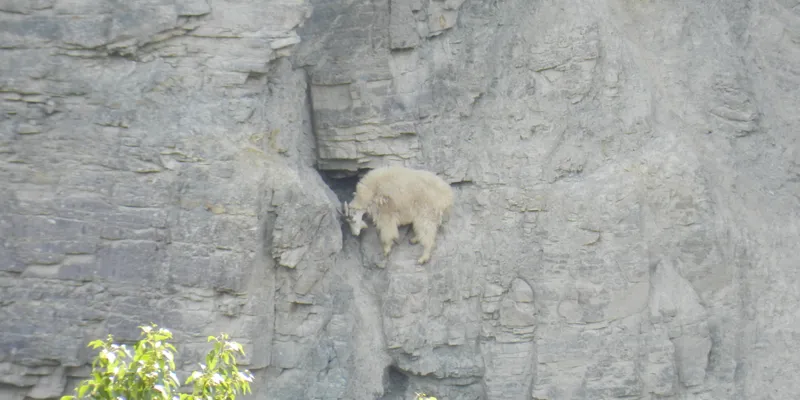
Mountain goats — often found in the remote alpine zones of North America — ascend nearly vertical cliffs with a fluidity that seems almost unreal. They defy physics the way a high‑rise elevator ignores gravity.
But how exactly do they do it — and what can their incredible movement teach us about balance, biomechanics, and even human fitness?
Let’s climb into the science.
Born to Climb: The Mountain Goat’s Rugged Habitat
Mountain goats (Oreamnos americanus) aren’t goats in the domestic sense — they’re highly specialized wild mammals that thrive in elevations ranging from 4,000 feet up to the snow line.
These steep, jagged terrains serve a purpose:
They keep predators at bay.
But they also present a survival challenge — one that mountain goats have mastered.
Mountain goats typically inhabit:
- Sheer rock faces
- Near‑vertical cliffs
- Icy ledges with minimal footholds
This environment looks inhospitable to most creatures — but for mountain goats, it’s home.
And one profound question emerges:
If an animal can climb what we consider impossible, what mechanisms inside its body allow that?
Let’s break it down.
Footwear Nature Made: The Hooves That Grip the Vertical
One of the first secrets to mountain goat climbing lies in their feet — specifically, their hooves.
Each hoof features two distinct layers:
🦶 A hard outer shell that grips tiny rock edges and holds fast on tiny ledges.
🦶 A soft, spongy inner pad that molds to surface contours, increasing traction — almost like built‑in climbing shoes.
This combination lets mountain goats cling to surfaces that look nearly impossible to hold onto — places where even seasoned climbers might only find a fingertip’s worth of grip.
It’s not luck. It’s evolutionary engineering.
And it doesn’t stop with the feet.
Balance and Body Geometry: The Goat’s Silent Advantage
From the front, mountain goats appear slender, but from the side, they look muscular and compact — and that shape matters.
Their body design ensures:
✔ A low center of gravity, stabilizing them on narrow ledges.
✔ Weight distribution that prevents tipping.
✔ Shoulders and neck muscles that generate upward force during climbs.
When a mountain goat climbs, it doesn’t just step up — it propels its body upward forcefully.
Researchers have observed that instead of pivoting around the shoulder — the expected point of rotation — mountain goats often pull with muscles well in front of the shoulders, showing the neck muscles play a larger role than previously imagined.
Ask yourself for a moment:
If this animal were your personal trainer, would you take fitness advice from it — or be too intimidated by its terrain?
Keep reading — because the mechanics behind that climb are just getting started.
Two Phases of a Vertical Climb: How Goats Physically Do It
Biomechanics researchers studying climbing mountain goats — including breaking down footage frame by frame — describe their action in two powerful phases.
Phase 1: Push‑Off Power
The goat’s hind legs stretch and push against the rock — like rockets launching.
These hind legs aren’t just strong — they’re engineered for vertical propulsion.
Phase 2: Pull and Lift
Once the front hooves make contact with an above edge, the mountain goat:
- tucks elbows close to its body
- uses powerful shoulder and neck muscles
- follows upward momentum straight up
instead of rotating sideways.
This motion keeps the goat’s center of mass steady, so it doesn’t teeter or slip off.
In other words, it isn’t random instinct — it’s precise biomechanics in action.
And this doesn’t just help them survive — it helps them thrive in near‑inhospitable terrain.
Sure‑Footed on the Steepest Slopes: Lessons for Humans
The term “sure‑footedness” describes an ability to navigate rough terrain without slipping — and mountain goats epitomize it.
For humans, sure‑footedness is essential in activities like:
- Hiking and mountain travel
- Rock climbing
- Trail running
- Balance training and fall prevention
Take a minute to picture this:
If a human could move with even half the sure‑footedness of a mountain goat, how different would your next hike be?
Training balance, muscle coordination, and body awareness aren’t just fitness goals — they’re survival skills in rugged terrain.
Maybe nature isn’t just fascinating — maybe it’s a fitness coach in disguise.
Surviving Predators by Staying Above Danger
Why climb at all?
For mountain goats, their extreme climbing ability isn’t a party trick — it’s a predator avoidance strategy.
By residing on near‑vertical rock faces, they stay out of reach from:
- wolves
- bears
- mountain lions
- other ground predators
These cliffs look death‑defying — but they’re actually safe zones for goats.
So the next time you debate whether to take that exposed trail on your next trip — think of the mountain goat’s logic:
Sometimes the deadliest ground is the “easy” path.
Evolution Built This — Not Chance
Mountain goats didn’t become world‑class climbers overnight.
Their ancestors likely survived by steadily adapting to environments with:
🌿 scarce predators on cliffs
🌿 better access to high‑altitude food sources
🌿 reduced competition for resources
Through thousands of years, traits like hoof design, muscular structure, and balance were honed by nature.
Today, every mountain goat climb you see on video isn’t just impressive — it’s the product of millions of years of evolution.
And that’s the real marvel.
Beyond the High Cliffs: What Goats Can Teach About Resilience
Mountain goats navigate landscapes that would terrify most humans.
And yet they do it every day, without fear or hesitation.
Their story isn’t just about climbing:
🏔 It’s about thriving in environments others avoid.
💪 It’s about balancing risk and reward.
🧠 It’s about adaptability in the face of danger.
If mountain goats can do all that without gear, what might we achieve with preparation, training, and perseverance?
It turns out these animals are more than wild wonders — they’re silent teachers on how to handle life’s steepest challenges.
From Nature to Your Next Adventure
Thinking about planning your next travel adventure to see mountain goats up close?
Here are some high‑value ideas:
✈ Alpine wildlife tours
🥾 Rock climbing and hiking travel packages
📸 Adventure photography trips focused on rugged terrain
Exploring terrain where mountain goats roam isn’t just a bucket‑list activity — it’s an opportunity to experience firsthand the environments that shaped some of nature’s most incredible climbers.
And that leads to a big open thought:
If nature engineered animals to conquer impossible slopes, what engineering exists within you — waiting to be tapped?