

Table of Contents
- A Bird with a Heart That Bleeds
- The Illusion That Captures Every Heart
- A Rare Gem Hidden in the Forests of Luzon
- The Tragedy of Beauty: Why They’re Disappearing
- Legends Written in Feathers
- A Masterpiece of Evolution
- Conservationists Fighting to Save a Symbol
- What Makes the Luzon Bleeding-Heart So Special?
- A Symbol for Conservation in the Philippines
- Seeing One in the Wild: A Rare, Sacred Moment
- What Can You Do to Help?
- The Bird That Teaches Us About Humanity
- Final Thoughts: The Heartbeat of Luzon
A Bird with a Heart That Bleeds
At first glance, it looks like something out of a myth — a dove with a deep crimson stain spreading across its chest, as if its heart has burst through its feathers.
But this isn’t a wound. It’s one of nature’s most haunting illusions.
Meet the Luzon Bleeding-Heart Dove (Gallicolumba luzonica), a bird so beautiful and mysterious that it almost seems unreal. Found only in the tropical forests of Luzon Island, Philippines, this dove carries a mark that has inspired legends, poems, and conservation movements alike.
And yet, despite its breathtaking beauty, it teeters on the edge of extinction.
The Illusion That Captures Every Heart
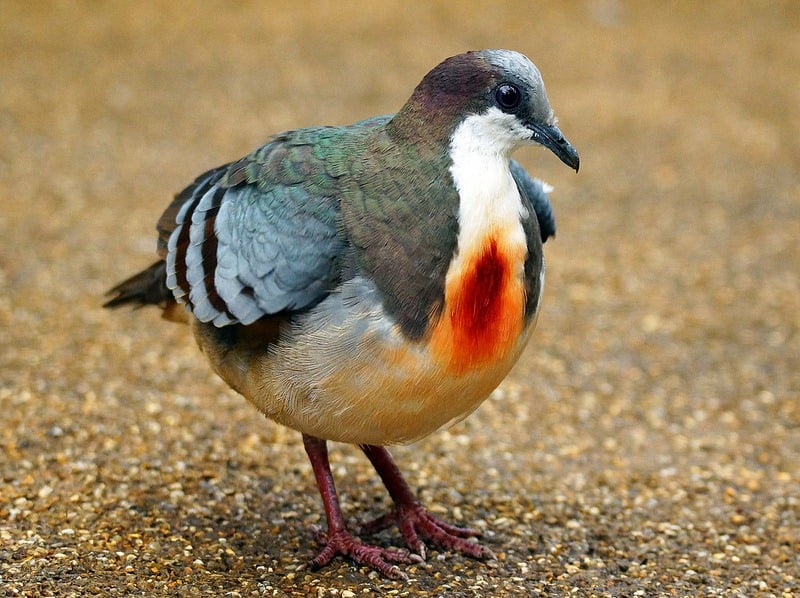
The Luzon Bleeding-Heart Dove gets its name from the blood-red patch on its breast, which contrasts dramatically with its pale gray and white plumage.
From a distance, it looks as though the bird has been pierced — its chest bleeding downwards in a striking scarlet streak.
But this “wound” is a unique feather pattern, a natural pigment display evolved over time. Scientists believe it may serve multiple purposes — from courtship display to camouflage in the dappled light of the forest floor.
Still, for anyone lucky enough to see it, the sight is unforgettable.
“It’s like the forest itself left its mark on them,” one wildlife photographer once said. “They carry the story of the land — beauty and fragility in one breath.”
A Rare Gem Hidden in the Forests of Luzon
Endemic to the Philippines, this dove lives primarily on Luzon Island, the largest and most populated island of the archipelago.
But spotting one in the wild? Nearly impossible.
The bird prefers dense, lowland rainforests, where sunlight barely touches the ground. It spends most of its life walking quietly on the forest floor, foraging for seeds, fruits, and small insects.
Unlike many doves that fly in open skies, the Luzon Bleeding-Heart is shy — choosing the shadows over the spotlight.
It’s as if it knows how fragile it is.
The Tragedy of Beauty: Why They’re Disappearing

Here’s the heartbreaking truth: there are fewer than a few thousand Luzon Bleeding-Hearts left in the wild.
Their numbers have plummeted because of two main threats — deforestation and illegal wildlife trade.
The forests of Luzon have been cut down at alarming rates for logging, agriculture, and urban expansion. As their habitat shrinks, so does their chance of survival.
To make matters worse, these birds are also captured for the exotic pet trade, prized for their stunning appearance.
Conservationists warn that unless urgent action is taken, the Luzon Bleeding-Heart could vanish within a generation.
Legends Written in Feathers
In Filipino folklore, some locals believe the bleeding heart symbolizes sacrifice and resilience.
The story goes that when the forests of Luzon were first formed, a dove offered its heart to protect the island’s people — staining its feathers forever.
Others say the bird’s crimson chest represents the heart of the Philippines itself — wounded by time, yet still beating.
These legends, though poetic, echo a deeper truth: this bird’s struggle mirrors the environmental challenges of an entire nation.
A Masterpiece of Evolution
Scientifically, the Luzon Bleeding-Heart is part of a small group of ground-dwelling pigeons known as Gallicolumba, several of which also display the same “bleeding” pattern.
Evolution shaped these doves to thrive in forest life:
- Their short wings make them agile in tight spaces.
- Their reddish and brown backs help them blend into leaf litter.
- Their gentle cooing call is barely audible — a whisper among the trees.
It’s a survival strategy honed over millennia. But when the forest disappears faster than they can adapt, even evolution can’t keep up.
Conservationists Fighting to Save a Symbol
Organizations like the Philippine Biodiversity Conservation Foundation (PBCFI) and Fauna & Flora International are working tirelessly to protect what’s left of this extraordinary species.
Their efforts include:
- Breeding programs in captivity to ensure population stability.
- Habitat restoration through reforestation in Luzon’s Sierra Madre mountains.
- Community outreach to discourage poaching and educate locals about conservation.
In 2023, a conservation team successfully released several captive-bred doves into protected areas — a hopeful milestone in a long uphill battle.
As one researcher noted:
“Every bird we return to the wild is like returning a heartbeat to the forest.”
What Makes the Luzon Bleeding-Heart So Special?
Beyond its beauty, this dove carries enormous ecological importance.
As a seed disperser, it plays a key role in regenerating the forest. When it forages for fallen fruits, it spreads seeds far from the parent tree, helping new growth flourish.
Without species like this, the rainforest’s cycle of life begins to break down — affecting everything from insects to larger mammals.
So, when we save the Luzon Bleeding-Heart, we’re not just saving a bird. We’re saving the lungs of Luzon, the forests that sustain countless other creatures — and people.
A Symbol for Conservation in the Philippines
In recent years, the Luzon Bleeding-Heart has become a symbol of hope and awareness.
It now features in conservation campaigns, art projects, and eco-tourism initiatives aimed at protecting the Philippines’ unique biodiversity.
Eco-travelers visiting Luzon are encouraged to support local wildlife sanctuaries, go on guided birdwatching tours, and avoid buying wild-caught birds — helping both the environment and local communities thrive.
The movement is slowly shifting public perception: from seeing wildlife as ornaments to recognizing them as living treasures.
Seeing One in the Wild: A Rare, Sacred Moment
For birdwatchers and photographers, spotting a Luzon Bleeding-Heart Dove in the wild is a dream come true — a moment of almost spiritual awe.
Those who’ve been lucky enough to witness it describe the same feeling: silence.
The bird emerges briefly from the underbrush, the faint sunlight glinting off its chest like a ruby. It stands still, curious yet cautious, before melting back into the forest’s embrace.
It’s as if the forest itself allows a fleeting glimpse of its heart — and then hides it again.
What Can You Do to Help?
Even if you live thousands of miles away, you can help protect this remarkable species.
Here’s how:
- Support reforestation efforts in the Philippines through global NGOs.
- Avoid purchasing exotic pets, especially wild-caught birds.
- Spread awareness about the Luzon Bleeding-Heart Dove on social media.
- Donate to conservation programs protecting endemic species.
Every small action matters — because when global attention shifts, so does funding, policy, and protection.
The Bird That Teaches Us About Humanity
In a world obsessed with progress, the Luzon Bleeding-Heart Dove reminds us of something essential — that fragility and strength can coexist.
It carries a wound that never bleeds, a symbol that beauty often survives through pain.
When you think about it, it’s a reflection of our own planet — delicate, scarred, and in need of care.
If this bird disappears, it won’t just be a loss of color from the forest — it’ll be a loss of meaning.
Final Thoughts: The Heartbeat of Luzon
Some say the Luzon Bleeding-Heart is a messenger — that its red chest carries the story of nature’s suffering, urging us to listen before it’s too late.
Perhaps that’s true.
Because behind that crimson mark lies a warning: every forest, every creature, and every heartbeat matters.
And if we choose to protect it, we may just find that the world — like this dove’s chest — starts to heal again.