
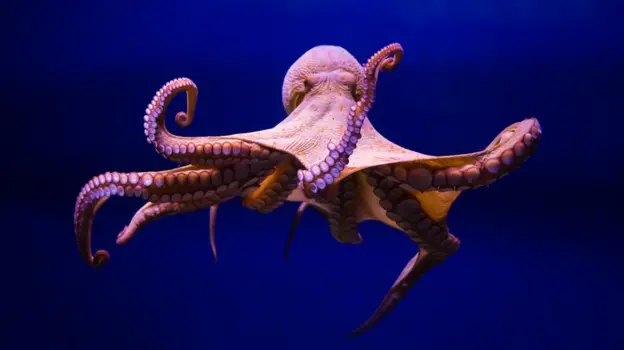
If someone told you an octopus could hold a grudge, you’d probably laugh.
But what if that grudge came with eight arms, a sharp mind, and the ability to hurl shells with the accuracy of a professional pitcher?
That’s not science fiction.
It’s real behavior observed in the wild — and it’s changing everything we thought we knew about animal intelligence.
What researchers discovered about octopuses in recent years is more astonishing than any documentary has hinted at. These animals don’t just solve puzzles or escape aquariums.
They remember.
They judge.
And sometimes… they retaliate.
If that sounds unbelievable, wait until you hear what scientists saw when these creatures got annoyed.
Table of Contents
- The Ocean’s Quiet Genius: A Brain Wired for Emotion, Memory, and Strategy
- The First Recorded Evidence: Shells Launched With Purpose
- But It Gets Even More Interesting… They Remember Who Annoyed Them
- The Science Behind Octopus Psychology: Why Holding a Grudge Makes Sense
- How Octopus Behavior Is Shaping Technology, Finance, and Future Innovation
- Tourism and Travel: Why People Now Visit “Octopus Cities”
- Do Octopuses Understand Revenge — Or Are We Seeing Ourselves in Them?
- What This Means for Humans — And the Future of Animal Research
The Ocean’s Quiet Genius: A Brain Wired for Emotion, Memory, and Strategy
Octopuses have always been mysterious. Their bodies bend like liquid. Their skin can change color in milliseconds. Their brains — spread across eight arms and a central neural hub — operate more like a networked supercomputer than a typical animal mind.
But beneath that strange biology lies something even more surprising:
complex social behavior.
For years, scientists believed octopuses were mostly solitary. But a new wave of underwater research sites — especially those studying octopus “cities” off the coast of Australia — revealed something startling:
Octopuses interact with neighbors.
They fight.
They negotiate.
They steal from each other.
And yes… they throw things when irritated.
Imagine a neighborhood where every argument ends with someone tossing seashells across the yard. That’s the octopus world.
But the real twist came when cameras caught something no one expected.
The First Recorded Evidence: Shells Launched With Purpose
In Jervis Bay, Australia, researchers set up cameras to study octopus communication. What they recorded changed marine biology overnight:
Octopuses were seen gathering shells, bits of silt, algae — even pieces of crab carcasses — loading them into their siphons, and blasting them at specific targets.
And these weren’t random movements.
They were intentional.
Strategic.
Aimed.
Sometimes at predators.
Sometimes at nosy divers.
Sometimes at another octopus who got too close.
And in one unforgettable moment — at a male octopus who wouldn’t stop trying to mate.
When the female wanted him gone, she didn’t swim away.
She grabbed a shell, angled her siphon carefully, and launched it like a torpedo.
Direct hit.
He finally got the message.
But It Gets Even More Interesting… They Remember Who Annoyed Them
Octopuses are known escape artists, puzzle solvers, and masters of camouflage. But memory?
Grudges?
Selective aggression?
Scientists weren’t sure — until they started studying how octopuses respond to individual humans.
In several labs around the world, octopuses consistently reacted differently to different people — even when wearing identical clothing.
One researcher fed them.
Another poked them with a stick during cleaning.
Guess which one the octopus squirted water at?
Guess which one the octopus avoided for months?
These animals can clearly distinguish friendly behavior from rude behavior.
And once they form an opinion?
It sticks.
This is where the story becomes even more fascinating — because researchers realized octopuses don’t just react emotionally. They act strategically.
They’re capable of delayed retaliation — waiting for the right moment to strike back.
If this happened to you, would you fight… or just keep swimming?
The Science Behind Octopus Psychology: Why Holding a Grudge Makes Sense
Sure, throwing shells sounds petty and dramatic.
But in a predator-filled ocean, selective aggression is survival.
Here’s why:
- Octopuses have short lives.
They must quickly learn what helps and what harms. - Their brains are huge for their body size.
This drives complex decision-making. - Their soft bodies are vulnerable.
So they use tools — and sometimes projectiles — to protect themselves. - The ocean floor is a competitive neighborhood.
Food, shelter, mates — every resource is fought over.
Holding grudges isn’t immaturity.
It’s an adaptive strategy.
And that strategy has implications for far more than marine biology — it touches psychology, AI, robotics, and even home design.
(Yes, really. Keep reading.)
How Octopus Behavior Is Shaping Technology, Finance, and Future Innovation
When scientists study octopuses, they aren’t just learning about oceans.
They’re studying a blueprint for advanced problem-solving.
Their behavior is influencing:
→ Military-inspired underwater robotics
Engineers design flexible robotic arms based on octopus tentacles.
→ Environmental strategies for ocean conservation
Understanding octopus intelligence helps governments plan marine protected areas.
→ AI development
Octopus memory networks inspired new research into distributed computing.
→ Behavioral economics
Researchers examine how octopus decision-making mirrors human risk assessment.
→ Home improvement design
The octopus’s dynamic camouflage inspires adaptive paint technology and energy-efficient window systems.
So a creature throwing a shell isn’t just funny — it’s helping humans rethink engineering.
But the most fascinating impact is yet to come.
Tourism and Travel: Why People Now Visit “Octopus Cities”
Travelers searching for eco-tourism adventures now flock to places where octopus communities thrive:
- Australia
- New Zealand
- Indonesia
- Hawaii
- The Mediterranean
Marine sanctuaries offer guided dives where visitors watch octopuses communicate, change colors, and — sometimes — toss debris at intruders.
In fact, some diving instructors warn tourists:
“Don’t stare too long, or you might get shelled.”
Imagine paying for a once-in-a-lifetime experience… and the highlight is an angry octopus throwing sand at your camera.
But for many travelers, that’s exactly the magic.
These creatures don’t behave like anything else in the ocean.
They challenge our assumptions.
They reveal hidden emotions.
They blur the line between instinct and intention.
Which raises the biggest question of all…
Do Octopuses Understand Revenge — Or Are We Seeing Ourselves in Them?
Scientists remain cautious.
We don’t want to assume octopuses think like humans.
But here’s the twist:
The more researchers study them, the more similarities appear.
Octopuses:
- React differently to kindness and cruelty
- Show memory of specific individuals
- Use tools with intention
- Display problem-solving that feels emotional
- Act out when frustrated
- Avoid those who once harmed them
- Target enemies with thrown objects
Is it revenge?
Is it strategy?
Is it something deeper?
The truth may take years to unravel — but octopus intelligence keeps evolving faster than anyone expected.
And if these creatures truly understand grudge-holding, it changes our understanding of consciousness across the animal kingdom.
What This Means for Humans — And the Future of Animal Research
Studying octopuses shifts everything we thought we knew about brain evolution.
They’re not related to mammals, birds, dolphins, or primates.
Their intelligence evolved independently.
Which means this:
There may be more than one way to build a mind.
One built on bone and fur.
Another built on soft skin and distributed neural systems.
If a creature so different from us can remember, judge, retaliate, and strategize…
What else can the natural world do that we haven’t yet discovered?
Every shell thrown by an octopus is a message:
“You don’t understand me yet.”
And that — more than anything — is why researchers are obsessed with studying these astonishing animals.