

Table of Contents
- The Earthquake Struck During Morning Activities
- Buildings Crumbled Across Parts Of Mindanao
- Children Were Among The Most Terrified
- Tsunami Warnings Triggered More Panic
- Government Agencies Mobilized Emergency Response
- Residents Described Extreme Fear During The Tremor
- Why The Philippines Faces Constant Earthquake Threats
- Social Media Turned The Disaster Into A Global Event
- Experts Warn About Aftershocks And Structural Damage
- The Human Cost May Continue Rising
- What This Earthquake Reveals About Global Disaster Risks
The Earthquake Struck During Morning Activities
According to the United States Geological Survey, the earthquake struck at approximately 7:37 a.m. local time.
The quake registered a magnitude of 7.8 and occurred at a depth of roughly 35 kilometers beneath the Earth’s surface.
Authorities said the epicenter was located off the shores of General Santos City near Sarangani province, at the southern edge of Mindanao.
Because the earthquake happened during busy morning hours, many people were already awake, commuting, working, or attending school.
That timing likely increased panic dramatically as thousands felt the ground suddenly begin swaying beneath them.
Videos rapidly spread online showing classrooms shaking violently while frightened children crouched outdoors waiting for the tremors to stop.
In some areas, school roofs collapsed while students evacuated to sports fields and open spaces.
Officials later confirmed that no injuries were immediately reported in several of the school incidents despite the frightening scenes.
Buildings Crumbled Across Parts Of Mindanao
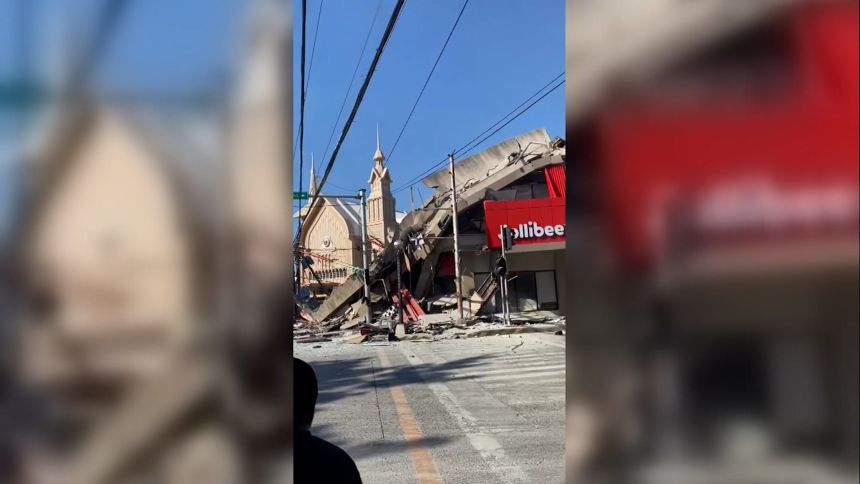
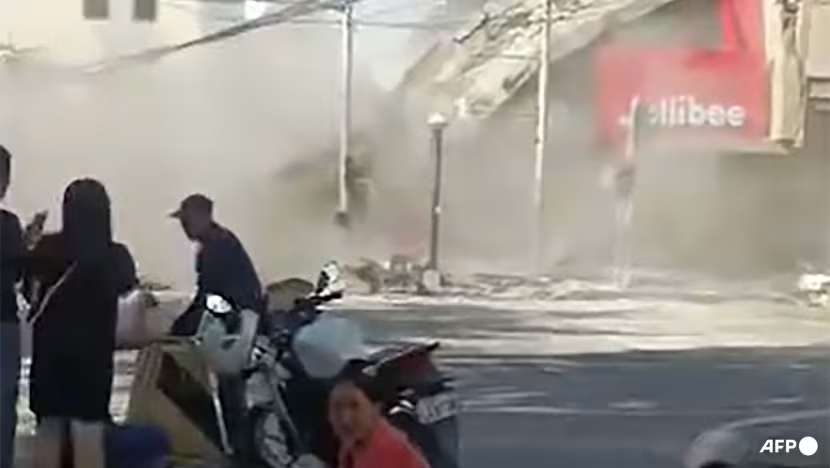
As emergency responders began assessing damage, images from General Santos City and nearby communities revealed collapsed structures, shattered walls, and heavily damaged businesses.
One of the most widely shared scenes involved a partially collapsed Jollibee restaurant where police and emergency workers gathered outside surrounded by debris.
Convenience stores, commercial buildings, and public structures also suffered visible damage.
In several areas, roads cracked while power outages disrupted communications and rescue coordination.
Authorities warned residents to remain cautious because aftershocks could continue for hours or even days following the main earthquake.
For many people living through the disaster, the fear did not end once the shaking stopped.
Strong earthquakes often leave survivors terrified of returning inside buildings due to concerns about structural collapse.
That fear was visible across social media footage where residents remained gathered outdoors long after the initial quake.
Children Were Among The Most Terrified
One of the most emotional aspects of the disaster involved scenes from schools across southern Philippines.
Videos circulating online showed young children crouching outside classrooms while teachers attempted calming frightened students.
In some footage, the ground visibly swayed beneath groups of students as buildings shook in the background.
The earthquake struck on the same day many public schools were beginning the new academic year.
What should have been a normal first day of classes suddenly became a traumatic experience for thousands of children.
Psychologists often warn that major natural disasters can leave lasting emotional effects on children, especially when they experience intense fear or witness destruction firsthand.
For many parents watching the videos online, the scenes felt deeply emotional because they reflected the helplessness families experience during sudden disasters.
Tsunami Warnings Triggered More Panic
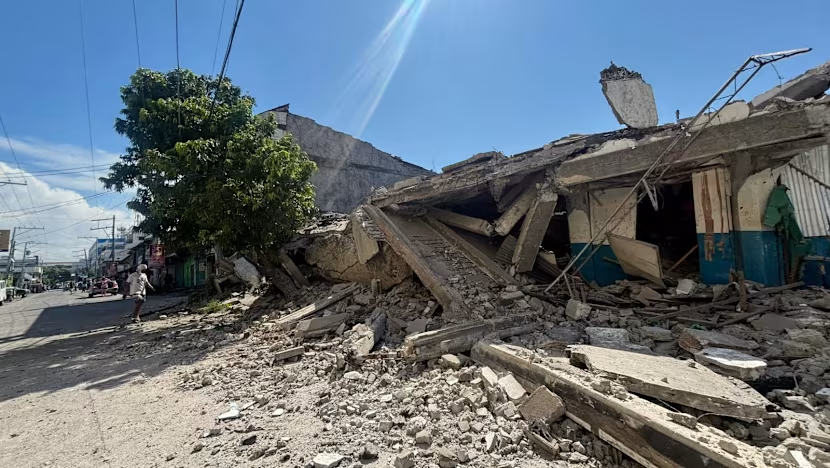
The earthquake’s massive strength immediately raised fears of tsunamis across the Pacific region.
Authorities in the Philippines, Japan, and Indonesia issued tsunami warnings shortly after the quake struck.
Philippine President Ferdinand Marcos Jr. urged residents in affected coastal provinces to move immediately to higher ground and not wait for additional instructions.
The warning intensified panic in several communities already dealing with earthquake damage.
Residents rushed away from shorelines fearing dangerous waves could arrive at any moment.
Although the Pacific Tsunami Warning Center later stated the most serious threat had largely passed, officials still warned people to remain alert because sea level fluctuations and dangerous currents could continue.
For survivors, the tsunami alerts created a terrifying second phase of uncertainty after the earthquake itself.
Government Agencies Mobilized Emergency Response
President Marcos quickly announced that all relevant government agencies had been ordered to begin rescue operations and evacuation efforts.
Emergency responders, military personnel, police officers, and disaster management teams were deployed across affected areas.
Hospitals prepared for incoming injuries while local governments attempted assessing infrastructure damage and casualty reports.
The Office of Civil Defense confirmed fatalities had occurred but warned that rescue crews were still verifying additional reports from remote locations.
Large earthquakes often create logistical challenges for emergency response because roads, communications systems, and utilities may all suffer damage simultaneously.
Officials stressed that search and rescue operations remained ongoing as crews continued reaching impacted communities.
Residents Described Extreme Fear During The Tremor
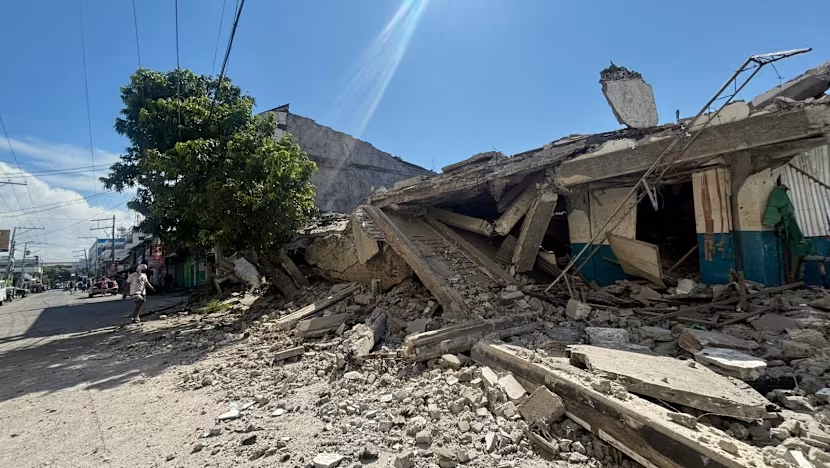
People across Mindanao described terrifying moments as buildings shook violently around them.
Some residents said walls cracked within seconds while furniture and appliances crashed to the floor.
Others reported hearing loud rumbling sounds before the strongest shaking began.
Police Chief Benjie Ancheta from Alabel town described the earthquake as the strongest he had personally experienced.
He said officers were gathered during a flag raising ceremony when the quake struck, immediately causing cracks in the police building itself.
Although no major casualties were immediately reported there, several people reportedly fainted from panic and shock during the tremor.
Earthquakes often create overwhelming psychological fear because they arrive without warning and make even solid ground feel unstable.
That unpredictability is one reason large quakes leave such deep emotional impressions on survivors.
Why The Philippines Faces Constant Earthquake Threats
The Philippines sits directly along the Pacific Ring of Fire, one of the world’s most geologically active regions.
The Ring of Fire is a massive arc of fault lines and tectonic boundaries surrounding the Pacific Ocean where earthquakes and volcanic eruptions occur frequently.
Countries including Japan, Indonesia, and the Philippines regularly experience seismic activity because of shifting tectonic plates beneath the Earth’s surface.
Scientists warn that major earthquakes are not rare in this region.
Instead, they are considered an ongoing reality communities must constantly prepare for.
The Philippines in particular faces a unique combination of natural threats including earthquakes, volcanic eruptions, landslides, and typhoons.
That combination creates enormous challenges for infrastructure, emergency planning, and disaster resilience.
Social Media Turned The Disaster Into A Global Event
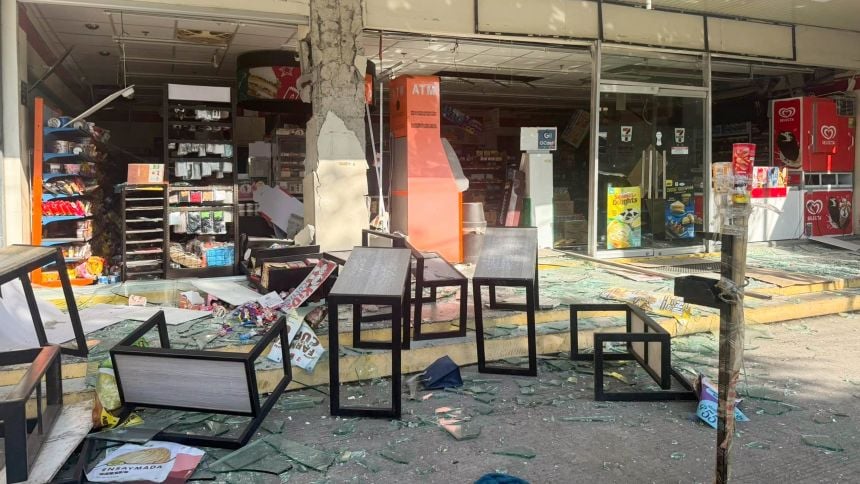
Within minutes of the quake, videos and photos flooded social media platforms worldwide.
Footage of swaying buildings, frightened students, damaged businesses, and collapsing structures spread rapidly online.
The visual nature of the disaster intensified international attention because viewers could immediately see the fear unfolding in real time.
In modern disasters, social media now plays a massive role in shaping public awareness and emergency response.
People trapped in damaged areas often post updates directly online before official information becomes available.
At the same time, viral footage can also increase panic if rumors or inaccurate information spread too quickly.
During the Philippines earthquake, authorities repeatedly urged residents to rely on official warnings and evacuation instructions rather than unverified social media claims.
Experts Warn About Aftershocks And Structural Damage
Following major earthquakes, experts often warn that aftershocks can continue for days or weeks.
These secondary tremors sometimes cause additional collapses in already weakened buildings.
Engineers and disaster officials across southern Philippines are expected to spend days assessing structural safety in schools, businesses, apartment buildings, and government facilities.
Even buildings that remain standing after earthquakes may suffer hidden damage that increases future risks.
Residents in affected areas were advised to avoid unstable structures until safety inspections could be completed.
Large earthquakes also frequently disrupt utilities such as electricity, water systems, internet service, and transportation infrastructure.
Those disruptions can slow rescue operations and complicate recovery efforts for entire communities.
The Human Cost May Continue Rising
Although authorities initially confirmed several deaths, officials warned the casualty count could rise as rescue operations continue.
Earthquakes often create evolving emergencies because some victims may remain trapped beneath debris for hours or days.
In rural or mountainous regions, damaged roads can delay rescue crews from reaching isolated communities quickly.
Families across Mindanao spent the day desperately attempting to contact loved ones amid communication disruptions and growing uncertainty.
For many people, the emotional trauma may continue long after physical recovery begins.
Natural disasters leave lasting psychological effects on survivors who suddenly experience how fragile normal life can become within seconds.
What This Earthquake Reveals About Global Disaster Risks
The devastating quake in southern Philippines is another reminder of how vulnerable millions of people remain to sudden natural disasters.
Despite modern technology and advanced warning systems, earthquakes still strike with terrifying unpredictability.
Entire communities can change forever within moments.
The disaster also highlights the importance of emergency preparedness, resilient infrastructure, and public education in regions facing constant seismic threats.
Countries along the Ring of Fire continue investing heavily in earthquake response planning because experts know major disasters are not a question of if, but when.
For the people of Mindanao, however, this tragedy is no longer theoretical.
Families are now mourning loved ones, inspecting destroyed homes, and trying to recover from one of the strongest earthquakes the region has experienced in years.
And as rescue workers continue searching damaged areas, the full human impact of the disaster may still be unfolding.