

Table of Contents
- A Creature Whose Eyes Change Color With the Seasons
- The 3-Second Hook: A Reindeer’s Eyes Glow Like Gold… Then Shift to Arctic Blue
- The Arctic: A Land Where Light Makes or Breaks Life
- Inside a Reindeer’s Eye: The Tapetum Superpower
- The Secret Is Pressure — And a Survival Trick You Won’t Expect
- Why Blue Eyes Matter in Winter
- Why Gold Eyes Matter in Summer
- A Scientific Mystery That Took Years to Crack
- What Humans Can Learn From Reindeer Eyes
- Travel, Tourism, and the Rising Fascination for Arctic Animals
- Your Eyes vs. Reindeer Eyes: A Sharp Contrast
- The Adaptation Took Thousands of Years — And Could Disappear Fast
- A Closing Look Into the Most Beautiful Eyes in the Animal Kingdom
A Creature Whose Eyes Change Color With the Seasons
Imagine looking into a mirror each season and seeing completely different eyes staring back at you.
Golden in the warm months, icy blue in winter.
For us, it’s impossible.
For reindeer—it’s essential for survival.
Deep in the Arctic, where sunlight disappears for months and then floods the land nonstop, one animal has evolved a biological superpower so strange and so beautiful that it shocked scientists when they first discovered it.
Reindeer literally change their eye color with the seasons.
The 3-Second Hook: A Reindeer’s Eyes Glow Like Gold… Then Shift to Arctic Blue
In summer, reindeer eyes shimmer with a fiery golden glow.
In winter, they turn a haunting, luminous blue.
This isn’t makeup.
It’s not genetics.
It’s not mood.
It’s pure survival engineering — the Arctic way.
And once you learn what causes the transformation, you’ll never look at animals the same way again.
The Arctic: A Land Where Light Makes or Breaks Life
To understand the eye-color shift, we have to understand their world.
The Arctic is extreme in a way few places are:
- 24 hours of sunlight in summer
- 24 hours of darkness in winter
- Temperatures that plunge far below freezing
- Snow that reflects light like millions of mirrors
- Predators that blend seamlessly into the white landscape
Humans wouldn’t even last the night without advanced gear.
Reindeer, however, thrive.
But to survive, they need something far more precise than thick fur or strong legs:
They need vision tailored to the light conditions of an ever-changing world.
That’s where their magical eye color comes in.
Inside a Reindeer’s Eye: The Tapetum Superpower
Dogs and cats have it.
Mountain lions have it.
Even some fish have it.
It’s called the tapetum lucidum, a mirrored surface behind the retina that reflects light and enhances night vision.
When your dog’s eyes “glow” in photos or headlights, that’s the tapetum at work.
Reindeer have one too—but theirs is completely different.
In summer, reindeer tapetums are golden, reflecting extra light to avoid glare from 24-hour sunshine.
In winter, reindeer tapetums turn blue, scattering light in all directions—giving them the ability to see in near-complete darkness.
But the real question scientists asked was:
How does an eye physically change color based on the season?
The answer?
It’s both brutal and brilliant.
The Secret Is Pressure — And a Survival Trick You Won’t Expect
During the Arctic summer, a reindeer’s pupils stay narrow because of constant sunlight.
But in winter, the reindeer’s pupils stay dilated for months, trying to catch every tiny photon in darkness.
Here’s where the magic happens:
Winter Dilation → Eye Pressure Rises → Tissues Compress → Color Changes
When the pupils remain wide open for so long, pressure inside the eye increases.
This pressure pushes photonic crystals in the tapetum closer together.
And when structures compress, they scatter different wavelengths of light.
- Loose crystals = golden reflection
- Compressed crystals = blue reflection
In simple terms:
Summer light → Gold eyes
Winter darkness → Blue eyes
No other animal on Earth has been found to do this.
Why Blue Eyes Matter in Winter

Blue tapetums don’t just reflect light like gold ones—they scatter it.
That scattering increases sensitivity to the faintest light sources:
- Aurora borealis
- Reflected moonlight on snow
- Faint glimmers in the distance
- Predator silhouettes
- Footprints in moonlit ice
Imagine walking outside and seeing every shadow, every ripple in snow, every shift in the dark — even the things humans would miss entirely.
That ability is life or death.
Because in the Arctic winter, food is scarce and predators are plentiful.
Would you fight or flee if you saw a shape in the distance?
A reindeer doesn’t get to choose wrong.
Why Gold Eyes Matter in Summer

During Arctic summers, sunlight blasts the tundra for 24 hours a day.
Snow reflects the bright sun into blinding light.
If reindeer kept their winter-blue eyes, they’d be overwhelmed by glare.
They’d be unable to see predators, terrain, or food.
Golden eyes reflect light efficiently, protecting them from too much brightness — like wearing the best sunglasses nature ever designed.
You could say:
Gold = sunglasses mode
Blue = night-vision mode
And it all happens naturally, every year, without conscious effort.
A Scientific Mystery That Took Years to Crack
For decades, biologists and Arctic researchers noticed something strange: reindeer eyes seemed to glow different colors in various seasons.
The phenomenon was first documented in the 1990s but wasn’t fully understood until almost twenty years later.
Scientists began collecting eye samples — both golden and blue — and analyzed them under high-resolution microscopes.
What they saw blew them away:
The photonic crystal structure in the tapetum physically shifted, like shifting tiles on a microscopic mosaic.
Imagine tiles compressing in winter, then loosening in summer.
That shift changed the wavelengths of light the eyes reflected.
This wasn’t just color change.
This was biological engineering far beyond anything humans built.
What Humans Can Learn From Reindeer Eyes
This is where the story expands beyond nature.
The science behind reindeer eyes is now being studied for:
Advanced LED technology
Understanding how reindeer manipulate photonic crystals could influence energy-efficient lighting.
Military night-vision advancements
Blue tapetum scattering could inspire adaptive night-vision devices.
Improved road reflectors
Designers study photonic structures to enhance low-light visibility.
Architectural lighting systems
Home-improvement designers look into adaptive lighting that shifts based on season or sunlight intensity.
Medical breakthroughs in eye pressure
Reindeer eye pressure studies may help humans understand glaucoma and pressure-related eye diseases.
In other words…
Reindeer aren’t just surviving the Arctic.
They’re teaching us how to build a better, safer world.
Travel, Tourism, and the Rising Fascination for Arctic Animals
Wildlife tourism involving reindeer is booming in places like:
- Norway
- Sweden
- Finland
- Alaska
- Arctic Canada
Visitors from around the world travel to see these animals during different seasons — and yes, many come specifically to witness the eye-color shift.
Travel blogs and photographers say the same thing:
You don’t truly understand the Arctic until you see a reindeer up close.
And for those looking to travel during times when the aurora borealis lights up the sky, the blue winter eyes create a hauntingly beautiful glow that photographers chase for years.
Your Eyes vs. Reindeer Eyes: A Sharp Contrast
Humans have static-colored eyes.
Reindeer? Seasonal transformers.
Humans struggle in low light.
Reindeer thrive in near darkness.
Humans need sunglasses to handle intense sun.
Reindeer naturally adjust.
So ask yourself:
If your eyes could change color with the seasons, would you want them to?
Would it make winter driving easier?
Would it reduce eye strain in bright summers?
Would it help night-shift workers?
Reindeer make us rethink what eyes are capable of.
The Adaptation Took Thousands of Years — And Could Disappear Fast
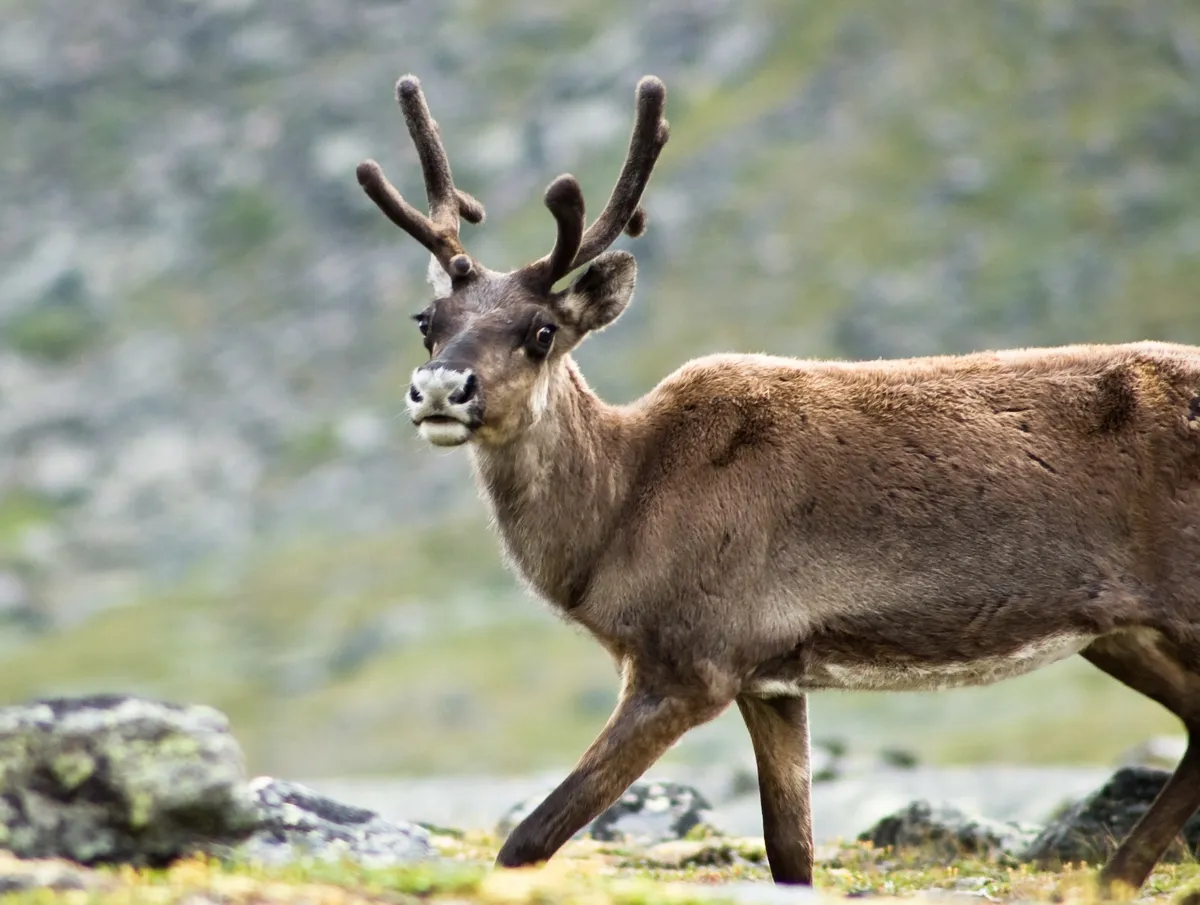
Climate change is now threatening Arctic ecosystems.
As ice melts, seasons grow shorter, temperatures rise, and light patterns shift.
If seasons change too fast, reindeer may struggle to match their eye adjustments — a mismatch that could impact survival.
Imagine having winter-blue eyes in a suddenly bright environment.
Or gold eyes in sudden winter darkness.
Scientists worry that reindeer may suffer increased predation or difficulty finding food as seasonal rhythms get disrupted.
This is not just a curiosity story.
It’s a warning.
A Closing Look Into the Most Beautiful Eyes in the Animal Kingdom
The next time you see a reindeer — in photos, in travel documentaries, or in the wild — remember:
Those glowing eyes aren’t just pretty.
They are ancient tools forged by Arctic darkness and endless sun.
They are survival.
They are adaptation.
They are one of the rarest transformations in the animal world.
Gold in summer.
Blue in winter.
Two colors.
One purpose.
A reminder that life always finds a way to see through the darkness.