
Table of Contents
The Context of the Venezuela Crisis
The recent standoff between Russia, the U.S., and Venezuela takes place against the backdrop of a decade-long crisis in Venezuela. Venezuela has been struggling with political and economic instability, with President Nicolás Maduro facing widespread opposition and international sanctions, particularly from the U.S. The country’s oil industry, once a major source of revenue, has been severely impacted, leading to economic collapse and widespread poverty. Despite these challenges, Venezuela continues to possess one of the largest oil reserves in the world, making it a critical player on the global stage.
Venezuela’s close relationship with Russia has grown in recent years, with Russia providing military aid and economic support to Maduro’s government. The U.S., on the other hand, has imposed sanctions on Venezuela, targeting its oil exports and restricting access to international markets. The tension between the U.S. and Venezuela has only intensified, particularly with Russia’s increasing involvement in the region.
The Tanker Incident

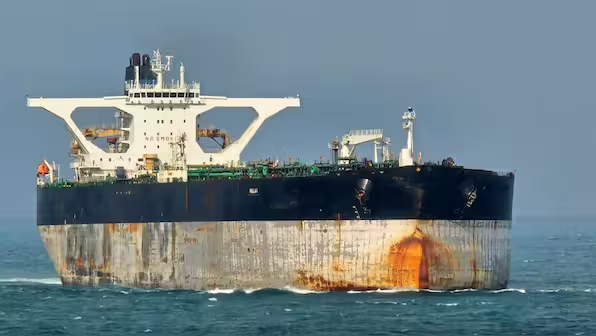
The incident involving the Russian submarine and the U.S.-targeted tanker is the latest chapter in the ongoing tensions over Venezuela’s oil exports. The tanker, which was carrying oil from Venezuela, was reportedly in international waters when the U.S. military issued a threat to intercept the ship. The U.S. government’s move was seen as part of its broader strategy to cut off Venezuela’s access to international oil markets in an effort to undermine Maduro’s regime.
In response, Russia quickly dispatched a submarine to escort the vessel, signaling its intent to protect its ally. This military maneuver escalated an already high-stakes situation, as it involved direct military involvement from two global powers. For Russia, this was a show of strength, a message to the U.S. that it would not stand idly by while its interests in Venezuela were threatened. For the U.S., it was a reminder of the growing influence of Russia in the Western Hemisphere, something the U.S. had long considered its sphere of influence.
Russia’s Strategic Move
Russia’s decision to deploy a submarine to escort the tanker is not just a tactical move; it is a statement of intent. The use of a submarine, one of Russia’s most powerful military assets, underscores the seriousness of the situation and the lengths Russia is willing to go to protect its interests. Submarines are particularly effective in such operations due to their stealth and ability to operate undetected for extended periods. By positioning its submarine in international waters, Russia was not only ensuring the safety of the tanker but also signaling to the U.S. that it was prepared to take bold military action to defend its allies.
The deployment of the submarine also highlights the increasing military presence of Russia in Latin America. In recent years, Russia has sought to expand its influence in the region, providing military support to countries like Venezuela and bolstering its presence through joint military exercises and arms deals. The U.S. has viewed this with increasing alarm, seeing Russia’s growing presence in the region as a challenge to its dominance in the Western Hemisphere.
U.S. Military’s Role and the Threat of Escalation

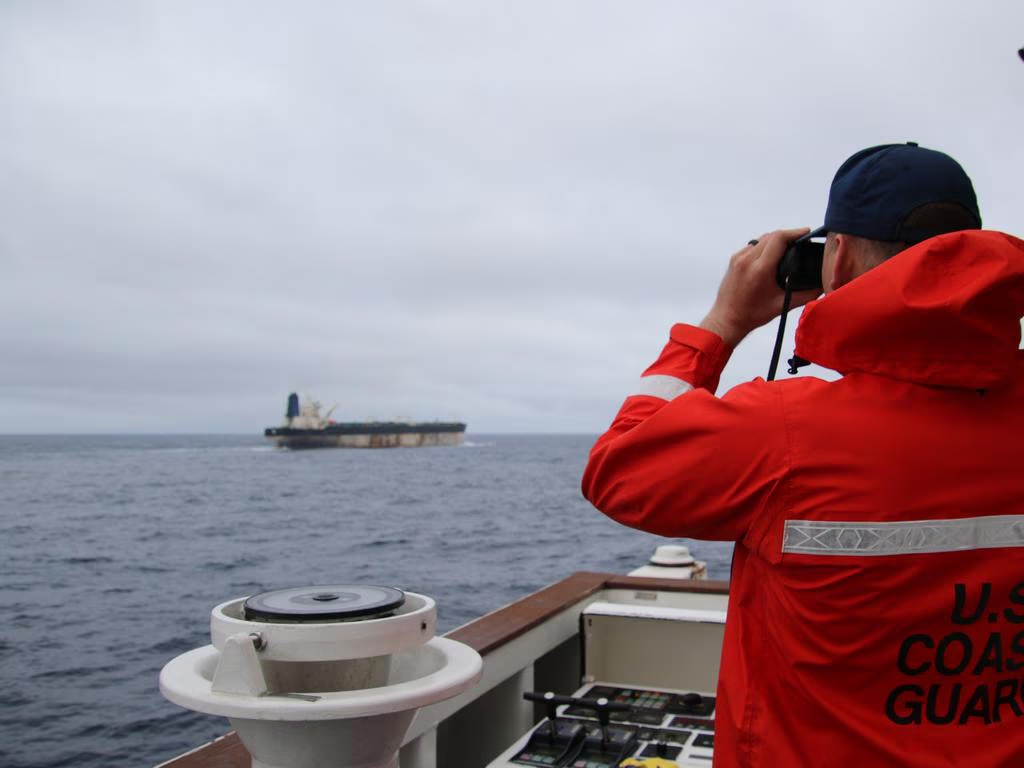
The U.S. military’s threats to intercept the Venezuelan tanker reflect the broader strategy of exerting pressure on the Maduro regime through economic and military means. The U.S. has long sought to curb Venezuela’s oil exports as part of its efforts to weaken Maduro’s government and force regime change. While the U.S. has relied heavily on sanctions, military intervention has remained a constant undercurrent in its strategy.
The threat to intercept the tanker was likely intended to send a message to both Venezuela and Russia: the U.S. is willing to take direct action to block oil exports from the country. However, this strategy carries significant risks, especially considering Russia’s involvement in the region. Any military engagement between U.S. and Russian forces would have profound implications for global stability, particularly given the already tense relations between the two countries.
The Geopolitical Implications
The standoff over the Venezuelan tanker is a microcosm of the broader geopolitical struggle between the U.S. and Russia. In recent years, Russia has increasingly sought to challenge U.S. dominance on the global stage, particularly in regions where the U.S. has historically had significant influence. Venezuela, with its vast oil reserves and strategic location, is one of the key battlegrounds in this struggle.
For Russia, supporting Venezuela is not just about protecting an ally; it is also about asserting its power in the Western Hemisphere, a region that the U.S. has traditionally considered its own domain. Russia’s military and economic support for Venezuela is a direct challenge to U.S. policy and a sign of the shifting balance of power in the region. As Russia continues to bolster its military presence in Latin America, the U.S. will likely face increased challenges in maintaining its influence.
The Impact on Venezuela’s Economy and Oil Exports
Venezuela’s oil exports are a lifeline for the country’s economy, even as the sector has struggled under the weight of U.S. sanctions and mismanagement. The country’s oil production has plummeted, and its ability to access global markets has been severely restricted. The U.S. has been instrumental in cutting off Venezuela’s oil exports by imposing sanctions on the country’s state-owned oil company, PDVSA, and by pressuring other nations and companies to avoid doing business with Venezuela.
However, Russia has stepped in to fill the void left by Western companies and governments. By providing military and economic support to Venezuela, Russia is not only securing its own interests in the region but also helping to stabilize Venezuela’s struggling oil industry. The escort of the tanker is just the latest example of Russia’s commitment to protecting Venezuela’s oil exports and ensuring that the country remains part of its geopolitical sphere of influence.
What This Means for the Future of U.S.-Russia Relations
The deployment of a Russian submarine to escort a Venezuelan tanker represents a significant escalation in U.S.-Russia relations. While both countries have been engaged in a variety of proxy conflicts and diplomatic standoffs, this situation could bring them closer to direct military confrontation. With both nations possessing powerful military assets in the region, the potential for a clash is higher than ever.
The situation also highlights the growing importance of Latin America as a geopolitical battleground. For the U.S., Venezuela represents a strategic concern, as it is located in close proximity to the U.S. and holds vast natural resources. For Russia, supporting Venezuela is a way to challenge U.S. dominance in the Western Hemisphere and expand its influence.
As the standoff continues, the world will be watching closely to see how the situation unfolds. The U.S. and Russia’s actions in Venezuela will likely set the stage for future engagements in other parts of the world where the two powers are vying for influence.
Conclusion
The decision by Russia to deploy a submarine to escort a Venezuelan tanker targeted by the U.S. is a significant moment in the ongoing geopolitical struggle between the two superpowers. This escalation highlights the increasingly tense relations between Russia and the U.S. and underscores the strategic importance of Venezuela in the broader geopolitical context.
As the situation continues to unfold, the potential for direct military conflict remains high. The world is watching to see if this standoff will lead to further escalation or if cooler heads will prevail. What is clear is that the U.S. and Russia’s actions in Venezuela will have long-lasting consequences for global stability and the future of international relations.