
Table of Contents
- Appeals Court Delivers Major Blow to Trump Administration
- The Executive Order That Sparked National Controversy
- Pete Hegseth Emerges as Central Figure in the Fight
- Why the Court’s Language Matters So Much
- Transgender Troops Remain in Service for Now
- Trump Faces Mounting Legal Setbacks
- The Broader Debate Over Military Readiness
- Supreme Court Showdown May Be Coming
- What This Means for America Going Forward
Appeals Court Delivers Major Blow to Trump Administration
The ruling came from a divided federal appeals court panel that reviewed President Donald Trump’s executive order targeting transgender military service. The order, signed earlier in 2025, argued that transgender identity conflicted with military discipline, honesty, and readiness.
Under the policy later implemented by Defense Secretary Pete Hegseth, individuals diagnosed with gender dysphoria would effectively be disqualified from military service in most circumstances. Existing service members also faced possible removal depending on how the policy evolved through the Department of Defense.
But the appeals court majority concluded that the administration’s reasoning appeared deeply flawed.
Judge Robert Leon Wilkins, writing for the majority, stated that the restrictions seemed arbitrary and unsupported by sufficient evidence. According to the court, the administration may have been motivated not by legitimate military concerns, but by hostility toward transgender individuals as a politically unpopular group.
That language immediately drew national attention because it framed the issue not merely as a policy disagreement, but as a potential constitutional violation involving discrimination.
Legal experts noted that courts traditionally give presidents broad authority over military matters. However, the judges suggested that even military policy decisions cannot violate constitutional protections without sufficient justification.
The ruling therefore became far more than a temporary procedural setback. It raised serious questions about whether the administration could legally defend the policy at all.
The Executive Order That Sparked National Controversy
Trump’s executive order quickly became one of the most debated actions of his second administration.
The order argued that transgender identity undermined military effectiveness and discipline. It specifically claimed that gender dysphoria conflicted with the standards expected of soldiers and negatively impacted readiness.
Critics immediately condemned the language as stigmatizing and inflammatory.
Civil rights organizations argued that the administration was reviving rhetoric that painted transgender Americans as inherently dishonest or unstable. Veterans groups also criticized the move, pointing out that transgender troops had already been serving openly in the military for years without widespread evidence of disruption.
The policy represented a dramatic reversal from previous administrations that had gradually expanded protections for transgender service members.
Under the new rules promoted by Hegseth’s Pentagon, the military would presumptively disqualify individuals with gender dysphoria unless narrow exceptions applied. Opponents argued that the policy effectively functioned as a blanket ban disguised as a medical standard.
That distinction became central to the court case.
Government lawyers attempted to frame the restrictions as medical and operational rather than discriminatory. But the appeals court majority appeared unconvinced.
According to the judges, several supporting memos and official documents contained language that demeaned transgender individuals and questioned their integrity simply because of their gender identity.
Those findings significantly weakened the administration’s defense.
Pete Hegseth Emerges as Central Figure in the Fight
Although Trump signed the executive order, Defense Secretary Pete Hegseth rapidly became the public face of the policy.
Long before entering government, Hegseth had built a reputation as an outspoken conservative commentator who criticized diversity initiatives in the military. He repeatedly argued that social and cultural issues were distracting the armed forces from combat readiness.
After becoming defense secretary, Hegseth intensified those arguments.
He publicly defended restrictions on transgender troops and dismissed criticism from LGBTQ advocates. Several of his comments became flashpoints online, especially after he referred to transgender service members using language critics called insulting and dehumanizing.
Supporters praised Hegseth for taking a hardline approach to military standards. Critics accused him of politicizing the Pentagon and targeting minority groups for ideological reasons.
Following the court ruling, Hegseth responded defiantly on social media, promising to continue the fight all the way to the U.S. Supreme Court.
That response signaled that the administration has no intention of backing down despite the legal defeat.
The battle over transgender military service is therefore far from over.
Why the Court’s Language Matters So Much
Legal analysts quickly focused on the unusually strong language used by the appeals court majority.
The judges did not merely criticize the administration’s evidence. They suggested the policy may have been driven by a desire to harm transgender people.
That accusation carries enormous constitutional implications.
Under equal protection principles, government policies targeting specific groups can face heightened judicial scrutiny, especially if courts believe discriminatory motives are involved.
By describing the administration’s rationale as potentially pretextual, the judges indicated skepticism that military readiness was the true driving factor behind the policy.
This distinction matters because courts often defer heavily to military leadership on operational matters. But if a policy appears rooted in prejudice rather than legitimate defense concerns, judicial deference becomes less automatic.
The ruling therefore creates a much more difficult legal environment for the administration moving forward.
Some constitutional scholars described the decision as one of the most significant judicial rebukes yet against Trump’s second-term social policies.
Others warned that the issue could eventually become a landmark Supreme Court battle over executive authority, transgender rights, and constitutional equality.
Transgender Troops Remain in Service for Now
One of the most immediate consequences of the ruling is that transgender troops already serving in the military cannot currently be removed under the challenged policy.
For many service members, the decision brought temporary relief after months of uncertainty.
Several advocacy organizations representing LGBTQ military personnel stated that many transgender troops had feared losing careers they spent years building. Others worried about the emotional toll of being publicly portrayed as incompatible with military service.
The court ruling pauses those removals while the larger lawsuit continues through the judicial system.
However, the decision does not fully eliminate restrictions on future transgender recruits. Some limitations remain in place while litigation proceeds.
That partial outcome reflects the complicated nature of ongoing legal battles surrounding executive orders and military policy.
Still, advocates described the ruling as a major symbolic victory.
For many supporters, the case is not only about military service but also about broader questions regarding dignity, citizenship, and equal treatment under the law.
Trump Faces Mounting Legal Setbacks
The transgender military ruling arrived during an especially turbulent stretch for the Trump administration.
Within days of the decision, multiple federal judges had already blocked or questioned other administration initiatives. Among the most controversial was Trump’s proposed anti weaponization fund reportedly valued at $1.8 billion.
Federal judges in Virginia temporarily halted aspects of the program while investigations into related agreements continued.
Meanwhile, another court dispute involving the Kennedy Center created additional headlines after a judge reportedly ordered Trump’s name removed from certain projects tied to the institution.
These legal defeats have fueled criticism from opponents who argue the administration is repeatedly overstepping constitutional boundaries.
Supporters of Trump, however, claim activist judges are deliberately targeting conservative policies.
The growing list of courtroom battles reflects how deeply divided the United States remains on issues involving executive authority, culture war politics, and the limits of presidential power.
Legal experts believe many of these cases are ultimately heading toward the Supreme Court, where conservative justices could play a decisive role in determining the future of several administration policies.
The Broader Debate Over Military Readiness
Supporters of the transgender military restrictions continue to argue that the issue is fundamentally about operational effectiveness rather than discrimination.
Conservative commentators and some military veterans insist that the armed forces should prioritize unit cohesion, deployment readiness, and medical standards above all else.
They argue that military service is different from civilian employment because national security concerns require stricter rules.
Opponents strongly reject that argument.
They point to years of military service by transgender personnel without widespread evidence of operational disruption. Numerous former military leaders have also stated that inclusion policies did not damage readiness or effectiveness.
Critics argue the debate has become heavily politicized and disconnected from the actual experiences of troops serving in the field.
Some analysts also note that the military has historically faced similar controversies regarding racial integration, women in combat roles, and gay service members.
In each case, opponents initially warned that inclusion would undermine readiness, only for the military to later adapt successfully.
That historical context continues shaping the current debate.
Supreme Court Showdown May Be Coming
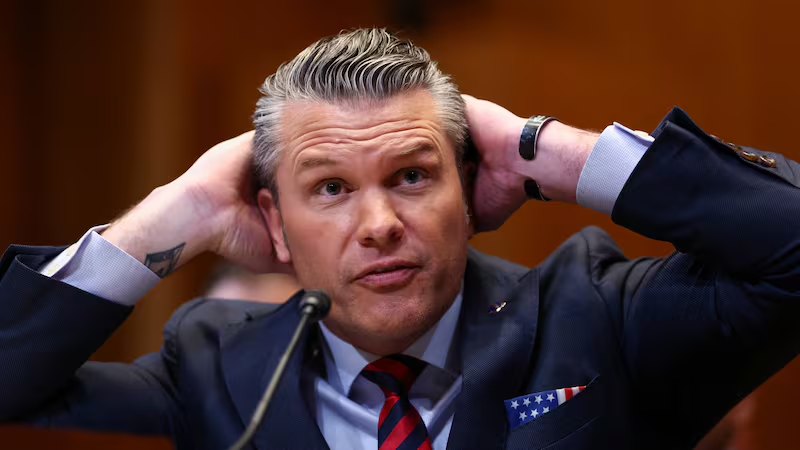
Because the administration plans to appeal aggressively, many legal observers believe the case is ultimately heading to the U.S. Supreme Court.
If that happens, the outcome could have enormous consequences far beyond military policy alone.
The Supreme Court may eventually need to decide how much authority presidents possess to shape military rules involving gender identity and whether constitutional protections limit those powers.
The case could also influence future legal disputes involving transgender rights in education, healthcare, sports, and public accommodations.
For now, uncertainty remains.
While the appeals court ruling temporarily blocks major portions of the policy, the legal fight is still unfolding. Both sides appear determined to continue battling through every level of the judicial system.
That means transgender service members, military leaders, and political activists may face months or even years of continued legal uncertainty.
What This Means for America Going Forward
The controversy surrounding transgender military service reflects much larger cultural and political tensions currently reshaping American society.
At its core, the debate is about far more than military regulations. It touches on identity, equality, executive authority, constitutional rights, and the role government should play in defining who gets to fully participate in public life.
For transgender Americans, the case represents another deeply personal battle over recognition and legitimacy.
For conservatives supporting the restrictions, the issue symbolizes broader concerns about military culture and social change.
And for the courts, the challenge involves balancing presidential authority with constitutional protections in one of the nation’s most politically sensitive institutions.
Regardless of where people stand politically, the ruling has already become one of the defining legal and cultural flashpoints of Trump’s current presidency.
The final outcome could shape not only the future of transgender military service, but also the broader national conversation about rights, identity, and the limits of executive power in modern America.