

Table of Contents
- A Race Against Time on Two Wheels
- When a Hospital Is Miles Away
- The Birth of a Life-Saving Idea
- Meet the Heroes Behind the Handlebars
- A Mother’s Story of Survival
- The Mechanics of Hope
- Transforming Rural Healthcare
- Powered by Community
- The Global Impact of a Local Solution
- Why the World Should Pay Attention
- Pedaling Toward a Better Future
- The Lesson Beyond the Wheels
- The Quiet Revolution
A Race Against Time on Two Wheels
The dirt roads of rural Uganda are quiet—until you hear the sound of bicycle tires cutting through the dust.
It’s not a delivery or a casual ride. It’s an ambulance.
In a country where emergency vehicles can’t reach remote villages, a simple bicycle, fitted with a small trailer, is often the difference between life and death.
And behind every pedal stroke is a story of resilience, ingenuity, and compassion.
When a Hospital Is Miles Away
In Uganda’s countryside, hospitals can be dozens of kilometers from rural homes. Roads are rough, buses are scarce, and fuel costs are high.
So when someone falls ill, or a pregnant woman goes into labor, there’s often no way to reach medical help in time.
For years, families carried loved ones on their backs or on makeshift wooden stretchers. Some didn’t survive the journey.
But then came an idea so simple, it changed everything—a bicycle ambulance.
The Birth of a Life-Saving Idea
The concept was born out of necessity and human creativity.
Nonprofit organizations and local innovators began designing low-cost ambulance trailers that could attach to the back of bicycles.
Each one is built with a sturdy frame, a stretcher, and a protective canopy to shield patients from the sun and rain.
They don’t need fuel, they don’t get stuck in mud, and they can go where cars can’t.
And just like that, a new kind of emergency response system took shape—powered not by engines, but by human determination.
Meet the Heroes Behind the Handlebars

Most of Uganda’s bicycle ambulance riders aren’t doctors or trained EMTs. They’re ordinary villagers—farmers, shopkeepers, teachers—who’ve chosen to volunteer their time to save lives.
When a call comes in, they don’t hesitate. Day or night, rain or shine, they mount their bikes and ride.
Sometimes, they pedal for hours over hills and rough terrain, carrying a mother in labor or a child with fever.
“We may not have sirens or flashing lights,” one rider said, “but we have strong legs and stronger hearts.”
And for many families, that’s enough.
A Mother’s Story of Survival
In a small Ugandan village, 24-year-old Namatovu Grace went into labor one night. The nearest health clinic was 20 kilometers away.
There were no cars. No phone signal. No light except the moon.
Her husband, desperate, called for the community’s bicycle ambulance volunteer. Within minutes, the man arrived, pedaling furiously into the darkness.
After nearly two hours, they reached the clinic—just in time for Grace to give birth safely.
“Without that bicycle, I would have lost both my wife and baby,” her husband said tearfully.
It’s a story repeated thousands of times across Uganda—proof that sometimes, saving lives doesn’t require technology, just humanity.
The Mechanics of Hope
Each bicycle ambulance costs less than $250 to build, making it one of the most affordable emergency transport systems in the world.
They’re crafted locally, often from recycled metal parts, by Ugandan welders and mechanics.
Community members maintain them, ensuring that every bolt, tire, and chain is ready when the next emergency strikes.
Unlike modern ambulances that depend on electricity, fuel, or complex maintenance, these bikes run on renewable human energy.
In a world racing toward automation, Uganda is proving that low-tech can sometimes be life-tech.
Transforming Rural Healthcare
The introduction of bicycle ambulances hasn’t just improved emergency response—it’s transformed entire communities.
Villages that once feared childbirth or snakebites now have hope.
Healthcare workers report that maternal and infant mortality rates have dropped in areas served by bicycle ambulances.
Farmers return to work faster after injuries. Children get treatment before illnesses become fatal.
It’s not just about transportation—it’s about dignity, equality, and access.
Powered by Community
The system thrives not because of money or machines—but because of people.
Each community manages its own network of riders and bikes. Locals contribute small amounts for maintenance or fuel for lanterns used during night rides.
The drivers know every road, every shortcut, and every patient by name.
It’s this deeply personal connection that keeps the wheels turning—literally and figuratively.
When one rider was asked why he keeps volunteering, his answer was simple:
“Because one day, it might be my family that needs a ride.”
The Global Impact of a Local Solution
The success of Uganda’s bicycle ambulances has inspired similar programs in Malawi, Zambia, South Sudan, and even Nepal.
Aid organizations and governments are taking notice, calling it a model of sustainable healthcare innovation.
It’s an idea that challenges the assumption that saving lives always requires massive infrastructure or expensive technology.
Sometimes, it just takes a bicycle and the will to move forward.
Why the World Should Pay Attention
As urban nations debate the future of electric cars and AI healthcare, rural communities like those in Uganda remind us of a timeless truth: innovation begins with empathy.
These bicycle ambulances are more than metal frames and tires—they’re a symbol of human ingenuity rising from necessity.
They represent the question every society must ask:
“If this happened to us—if hospitals were hours away—what would we do?”
That question doesn’t just apply to Uganda. It applies to all of us.
Pedaling Toward a Better Future
Efforts are now underway to expand Uganda’s bicycle ambulance networks nationwide.
Organizations like UNICEF, World Bicycle Relief, and local nonprofits are collaborating to train new riders, improve designs, and distribute more units.
Future models may include solar-powered lights, GPS trackers, and lightweight materials for faster travel.
But the heart of the mission remains unchanged: to make sure no one dies because they can’t reach a hospital in time.
The Lesson Beyond the Wheels
The story of Uganda’s bicycle ambulances is not just about healthcare—it’s about human resilience.
It’s about how a simple act—pedaling—can embody something profound: the belief that life, every life, is worth saving.
As one volunteer said:
“We don’t wait for help from the city. We become the help.”
And in that spirit, Uganda is teaching the world that hope doesn’t need an engine—it just needs a heartbeat.
The Quiet Revolution
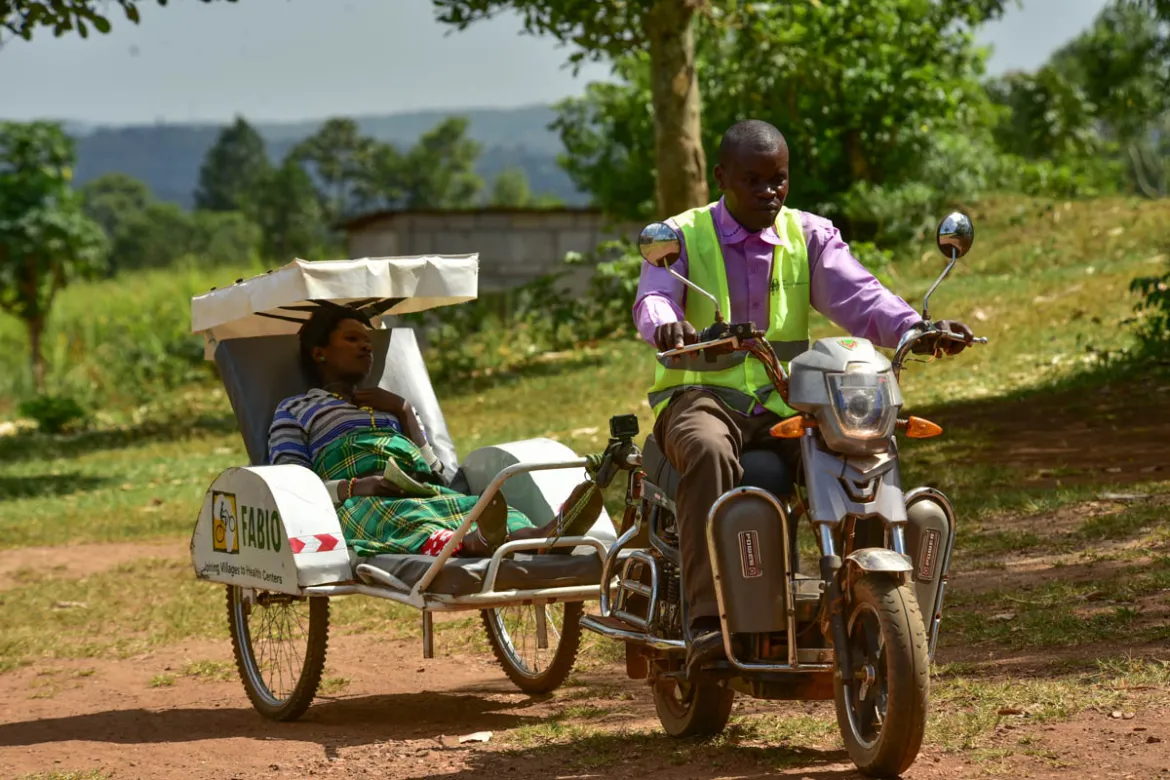
Every day, somewhere on a dirt road in Uganda, a bicycle ambulance races against time.
Its wheels spin through dust and rain, powered by a stranger’s determination to help another stranger live.
There’s no applause, no cameras—just the rhythmic sound of pedals and the fragile hope of survival.
It’s a quiet revolution, one that reminds us that the measure of progress isn’t how advanced our technology is, but how deeply we care for one another.