
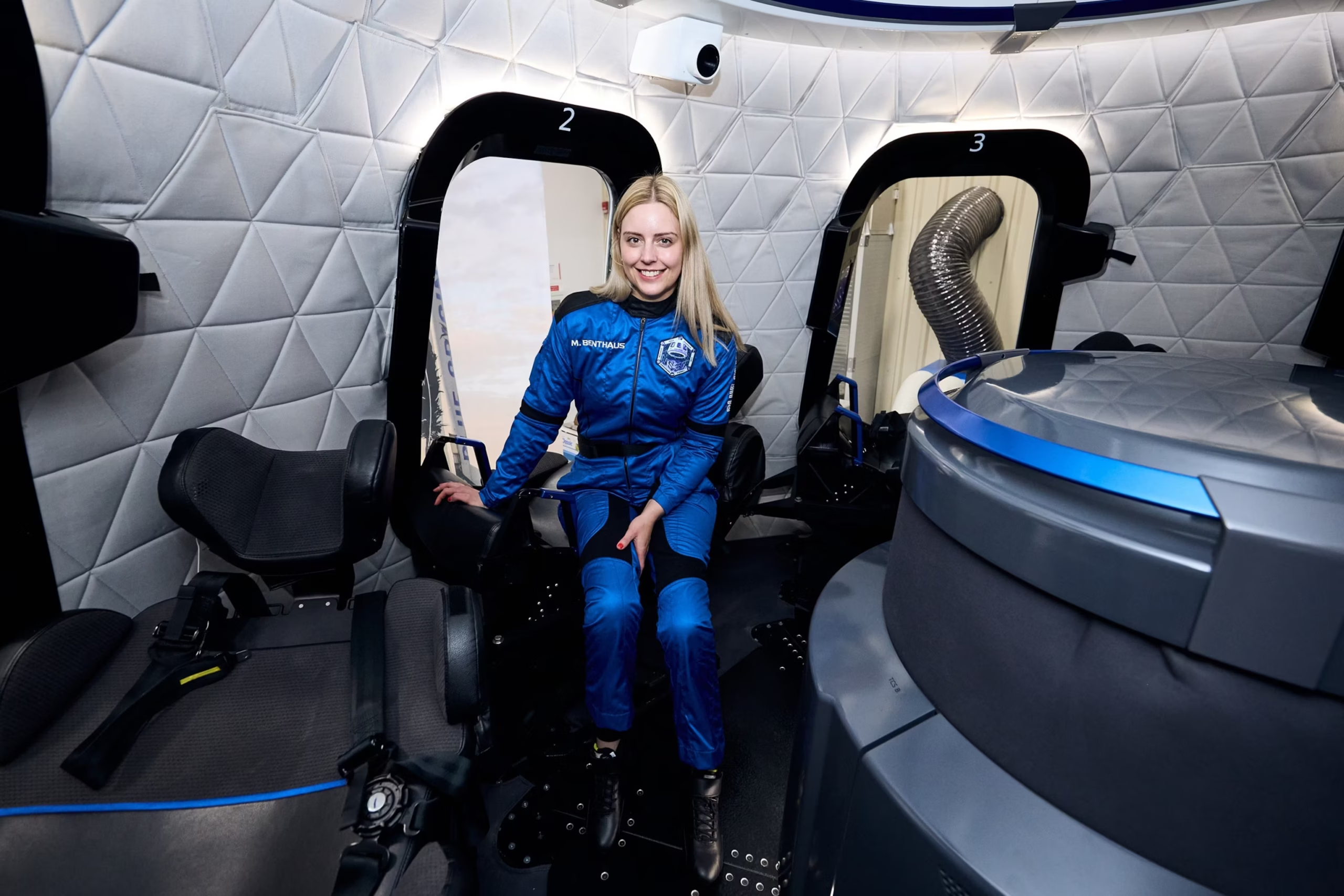
When news broke that a person who uses a wheelchair had successfully flown to space for the first time in human history, the announcement landed with far more weight than a routine spaceflight update. It was not simply another mission, another launch, or another headline about private space companies expanding their reach. It was a moment that forced a reckoning with decades of unspoken assumptions about who space travel is for and who it has quietly excluded.
For most of modern history, spaceflight has been framed as the ultimate test of physical perfection. Astronauts were expected to embody peak health, idealized strength, and near-flawless bodily function. These standards were rarely questioned, largely because they were presented as necessary for survival beyond Earth. Yet this first wheelchair-inclusive mission challenges that narrative at its core, suggesting that many barriers to space have been cultural rather than technical.
The individual at the center of this mission did not overcome disability to reach space. Instead, space technology finally adapted to include disability. That distinction matters. It shifts the story away from inspiration tropes and toward structural change, where systems evolve rather than people being forced to conform.
Table of Contents
- A Launch That Quietly Rewrote Spaceflight History
- Why Space Has Always Been an Exclusive Club
- Redefining Risk and Capability Beyond Earth
- The Psychological Impact of Representation in Space
- Engineering Inclusion Without Compromising Performance
- Why This Mission Changes the Future of Space Tourism
- Disability and the Myth of the “Perfect Body”
- The Ethical Implications of Who Gets to Leave Earth
- Public Reaction and the Limits of Inspiration Narratives
- What Comes Next After This Historic Flight
- A New Definition of Exploration
A Launch That Quietly Rewrote Spaceflight History
The spacecraft lifted off as scheduled, monitored by mission control teams trained to oversee the same technical complexities present in any modern space mission. Yet behind the familiar countdown and controlled ignition was a series of design decisions that had never before been prioritized. Cabin accessibility, mobility considerations, emergency procedures, and adaptive seating were integrated not as experimental add-ons but as core mission elements.
This was not a symbolic seat on a rocket. It was a fully operational spaceflight where disability was not treated as an exception but as a design condition. Engineers and mission planners worked to ensure that movement, safety systems, and daily operations in microgravity were accessible without compromising performance or mission integrity.
For decades, disability advocates argued that exclusion from extreme environments like space was less about feasibility and more about imagination. This mission appears to confirm that claim.
Why Space Has Always Been an Exclusive Club
The space race of the 20th century was shaped by military priorities and Cold War politics. Astronaut selection mirrored fighter pilot criteria, emphasizing physical uniformity and endurance. Over time, those criteria hardened into tradition. Space agencies rarely revisited whether those standards reflected actual requirements or inherited assumptions.
As spaceflight moved into the private sector, many expected these norms to loosen. Instead, early commercial missions largely replicated the same exclusionary frameworks. Seats were sold to the wealthy, not the diverse. Ability was still narrowly defined.
The first wheelchair-inclusive flight did not happen because the science suddenly advanced. It happened because someone finally asked a different question. Instead of asking whether a disabled person could survive space, planners asked how space could be designed to accommodate different bodies.
Redefining Risk and Capability Beyond Earth
Critics of inclusive spaceflight often argue that extreme environments demand extreme selectivity. Space is unforgiving, they say, and any deviation from established physical standards introduces unnecessary risk. What this mission demonstrates is that risk has always been contextual.
Space travel is already managed through redundancy, automation, and adaptive systems. Modern spacecraft rely less on brute physical ability and more on cognitive skills, decision-making, and technological interfaces. Many tasks once requiring physical exertion are now automated or remotely managed.
By adapting systems rather than excluding participants, engineers reduced risk instead of increasing it. The mission reframed disability not as a vulnerability but as a design variable.
The Psychological Impact of Representation in Space

Representation matters most in places where exclusion feels inevitable. Space has long been presented as a domain reserved for a select few. Seeing a wheelchair user cross Earth’s atmosphere disrupts that narrative in a way few other achievements could.
Psychologists note that visibility reshapes possibility. When marginalized groups see themselves represented in environments historically closed to them, aspirations expand. The impact is not abstract. It influences education, career choices, and self-perception, particularly for young people with disabilities who have rarely been invited to imagine themselves beyond Earth.
This flight did not merely carry one person into space. It carried a new story about who belongs there.
Engineering Inclusion Without Compromising Performance
One of the most persistent myths about accessibility is that it weakens systems. In reality, inclusive design often strengthens them. Features developed for accessibility frequently improve usability for everyone.
Adaptive seating improves stability in microgravity. Enhanced handholds benefit all crew members during transitions. Simplified interfaces reduce cognitive load under stress. These design choices do not dilute performance. They refine it.
Space agencies have long emphasized redundancy and adaptability as survival principles. Inclusive design follows the same philosophy, expanding operational flexibility rather than restricting it.
Why This Mission Changes the Future of Space Tourism
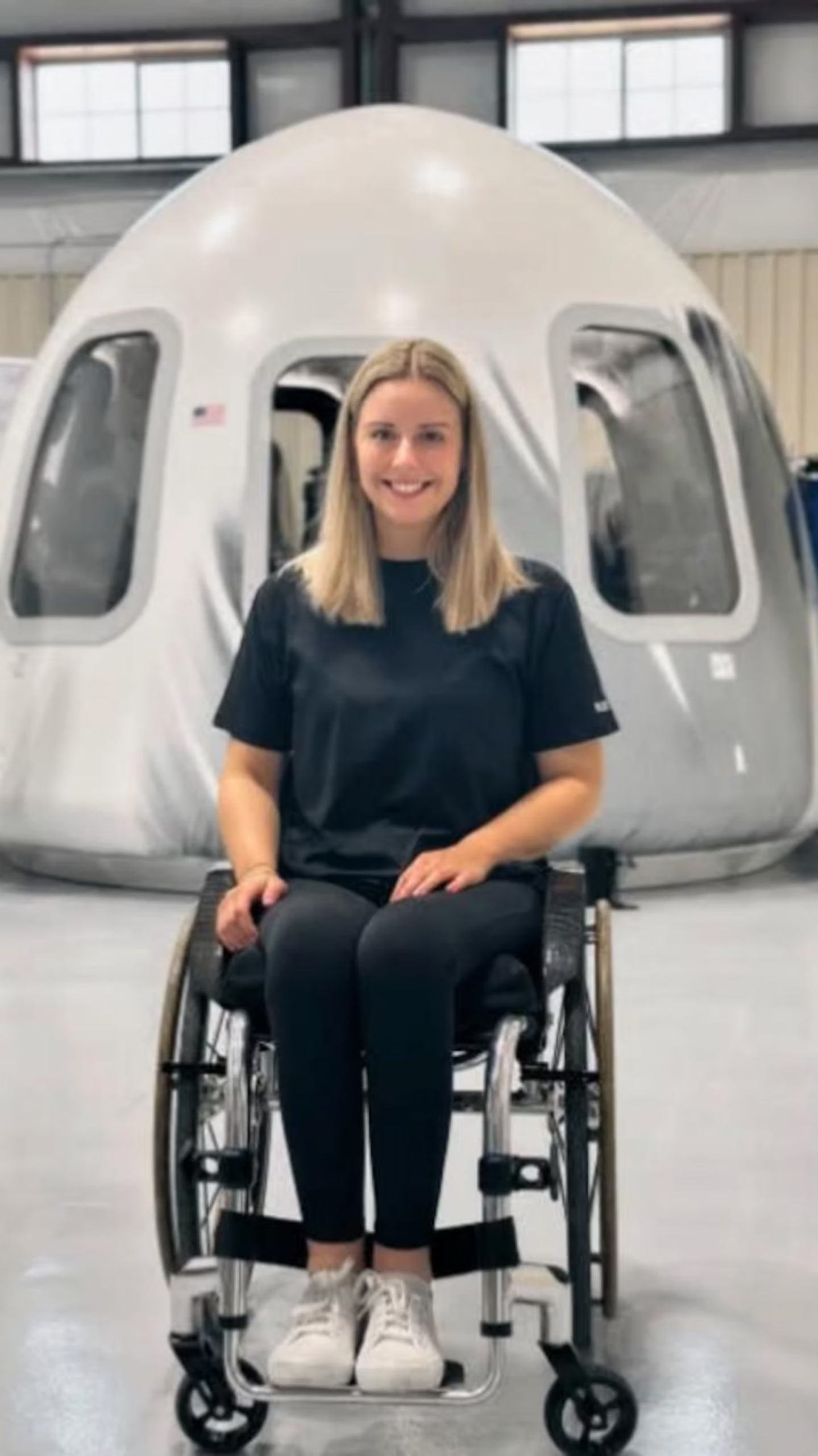
As private spaceflight grows, questions about access become unavoidable. If space tourism becomes a legitimate industry, exclusion based on disability will no longer be defensible. This mission sets a precedent that inclusion is possible without sacrificing safety or mission success.
Future space travelers will not all look the same, move the same, or experience gravity the same way. The industry now has a proof of concept showing that diversity is not a liability but an engineering challenge that can be solved.
Companies that ignore this shift risk positioning themselves as relics of an outdated vision of exploration.
Disability and the Myth of the “Perfect Body”
Space has always been a mirror for humanity’s ideals. Early astronauts symbolized national strength and physical dominance. This mission reflects a different value system, one that prioritizes adaptability, intelligence, and collaboration over physical uniformity.
Disability scholars argue that the idea of the “perfect body” has limited human progress more than it has protected it. By designing systems only for idealized bodies, societies exclude innovation driven by diversity.
Spaceflight, ironically, may now be leading the cultural shift toward broader definitions of capability.
The Ethical Implications of Who Gets to Leave Earth
As humanity looks toward long-term space habitation, ethical questions grow more urgent. Who gets to leave Earth if climate crises worsen. Who gets access to off-world resources. Who is invited into humanity’s future beyond this planet.
Excluding disabled people from that future would replicate historical injustices on a cosmic scale. This first wheelchair-inclusive flight signals an awareness that space ethics must evolve alongside space technology.
Exploration without inclusion is not progress. It is repetition.
Public Reaction and the Limits of Inspiration Narratives
Media coverage often frames disability milestones as inspirational stories of personal triumph. While well-intentioned, this framing can obscure the systemic change behind such achievements.
This mission was not about overcoming personal limitation. It was about institutions removing unnecessary barriers. The real accomplishment belongs as much to engineers, policymakers, and advocates as to the individual who flew.
Shifting the narrative away from inspiration and toward infrastructure is essential if inclusion is to become standard rather than exceptional.
What Comes Next After This Historic Flight
This mission is unlikely to remain unique for long. Space agencies and private companies are already examining how inclusive design can be integrated into future spacecraft, training programs, and long-duration missions.
The next milestones may involve astronauts with sensory disabilities, neurodivergent crew members, or other forms of physical variation long excluded from spaceflight consideration.
Each step will challenge another assumption about what capability looks like beyond Earth.
A New Definition of Exploration
At its core, exploration is about expanding boundaries. Not just geographic boundaries, but conceptual ones. Sending the first wheelchair user to space expands humanity’s understanding of who exploration is for.
The universe does not care how bodies move on Earth. Gravity, vacuum, and distance apply equally to everyone. It has always been human systems that decided who belonged.
This mission quietly but decisively challenged that decision. And in doing so, it redefined what it means to leave Earth together.