

A long-awaited moment in the journey of reconciliation has finally arrived.
On December 6, 2025, Indigenous leaders gathered on the snowy tarmac of Montreal’s Pierre Elliott Trudeau International Airport to witness a monumental moment in Canadian history.
After over a century, the Vatican has returned more than 60 sacred Indigenous artifacts that were taken from First Nations, Inuit, and Métis communities during colonial times. Among the treasures was a rare Inuvialuit sealskin kayak, one of the most prized possessions of its people.
But the significance of this moment goes beyond the physical artifacts. This is not just a return of objects; it’s a symbol of healing, justice, and a step towards cultural reclamation.
As the Indigenous leaders stood before the crates containing these precious items, they were not just touching the past—they were reconnecting with cultural ancestors, reviving practices long suppressed by colonial powers, and sending a message that cultural heritage can never be erased.
THE ROAD TO RECONCILIATION: A THREE-YEAR CAMPAIGN
This emotional homecoming did not happen overnight. The road to this historic moment was paved with decades of advocacy, persistence, and calls for justice.
In 2022, a group of Indigenous delegates visited Rome for discussions with Pope Francis about the historical abuses committed against Indigenous peoples, particularly the horrors of Canada’s church-run residential schools. During this pivotal meeting, the Pope issued a historic apology for the evil committed by many Christians against Indigenous peoples.
But the apology was not enough for many. Indigenous leaders had long sought the return of sacred objects and cultural treasures that had been taken from their communities during the colonial era. Among these items were artifacts displayed at the 1925 Vatican Mission Exposition, a controversial exhibit that showcased artifacts from Indigenous peoples around the world.
The Vatican had previously claimed that the artifacts were “gifted” to Pope Pius XI during the exhibition. However, this claim has been widely contested by Indigenous groups who argue that the items were taken under exploitative circumstances and are now rightfully theirs.
After Pope Francis’s apology, the Vatican pledged to return the artifacts. However, the transition of this responsibility fell to Pope Leo, the current leader of the Catholic Church. In a statement last month, the Holy See confirmed that the artifacts, along with their documentation, would be “gifted” back to the Indigenous communities.
THE ARTIFACTS: A SYMBOL OF COLONIAL HISTORY AND RESILIENCE

Among the 62 artifacts returned to Canada, one of the most significant pieces is the Inuvialuit sealskin kayak, a remarkable item that has survived for generations. The kayak, which hails from the western Arctic, is not just an artifact; it’s a **symbol of the resilience and ingenuity of the Indigenous peoples of the region.
However, the artifacts also serve as testaments to the colonial history that sought to erase Indigenous culture and identity. For generations, these sacred objects were housed in the Vatican and other European institutions, often displayed as curiosities rather than cultural treasures. Their return is a powerful statement that Indigenous communities are reclaiming their heritage and fighting for justice.
The return of these cultural ancestors is not just about reclaiming material possessions. According to Cody Groat, an Assistant Professor of History and Indigenous Studies, these objects are alive—they hold cultural knowledge and wisdom passed down through generations.
“They are now able to rejoin our communities and help with the continuity and revitalization of our cultural practices,” Groat said in a statement following the return of the artifacts.
THE IMPACT OF THE REPARATION: A STEP TOWARDS HEALING
The repatriation of these artifacts represents a major milestone in the reconciliation process between the Catholic Church and Indigenous peoples in Canada. But as First Nations National Chief Cindy Woodhouse Nepinak acknowledged in her remarks at the press conference, the journey is far from over.
“We’ve come a long way, and we have a long way to go,” she said.
The return of these sacred objects is not the end of a chapter—it is the beginning of a longer journey of healing, and a reminder of the lasting impact of colonization on Indigenous cultures.
While the return of the artifacts is deeply meaningful for many, Indigenous leaders are also aware that this act of justice is only one part of the ongoing struggle for full reconciliation.
THE CONTESTED HISTORY OF THESE ARTIFACTS
As the artifacts were unloaded from the plane, there was a poignant moment: the Inuvialuit sealskin kayak was the last to be removed. Carefully transported in its own crate, the kayak represents more than just a piece of history—it embodies the cultural vitality of the people who once used it.
Yet, despite the return of these artifacts, many questions remain about the origins of the objects and the ethical concerns surrounding their acquisition. The Vatican has claimed that many of these items were gifts given to Pope Pius XI, but for Indigenous peoples, this claim remains highly contestable. As Cody Groat explains, the context of these “gifts” is questionable at best.
“At a time when the identity of Canada’s Indigenous peoples was being erased, it’s difficult to accept that these items were truly ‘gifted,’” Groat explained. The Indian Act of 1876 and policies such as the banning of cultural practices and the forced attendance at residential schools created a system designed to erase Indigenous culture and language. The artifacts were taken at a time when Indigenous peoples were fighting for their survival, making it unlikely that these objects were given freely.
THE ROLE OF POPE FRANCIS IN THIS RECONCILIATION
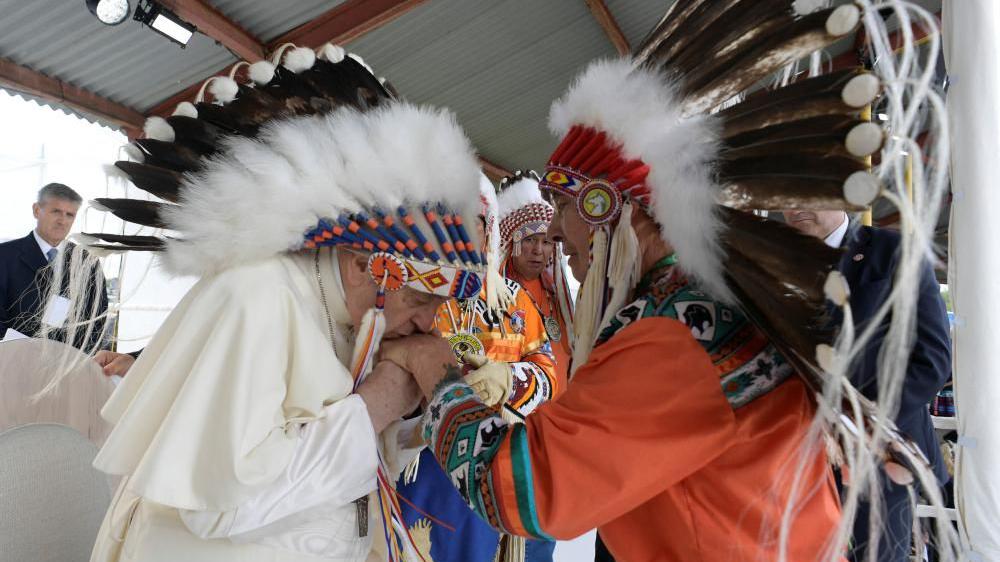
Pope Francis’s involvement in this process has been crucial. His penitential pilgrimage to Canada in 2022 marked a historic moment in the Church’s efforts to make amends for its involvement in the residential school system. During this visit, Pope Francis apologized for the evil committed by so many Christians against the Indigenous peoples of Canada.
His apology was seen by many as a necessary step in the ongoing reconciliation process. But Pope Francis also went further, pledging to return the sacred artifacts that had been held by the Vatican for so long. This commitment was a direct acknowledgment of the Church’s role in the colonial history of Canada, and an important step in acknowledging the long-lasting pain caused by that history.
The return of the artifacts marks the completion of Pope Francis’s vision for reconciliation with Indigenous communities, which has been carried on by his successor, Pope Leo. As Groat notes, it is promising to see Pope Leo take such meaningful action early in his papacy.
WHAT’S NEXT FOR THE ARTIFACTS?
The artifacts have now arrived in Canada and will be carefully examined at the Canadian Museum of History in Gatineau, Quebec. Experts and Indigenous leaders will work together to determine the exact provenance of each item and understand its significance to the various communities from which they came.
Inuit leadership and experts will have the opportunity to examine the kayak and other artifacts, reconnecting with their cultural heritage in ways that will strengthen their communities.
Indigenous peoples are now tasked with determining where the sacred objects will be housed. Some will be placed in museums, while others will likely be kept in Indigenous communities for ceremonial purposes, allowing future generations to connect with the past.
CONCLUSION: A STEP TOWARD FULL RECONCILIATION

The return of these sacred Indigenous artifacts is a historic event that will resonate for generations to come. But as National Chief Cindy Woodhouse Nepinak pointed out, the work of reconciliation is far from over.
The return of the artifacts is just one piece of a much larger puzzle—one that involves addressing the injustices of the past, recognizing the sovereignty of Indigenous peoples, and ensuring that future generations can connect with their cultural heritage in meaningful ways.
While this homecoming marks a new chapter in the relationship between Indigenous peoples and the Catholic Church, it also sets a powerful example for other institutions that hold stolen or unethically acquired artifacts.
The journey of healing, though long, is one that promises a brighter future for both Indigenous communities and the broader world as we continue to reckon with the past and work toward a future based on justice, healing, and respect.