
Table of Contents
- A Breakthrough That Redefines How Electricity Can Move
- What Wireless Electricity Through Air Really Means
- The Science That Makes Air a Temporary Conductor
- Where the Breakthrough Took Place
- Why This Differs From Earlier Wireless Power Attempts
- What This Could Change in the Real World
- The Technical Limits Scientists Still Face
- Why This Matters for the Future of Energy
- The Deeper Scientific Significance
- What Comes Next After Finland’s Achievement
A Breakthrough That Redefines How Electricity Can Move
When researchers in Finland confirmed that electricity could be transferred through air using wireless power rather than traditional wiring, the scientific community paused to take notice. For more than a century, modern civilization has depended on physical conductors to move electricity from one point to another.
Power lines, cables, plugs, and grids have shaped how cities are built and how energy is distributed. The Finnish achievement does not merely improve this system. It challenges its very foundation.
What follows is not the end of wires, but the beginning of a new way of thinking about how energy can travel.
What Wireless Electricity Through Air Really Means
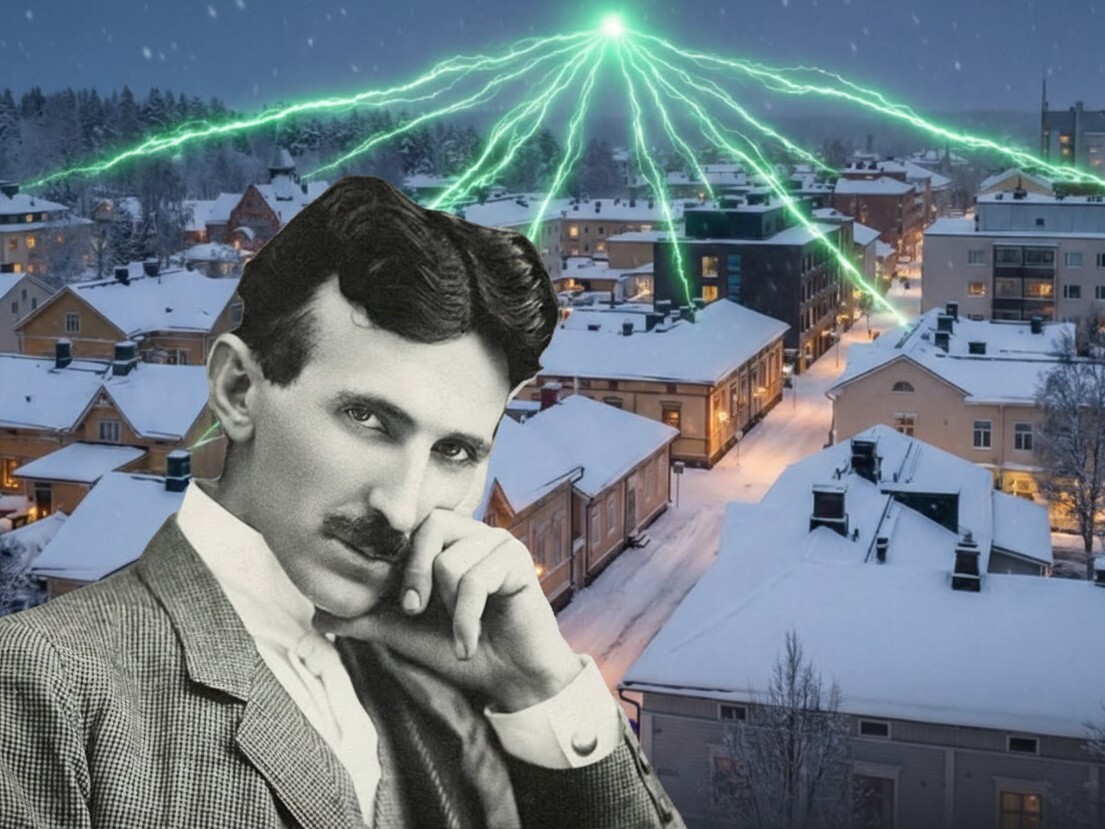
Electricity traveling through air does not imply uncontrolled energy floating freely across the environment. Instead, it refers to a controlled process in which electrical energy is transferred wirelessly using engineered electromagnetic or ionized pathways.
In this breakthrough, Finnish scientists demonstrated that power can be guided through air without direct physical contact between the source and the receiver. Unlike conventional wireless charging pads that rely on close proximity, this method allows energy transfer across open space.
This distinction is critical. It marks a shift from short range induction to true wireless transmission.
The Science That Makes Air a Temporary Conductor
Under normal conditions, air acts as an insulator. It resists electrical flow. However, when air molecules are energized or ionized, they can temporarily carry electrical charge.
The Finnish research leveraged precise electric fields to create a controlled conductive path in air. This allowed electricity to move in a stable and measurable way without cables.
The achievement lies not in raw power, but in control. By stabilizing a normally chaotic process, scientists turned air into a usable medium for energy transfer.
Where the Breakthrough Took Place
The research was conducted at University of Helsinki, where physicists and engineers specialize in atmospheric physics, plasma behavior, and energy systems.
Rather than focusing on immediate commercial applications, the team pursued a fundamental scientific question. Can electricity be transmitted through air in a controlled and repeatable way.
The answer, demonstrated through rigorous experimentation, was yes.
Why This Differs From Earlier Wireless Power Attempts

Wireless electricity is not a new dream. Visionaries like Nikola Tesla imagined power transmission without wires more than a century ago. However, earlier efforts struggled with inefficiency, instability, and safety risks.
Most modern wireless charging systems require extremely close contact and lose power rapidly over distance. The Finnish breakthrough differs because it focuses on directed transmission rather than passive induction.
This approach reduces energy loss and increases precision, solving problems that stalled previous attempts.
What This Could Change in the Real World
While cities will not abandon power lines overnight, wireless electricity through air opens new possibilities where wiring is impractical or dangerous.
Potential applications include space technology, sealed medical implants, hazardous industrial environments, and remote sensors. In these settings, eliminating physical wiring can improve safety, durability, and flexibility.
Even limited scale adoption could transform how critical systems are designed and deployed.
The Technical Limits Scientists Still Face
Despite its promise, the technology is not without challenges. Current experiments operate at modest power levels and over limited distances.
Energy loss increases with distance, and maintaining controlled air conduction requires careful calibration. Environmental factors such as humidity, pressure, and temperature also affect performance.
Researchers stress that this is an early stage breakthrough, not a ready made replacement for existing grids.
Why This Matters for the Future of Energy
The global energy conversation increasingly focuses on efficiency, adaptability, and resilience. As renewable energy sources expand, flexible transmission methods become more valuable.
Wireless electricity through air could complement traditional infrastructure rather than replace it. It may enable hybrid systems that combine wired stability with wireless adaptability.
In this way, the Finnish achievement contributes to a broader evolution rather than a sudden disruption.
The Deeper Scientific Significance
Beyond practical applications, the breakthrough expands scientific understanding of how electricity behaves in nontraditional environments.
By proving that air can serve as a controlled transmission medium, researchers open new avenues in physics, materials science, and energy engineering.
Many transformative technologies began as theoretical curiosities. This discovery belongs in that lineage.
What Comes Next After Finland’s Achievement
The next phase of research will focus on improving efficiency, extending range, and ensuring safety. Scientists will explore how different atmospheric conditions affect transmission and how the process can be optimized.
Collaboration across disciplines will be essential as the technology moves from laboratory demonstration toward applied research.
Finland’s achievement does not signal the end of wires, but it does mark a turning point. Electricity is no longer confined to cables alone. The air itself has entered the future of power.